

Quick Answer
What to include in Contractor Compliance Checklist for strata in 2026?
This should include a practical 10-step process that strata managers use to keep works on common property safe, legal, documented and audit-ready. It covers: vendor identity, licences/insurance, scope & KPIs, risk/SWMS/permits, site induction & access, on-site safety controls, quality evidence, variations & budget control, invoicing/close-out & records, and ongoing compliance including subcontractors.
If you manage a strata scheme, you know the drill: residents want quick answers, committees want clean reports, and the building itself never stops needing attention.
In that rush of make-safes, routine call-outs and planned works, Contractor Compliance can either be your safety net or your headache. The difference isn’t luck. It’s the process.
A clear, practical Contractor Compliance Checklist helps you book the right tradies, keep people safe, control costs, and produce audit-ready records without breaking a sweat.
This article walks you through the ten essentials that matter most for strata. Each section explains the “why”, then gives you a short checklist to drop straight into your templates.
The aim is simple: fewer surprises on site, faster approvals, and happier residents
1. Vendor identity & pre-qualification
Every smooth job starts long before the contractor rings the intercom. Pre-qualification is where you confirm who the vendor is, what they can do, and whether they’ll show up safely and professionally. In strata, this matters because work often happens in sensitive spaces; plant rooms, roofs, basements, and lift lobbies, where mistakes disrupt dozens or even hundreds of people.
A sensible pre-qual process should be short, friendly, and consistent. You’re not trying to drown vendors in paperwork; you’re establishing trust. Ask for business identity details, capability examples for similar buildings, and a simple safety profile. If a major leak hits at 11 pm, you want an approved list you can call without hesitation.
What should your vendor identity & pre-qualification checklist include?
- ABN/ACN, legal name vs trading name, GST status
- Like-for-like experience (lifts, roofs, fire, HVAC, electrical, drainage)
- After-hours coverage and typical response times
- Two or three relevant references (and call at least one)
- Safety basics: policy, induction approach, incident history, training snapshots
2. Licences & insurance
Licences and insurance are the non-negotiables in any Contractor Compliance Checklist. It’s not enough to know a company “has a licence”. You need to match the licence class to the actual task and the state or territory, and confirm that the people attending site are authorised to do the work. On insurance, sight the policy, check the dates, and make sure the limits suit your building and the risk, especially for high-rise or critical plant.
Treat expiries as live risks. Track dates and set automatic reminders so nothing slips. If a document has expired, the job doesn’t proceed. It’s that simple. This isn’t about being difficult; it’s about protecting residents, the owners corporation, and your own professional standing.
What should your licences & insurance checklist include?
- Licence class matches scope and state; attending personnel authorised
- Public Liability sighted (limits aligned to building risk)
- Workers’ Compensation (if staff are employed)
- Professional Indemnity (when designing/specifying/certifying)
- Certificate(s) of Currency on file; 30- and 7-day expiry reminders set
3. Scope, contract & KPIs
Ambiguity is expensive. A plain-English scope sets expectations for the contractor, the building manager and the committee. Spell out what’s included, what isn’t, and how you’ll measure success. In strata, good scopes also cover communication: who gets updates, how often, and what evidence you expect (photos are gold).
Don’t overcomplicate it; your goal is shared understanding. When everyone can see the same page, decisions get faster, invoices match reality, and committee emails are calmer. It’s also where you define a simple escalation path so safety concerns, delays and variations don’t stall the job.
What should your scope, contract & KPI checklist include?
- Inclusions/exclusions and rate card (materials + labour)
- KPIs: response time, first-time-fix target, update cadence, photo evidence
- Communication rules (who sees what, when)
- Escalation path for safety, delays and variations
- Approval thresholds (who can approve up to $X and after hours)
4. Risk assessment, SWMS & permits
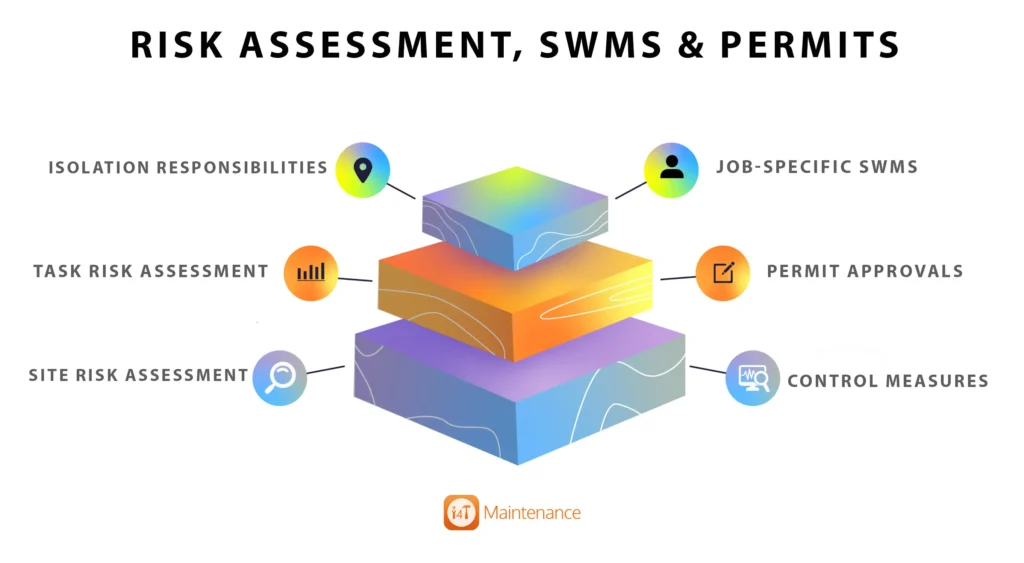
Not all jobs are equal. Work at heights, electrical tasks, confined spaces, asbestos handling and hot works carry real danger. Your controls need to match the risk. That starts with a site-specific risk assessment and, for high-risk construction work, a job-specific SWMS (Safe Work Method Statement). Generic PDFs won’t cut it.
Permits aren’t red tape for the sake of it. They force clarity about who’s isolating what, when systems will be reinstated, and who is on fire watch if hot works are involved. In strata buildings with shared alarms, lifts and ventilation, that discipline prevents false alarms, unplanned outages and costly call-backs.
What should your risk, SWMS & permits checklist include?
- Risk assessment tailored to the site and task
- Job-specific SWMS for heights, electrical, confined spaces, asbestos, and hot works
- Permits approved before starting (hot works, LOTO, roof access, confined spaces)
- Named responsibilities for isolations and reinstatements (e.g., fire panels)
- Controls listed (barricades, spotters, anchors, gas monitors, fire watch)
5. Site induction, access & resident notices
A crisp induction prevents confusion; clear notices prevent complaints. Give contractors a short site pack that covers hazards, parking and loading, key/fob collection, lift bookings and waste rules. Require sign-in/sign-out and visible ID. That’s not box-ticking; it’s accountability and safety.
Residents will forgive inconvenience if they feel informed. Tell them when the work will happen, what the impact will be, and who to contact. Promise noise windows and stick to them. If plans change, say so early. Silence is what turns small jobs into big grievances.
What should your induction, access & notices checklist include?
- One-page induction pack: hazards, amenities, parking/loading, waste
- Sign-in/out required; visible ID; induction acknowledgment
- Resident notice with dates/times, likely impacts and a contact point
- Lift/roof/plant room booking confirmed; keys/fobs arranged
- Arrival SMS is helpful for after-hours or emergency works
6. On-site safety controls
Most incidents come down to housekeeping, not heroics. Make safety visible and routine. Keep walkways clear, barricade work zones, and keep the space tidy. Use the right PPE and actually wear it. For electrical and plant work, use lock-out/tag-out and log isolations. Reinstate systems daily, especially fire panels and access control.
For heights, make anchors, EWPs and edge protection non-negotiable. For asbestos, follow the rules to the letter, signage, exclusion zones and correct waste handling. A two-minute toolbox talk at the start of the day gets everyone on the same page, including subcontractors.
What should your on-site safety checklist include?
- PPE appropriate and worn
- Barricades and signage around active work areas; clear walkways
- LOTO used for electrical/plant; isolations logged; daily reinstatement
- Heights controls (anchors/EWPs/edge protection) and trained operators
- Asbestos controls where relevant; correct waste stream and signage
7. Quality assurance & evidence
Evidence speeds approvals and protects budgets. Ask for photo sets, before, during and after, so committees can see value without a site visit. For technical tasks, collect test sheets and commissioning reports: pressure tests, calibrations and compliance forms. Define what “practical completion” and “final completion” mean so you’re not debating when a job is “done”.
File everything in a way that the next tradesperson can use. When evidence, certificates and manuals live against both the job and the asset record, follow-on work is faster and fewer things are missed.
What should your quality & evidence checklist include?
- Photo set: before, during and after (clear angles, timestamps)
- Test/commissioning results where relevant
- Certificates, warranties and manuals on completion
- Defects logged with due dates and responsibility
- Evidence filed to both job and asset records
8. Variations & budget control
Variations aren’t disasters; unmanaged variations are. When conditions change, get a short written request that explains what changed, why, and the price/time impact. If the extra isn’t urgent, pause until the right person approves it. In emergencies, use a capped spend and tidy up the paperwork the next business day.
Transparent notes kill disputes. Include a quick photo and a one-line reason for the change. If the same variation crops up repeatedly, it’s a scoping problem; fix the template, don’t just keep paying.
What should your variations & budget checklist include?
- Variation form: change, reason, cost/time impact
- Approval thresholds documented (incl. after-hours)
- Capped spend protocol for make-safes
- Variation history attached to the work order
- Photo evidence supporting the change
9. Invoicing, close-out & records
Paying promptly is part of a healthy vendor relationship, but only once the job is fully documented. A compliant invoice references the work order, matches line items to the scope or approved variations, and shows dates and hours worked. Attach the evidence: photos, closed permits, test sheets and certificates. Confirm that systems were reinstated; fire panels, lifts and access control shouldn’t be left in bypass.
Close the loop by updating the asset register and adding the next service date. When a chair asks for an audit pack, you should be able to export the entire story; scope, permits, SWMS, photos, tests, certificates and invoice, in minutes.
What should your close-out & records checklist include?
- Invoice references PO/WO; line items match scope/variations
- Evidence attached: photos, closed permits, tests, certificates/manuals
- Reinstatements confirmed (fire panel, lifts, access, isolations)
- Asset register updated; next service scheduled
- Consistent naming so an audit pack exports cleanly
10. Ongoing compliance & subcontractors
Compliance isn’t a one-off file you can forget about.
Track licence, insurance and induction expiries with reminders at 30 and 7 days. Re-qualify vendors annually or biannually and focus on what matters: safety performance, communication quality and first-time-fix rates. Use light-touch KPIs to spot trends; are call-backs rising, or response times slipping?
Subcontractors must be held to the same standards as head contractors. That means they’re named on bookings, visible in sign-in logs, and included in your SWMS and permits. If labour-hire is used, make sure someone on site clearly owns supervision and safety for the day.
What should your ongoing compliance & subcontractor checklist include?
- Expiries tracked with automated reminders
- Annual/bi-annual vendor re-qualification completed
- KPIs reviewed quarterly (response time, first-time fix, call-backs, safety, satisfaction)
- Subcontractors named, licensed/insured, inducted, and visible in logs
- Clear supervision responsibility for labour-hire arrangements
Make Contractor Compliance Effortless
Ready to make contractor compliance effortless? Manage pre-qualification, licences and insurance, SWMS and permits, photos, certificates, expiries, invoices and KPIs in one place with i4T Maintenance – Maintenance Management Software.
Bring your entire Contractor Compliance Checklist into a single, simple dashboard so you can respond faster, prove value clearly, and keep residents happy. Book a demo today!
FAQs
Match the building and task risk. Many schemes use $10–20 million Public Liability as a baseline and go higher for tall buildings or major plant. Always sight the Certificate of Currency and check the expiry date.
Whenever high-risk construction work is involved, working at heights, electrical, confined spaces, asbestos or hot works. The SWMS must be job-specific and reflect your actual site controls.
Yes, if you cap spend and confirm the contractor’s basic licence and insurance are current. Collect the job-specific SWMS and any required permits as soon as practical; ideally the next business day.
A practical rule is for the life of the asset plus seven years, or as your insurer or regulator advises. Store files by vendor, job and asset so audit packs and histories are easy to produce.
Absolutely. Apply the same requirements, licences, insurance, SWMS, inductions, and make sure subcontractors are named on bookings and visible in sign-in logs. No visibility means no real compliance.
Keep it simple: response time, first-time-fix rate, call-back rate, safety incidents, and a short satisfaction score from the committee or building manager. Review quarterly and use the trends to coach or change.
Use a standard variation form with a photo, a one-line reason, and the cost/time impact. Set approval thresholds so the right person can sign quickly. For emergencies, combine a capped spend with next-day paperwork.
Standardise your job files. Each one should hold the scope, SWMS/permits, photos, test sheets, certificates and the invoice. Keep everything in one system with consistent naming so exports take minutes, not hours.