

If strata life had a soundtrack, reactive maintenance would be the part where the music suddenly stops and everyone turns to look at you.
A resident calls to say the garage gate won’t open. The lift is making a noise it’s never made before. There’s water in the basement again. The contractor you need is booked out. The committee wants answers. And somehow, you’re meant to keep the building safe, compliant, and running smoothly… without blowing the budget.
That’s exactly why a strong preventive program matters in 2026. Not as a lofty “best practice”, but as a practical way to make maintenance calmer, more predictable, and easier to explain to stakeholders.
This playbook is written for Australian property and strata teams who want a system they can actually run, using a sensible preventive maintenance checklist and a workable strata maintenance schedule template, without turning their lives into spreadsheets and reminder chaos.
What preventive maintenance really looks like
Preventive maintenance is the work you schedule on purpose: inspections, servicing, testing, cleaning, and small fixes that stop bigger problems from forming. It’s not glamorous. But it’s the difference between planning a routine service and paying for an emergency call-out at the worst possible time.
You’ll know you’re moving in the right direction when fewer issues become “urgent”, contractors arrive prepared, you’re not reinventing the wheel for each building, and you have consistent information across teams and assets.
1. Build the asset register you wish you’d inherited
Most maintenance pain comes from one underlying issue: you can’t maintain what you can’t clearly see.
An asset register is your single source of truth. It doesn’t need to be fancy; it needs to be accurate enough that you can confidently answer: What do we have? Where is it? What does it need? When was it last serviced?
The key is to start with the assets that cause the biggest problems when they fail: pumps, gates, access control, hot water systems, fire equipment, and anything that can cause damage or disruption.
When you’ve got an asset register in place, you stop relying on memory and old emails. Instead, you make decisions based on reality.
A good register usually includes:
- asset name, location, and type
- make/model (if known) and install/approximate age
- warranty/guarantee details
- service history and latest reports
- a basic condition rating (good/fair/poor)
That’s enough to transform how you plan, budget, and brief contractors.
2. Turn your plan into a rhythm with a strata maintenance schedule template
A lot of teams have a “maintenance list”. The problem is that a list doesn’t create a rhythm, and without rhythm, work becomes reactive again.
A strata maintenance schedule template is essentially your annual calendar for planned work. It helps you spread tasks and spend across the year, avoid bottlenecks, and line up contractors early.
The most useful trick here is to build the schedule in layers of an annual plan, a quarterly view and a monthly run sheet.
This approach is especially helpful in Australia, where seasonal shifts can turn “minor” issues into expensive ones. If you schedule roof and drainage checks ahead of the wet season, you dramatically reduce the chance of last-minute water ingress dramas.
A simple schedule template should clearly show:
- What’s due monthly, quarterly, biannually, and annually
- Who owns each task, from contractors to the building team
- What evidence do you need back, including the report, readings and photos
Once this is in place, maintenance becomes a planned workflow, not a series of interruptions.
3. Use risk to set priorities, not noise
Every building has a constant stream of requests. Some are important. Some are annoying. And some are simply the loudest.
A risk-based approach helps you prioritise like a professional, not like a firefighter.
Instead of asking “what’s the newest complaint?”, you’re asking if this could cause injury or property damage, create compliance exposure, or how disruptive and expensive it will be?
This is how you protect budgets and reduce emergencies: by focusing preventive effort where the stakes are highest.
It also gives you a calm, logical way to communicate decisions to committees: “Here’s what we’re doing first, and here’s why.”
If you need a simple prioritisation model:
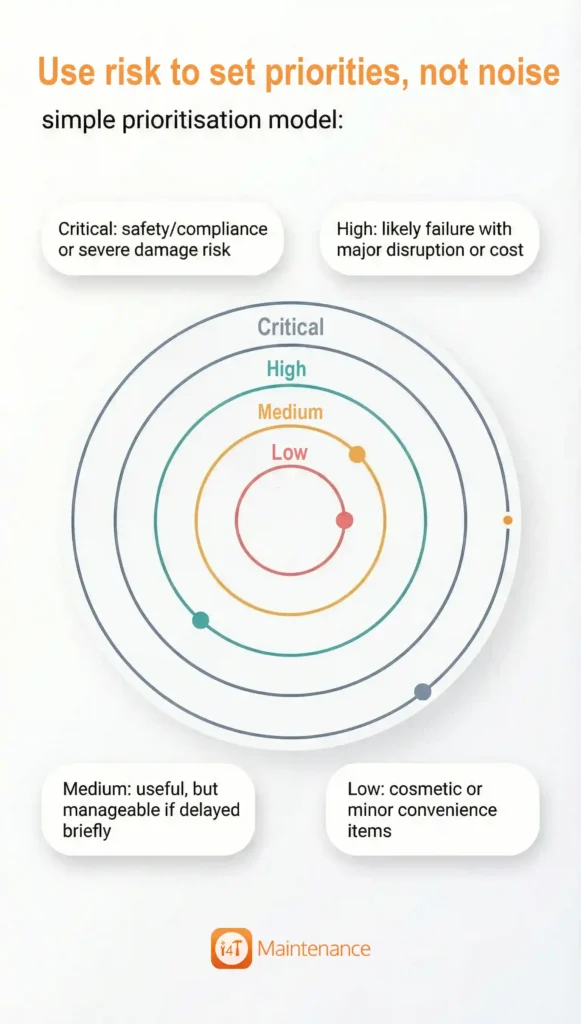
- Critical: safety/compliance or severe damage risk
- High: likely failure with major disruption or cost
- Medium: useful, but manageable if delayed briefly
- Low: cosmetic or minor convenience items
This prevents your preventive plan from being hijacked by noise.
4. Create a preventive maintenance checklist
“Yep, it’s done.”
Two words that can hide a lot of uncertainty.
A strong preventive maintenance checklist removes ambiguity. It defines exactly what needs to happen, how often, and what proof you need back so you don’t have to chase, guess, or argue later.
The biggest win isn’t the checklist itself; it’s the consistency. When every site uses the same format, reporting becomes easier, handovers improve, and you can actually compare performance across buildings.
Each checklist item should be written so a stranger could understand it, including:
- The specific task
- Monthly, quarterly, or annual frequency
- Who is responsible
- Building access requirements
- Photo, report, or certificate proof needed
- What “acceptable” looks like
Once your checklist requires evidence, you stop losing work inside phone calls and one-line emails.
5. Separate “compliance” from “general maintenance”
Compliance tasks have a nasty habit of living in someone’s inbox until the exact day they’re due, and then turning into a last-minute scramble.
The smartest preventive programs treat compliance as its own stream with its own schedule, documentation, reminders, and accountability.
Because compliance isn’t just another task. It’s often tied to safety, liability, and insurance outcomes.
Across Australia, what applies depends on your building type and state/territory requirements. So rather than assuming a universal list, the best approach is: identify what applies to each building, schedule it, and store evidence in a way you can retrieve quickly when asked.
Typical examples can include:
- fire safety servicing and testing
- emergency lighting checks
- registered plant and lift servicing
- backflow device testing
- pool safety and plant maintenance
The point isn’t the list. The point is creating a system where compliance isn’t “remembered”; it’s managed.
6. Plan for Australia’s seasons ahead
Seasonal planning is one of the easiest ways to look proactive, reduce surprises, and save money. Yet it’s often overlooked because people are busy, until the first big storm hits.
In Australia, small weaknesses show up fast:
- Blocked gutters become internal leaks
- Stormwater systems get tested in a single afternoon
- Heat pushes HVAC and ventilation to their limits
- Humidity exposes waterproofing and mould risk areas
Seasonal preventive maintenance isn’t extra work. It’s shifting work to the right time so you avoid emergency work later.
If you want a simple seasonal mindset:
- before wet weather: roof, gutters, downpipes, stormwater pits/pumps
- before peak heat: HVAC servicing, ventilation checks, plant room readiness
- before high-usage periods: gates/doors, access control, lighting reliability
The benefit is not just fewer failures; it’s also better contractor availability, because you’re booking ahead instead of competing with everyone else during peak demand.
7. Standardise contractor scopes
Preventive maintenance can quietly fail if contractor scopes are inconsistent.
One contractor does a thorough inspection and sends a useful report. Another turns up, ticks a box, and you receive a one-line invoice with no detail. Now you’re paying for work you can’t verify, compare, or defend.
The solution is surprisingly simple: standardise scopes for recurring tasks and insist on consistent deliverables.
When your scope is standard, you get repeatable quality, easier quoting, better benchmarking across sites, less rework and fewer arguments.
A practical contractor scope should clarify:
- What’s included in every visit
- What readings/photos are required
- What “defects” must be reported immediately
- Expected report turnaround time
This isn’t about being difficult. It’s about making maintenance measurable.
8. Turn preventive planning into predictable budgets
Committees don’t love maintenance spending, but they do love clarity.
The best preventive programs make costs easier to understand because they’re planned. Instead of getting hit with random invoices, you can show what’s coming up, why it matters, what it’s likely to cost, and what happens if you don’t do it.
A helpful way to structure this is to separate spending into three buckets:
- routine servicing
- minor preventive repairs
- larger replacements and capital works planning.
This helps everyone see the difference between “keeping things running” and “replacing things that are reaching end-of-life.”
Even if your cost estimates aren’t perfect at first, the act of planning creates stability. Then, as you collect better data over time, forecasting becomes much stronger.
9. Make access and communication part of the maintenance plan
A preventive plan can be technically perfect and still fail if access is chaotic.
If residents aren’t informed early, trades can’t get in. Jobs get rescheduled. Costs go up. Frustration rises. And suddenly you’re back in reactive mode; not because the building failed, but because the process did.
Great strata teams treat communication as part of the maintenance workflow. Not as a separate job, you do “if you have time.”
What residents usually want is simple:
- What’s happening
- When it’s happening
- How it affects them
- What they need to do
Short, consistent templates reduce your workload and keep things professional.
A good message is often only 3–5 sentences. The power is in clarity, not length.
10. Review and improve like a portfolio manager
The final step is the one that turns a “plan” into a “program”.
Preventive maintenance improves when you review outcomes, not just tasks. Doing tasks doesn’t automatically mean you’re reducing failures.
A simple monthly review keeps you in control. Ask what’s overdue and why, where repeat issues are popping up, whether contractors are delivering evidence, and where costs are drifting beyond expectations
Then a quarterly report gives you the story committees and owners care about: progress, trends, risk reduction, and where money is going.
If you want to keep measurement light but meaningful, track:
- scheduled task completion rate
- reactive call-outs, especially after-hours
- top repeat issue categories
- top cost centres
- contractor performance
When you use the same handful of metrics every quarter, your reporting becomes easier, and your credibility goes up. People can see the pattern and the improvement.
A calmer 2026 starts with a system you can repeat
Preventive maintenance isn’t about doing more work. It’s about doing the right work at the right time, in a way you can track, prove, and explain.
If you take only one thing from this playbook, make it this: create a repeatable rhythm.
Asset register → schedule template → checklist → evidence → review. That’s how you reduce emergencies, stabilise spend, and make maintenance feel manageable again.
If you’re ready to run your preventive maintenance checklist and strata maintenance schedule template without chasing emails and juggling spreadsheets, i4T Maintenance helps Australian strata and property teams plan, assign, track, and report preventive maintenance in one connected workflow, across one building or an entire portfolio.
Book a demo today!
FAQs
Preventive maintenance is planned servicing, inspections, and small fixes that keep common property running safely and reliably. Instead of waiting for something to fail, you schedule work ahead of time to reduce breakdowns, disruptions, and long-term costs.
A good preventive maintenance checklist should clearly show what needs to be done and how you’ll confirm it’s completed. Include the task name, frequency, who is responsible, any access requirements, and the proof you need back.
Start by listing routine tasks and compliance servicing for the building, then assign each task a frequency. From there, map them across a 12-month calendar and break it into quarters so the workload and costs are spread out. This becomes your strata maintenance schedule template, you can reuse and improve each year.
Do a quick check every month to make sure tasks aren’t going overdue and contractors are providing reports. Then do a bigger review every quarter to spot patterns like repeat issues, rising costs in one area, or assets that are getting close to end-of-life. A yearly refresh helps you update the schedule and adjust frequencies.
For most strata and property teams, yes. Spreadsheets can work at the start, but they’re easy to miss updates, lose documents, or forget follow-ups. Software makes it simpler to assign tasks, set reminders, store evidence, and generate clear updates for committees and owners, especially when you manage multiple buildings.