
For strata managers overseeing multiple residential properties, the challenge to improve response time in maintenance is more than just reacting quickly. It’s about creating smarter, streamlined systems that ensure every maintenance request is logged clearly, triaged accurately, dispatched promptly, scheduled efficiently, and communicated effectively. When maintenance delays snowball, it adds stress for residents, committees, and the strata team alike, impacting satisfaction and operational flow. This article dives into five practical ways strata managers can enhance maintenance response times, helping reduce headaches and improve upkeep outcomes across their properties.
Why Maintenance Response Time Matters in Strata Management
In strata management, maintenance response time impacts more than just fixes—it influences resident satisfaction, committee trust, operational efficiency, and compliance. Slow responses often lead to frustrated residents chasing updates or lodging duplicate requests. Committees might begin questioning the strata team’s effectiveness and the reliability of contractors. Operationally, unresolved maintenance builds up workloads, creates bottlenecks, and risks compliance issues when urgent or safety-related jobs lag. Ultimately, timely maintenance fosters a positive living environment and solid team cohesion, making responsive service a non-negotiable priority.
What Usually Slows Down Maintenance Response in Strata Properties
Common bottlenecks in strata maintenance stem from inefficient workflows and unclear communication. Requests often come through scattered channels—emails, phone calls, or resident portals—making it tricky to track priorities and job details. Missing or incomplete information causes avoidable delays while strata teams chase clarifications. Without a clear priority system, urgent jobs can get mixed with routine fixes, slowing down response. Manual dispatch processes, where requests are assigned by phone or spreadsheet, introduce lag and reduce visibility. Coordination with contractors is often fragmented, and inconsistent follow-ups leave residents in the dark. Understanding these pitfalls helps strata managers focus on targeted workflow improvements.
1. Centralise Every Maintenance Request in One Workflow to Improve Response Time in Maintenance
Centralising all maintenance requests into a single, structured workflow is foundational for improving response time in maintenance. When requests are spread across multiple channels, critical jobs can be missed, duplicated, or delayed during handoffs. A central intake process ensures every request is captured with consistent information from the outset, dramatically reducing time lost on clarifications and miscommunications.
By using a dedicated system or platform tailored to strata needs, management teams can funnel all incoming issues through one portal—whether reported by residents, committees, or contractors. This approach creates a clear queue of jobs with standard fields like location, description, urgency, and photos, enabling teams to assess and action faster.
Clear intake workflows also allow straightforward tracking and reporting, so delayed requests don’t slip through the cracks.
Why scattered requests slow everything down
Scattered requests mean multiple entry points and inconsistent data. For example, some residents may email maintenance directly, others may call reception, while committees raise issues through meeting minutes. When jobs get entered manually later, details are often incomplete or lost, causing duplication and confusion. This fractured approach distracts managers with administrative overhead and increases the risk of forgotten or delayed repairs.
What information strata teams need upfront
To action repairs quickly, strata teams require key details at first contact: exact unit or common area location, clear description of the issue, urgency level, photos if possible, and resident contact info for follow-up. Having this upfront avoids back-and-forth clarifications and allows immediate triage.
How a single workflow creates faster action and fewer missed jobs
A single maintenance request workflow streamlines processing and decision-making. It’s easier to prioritise jobs based on urgency, assign them promptly, and keep all stakeholders updated. Having every request electronically logged provides transparency and audit trails, reducing the chance of overlooked jobs and redundant follow-ups.
2. Use a Clear Priority and Triage Process From the Start
Establishing a clear triage process that separates maintenance requests into emergency, urgent, and routine categories is essential to improve response time in maintenance. Not all problems require the same speed or resources. By assessing each request’s urgency quickly, strata managers can ensure critical issues get immediate attention while routine tasks are scheduled appropriately.
A simple, well-defined triage system helps avoid confusion and better allocates trade contractors. It also sets realistic service expectations for residents and committees, building trust and reducing frustrations caused by perceived inaction.
The difference between emergency, urgent, and routine maintenance in strata
Emergencies include situations that threaten safety or property, such as burst pipes flooding common areas or electrical faults posing fire risks. Urgent issues might involve heating breakdown in winter or security system faults requiring same-day fixes. Routine jobs involve maintenance that can be planned within weeks, such as repainting or regular servicing.
How triage improves response speed and job handling
With triage in place, strata staff can respond to emergencies instantly, dispatch urgent jobs quickly, and schedule routine maintenance without disrupting critical workflows. This orderliness minimises resource conflicts and ensures messages to residents and contractors are clear and aligned.
Why service expectations matter for residents and committees
Clear triage helps set transparent expectations—residents know when to expect responses based on job categories, reducing repeat calls and complaints. Committees gain confidence that the bilateral team understands priorities and is managing resources effectively.
3. Build a Fast Job Dispatch System That Assigns the Right Contractor Quickly
One of the biggest delays in strata maintenance happens during job assignment. Manual dispatch, such as calling contractors individually or using spreadsheets, adds avoidable lag. Implementing a fast job dispatch system lets strata managers allocate jobs faster and more accurately, improving overall response time in maintenance.
A dedicated dispatch system centralises contractor details, availability, and trade specialisations. It automates or simplifies assigning the right contractor based on location, skillset, and workload, streamlining workflows.
Real-time status updates enhance visibility, allowing managers to track outstanding jobs, confirm contractor acceptance, and follow up swiftly when needed. This boosts accountability and accelerates job progress.
Why manual dispatch slows response times
Manual dispatch wastes precious time with phone tag, missed calls, and missed job details. Without central tracking, it’s easy for jobs to be unintentionally delayed or forgotten. Managers also struggle to monitor contractor workloads or see job progress in real time.
What a fast job dispatch system looks like in practice
In practice, a fast job dispatch system consolidates contractors’ profiles, their job history, and current availability. Managers assign new jobs through an intuitive interface with just a few clicks, while contractors receive instant notifications through mobile apps or SMS. Feedback loops allow easy job status updates and photo uploads, keeping everyone aligned.
How faster dispatch improves contractor performance and status visibility
Timely dispatch keeps contractors accountable—they respond faster knowing their workload and deadlines are visible. Managers can detect bottlenecks early, reassign jobs when delays occur, and keep layers of transparency for residents and committees.
4. Improve FSM Scheduling Efficiency Across Multiple Jobs and Properties
FSM scheduling efficiency (Field Service Management scheduling efficiency) dramatically influences how quickly maintenance jobs progress across strata properties. Efficient scheduling means optimising trade contractors’ routes, balancing urgent jobs with planned work, and keeping real-time visibility on job statuses for multiple buildings at once.
Without proper scheduling tools, contractors may be double-booked, or travel times waste precious hours. This inefficiency extends completion times and frustrates residents.
Improved FSM scheduling means well-coordinated visits that reduce downtime, lower labour costs, and ensure completed maintenance within acceptable time frames.
Why poor scheduling creates avoidable delays
Disorganised scheduling causes overlapping jobs, last-minute cancellations, or missed appointments. Contractors scrambling to meet urgent calls may neglect scheduled routine maintenance, creating a backlog that grows unchecked.
How FSM scheduling efficiency improves turnaround and visibility
FSM software and smart scheduling tools calculate optimal travel routes and allocate jobs based on contractor skillsets and availability. Managers see a live dashboard with real-time updates, enabling proactive adjustments to schedules, improving turnaround times for all jobs.
Why better scheduling supports both urgent and planned work
A balanced schedule makes sure urgent maintenance gets immediate attention while routine and preventative work isn’t neglected. This holistic approach improves the overall condition of strata properties and reduces emergency breakdowns.
5. Keep Residents and Committees Updated Automatically So Delays Do Not Snowball
Transparent communication impacts perceived maintenance response time just as much as operational efficiency. When residents and committees get regular updates automatically, frustrations drop and duplicate requests reduce. Automated notifications can list job acceptance, technician arrival times, work completion, and any unexpected delays.
Such communication improves trust and lowers the administrative burden on strata managers who otherwise spend hours responding to calls and emails seeking updates.
Clear, consistent updates also create a professional image for the strata team and contractors alike, creating smoother interactions all round.
Why lack of updates makes maintenance feel slower
When residents hear nothing after reporting an issue, the wait feels longer. They tend to assume the problem is ignored, which leads to repeated calls to management, escalating tensions even if work is in progress.
Which maintenance updates should be automated
Best practice is automated updates triggered by key events—request receipt, job prioritisation, job dispatch, technician en route, job completion, and any delays or rescheduling. Using SMS, email, or resident portal alerts keeps stakeholders informed in real time.
How better communication reduces admin and follow-up volume
Automating routine communications cuts down on repetitive queries to strata teams and committees. This reduces follow-up work, freeing managers to focus on resolving issues rather than fielding calls and emails.
How to Measure Whether Your Maintenance Response Time Is Actually Improving
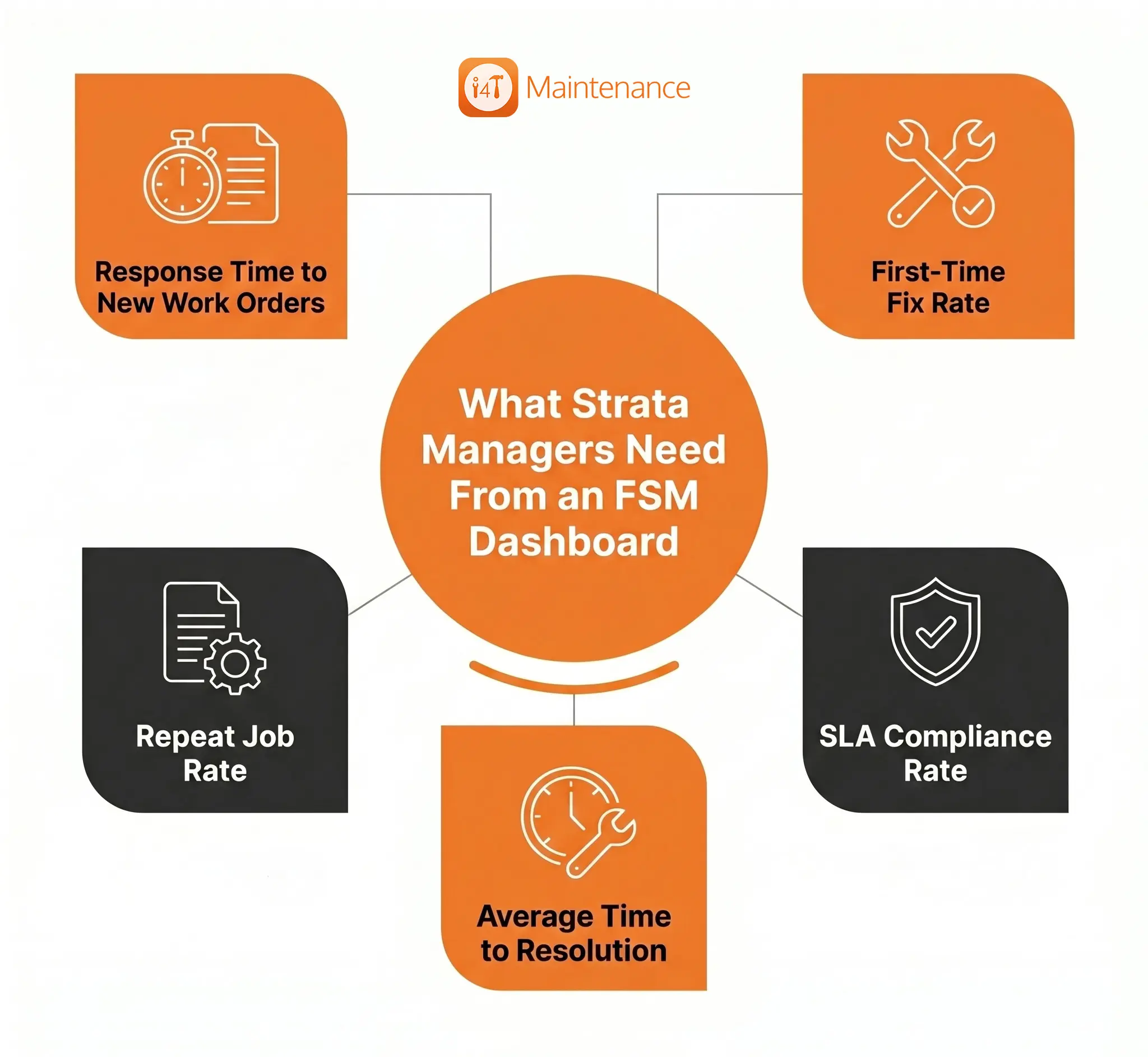
Measuring maintenance response effectively is necessary to validate improvements and spot new challenges. Key performance metrics suited to strata managers include:
First response time: How quickly the team acknowledges a request after it’s logged.
Time to dispatch: The interval between logging a job and assigning it to a contractor.
Time to attend: How long before a contractor arrives on site after dispatch.
Completion time: Total time from request to work finished.
Number of overdue jobs: Jobs that pass deadlines without resolution.
Repeat issues: Frequency of recurring faults at the same location.
Contractor turnaround performance: Average times contractors take to complete tasks.
Regularly reviewing these metrics helps strata teams fine-tune workflows and drive continuous improvements.
Common Mistakes That Keep Maintenance Response Times Slow
Certain common mistakes cause ongoing slowdowns despite best intentions. These include overly relying on email chains and spreadsheets for job logging, which can create confusion and lost requests. Weak intake processes lacking mandatory fields result in missing job details and slower triage. Poor prioritisation leads to urgent jobs waiting behind routine ones. Overcomplicated approval layers stall dispatch. Limited visibility on contractor schedules prevents swift reassignments when trades are unavailable. Lastly, ignoring workflow data means teams miss trends or inefficiencies that could be fixed with smarter tools.
Conclusion
Improving maintenance response time in strata properties comes down to introducing better systems rather than relying solely on effort or urgency. Centralising requests ensures no job is lost or delayed by scattered data. Clear triage prioritises repairs by urgency, streamlining response. A fast job dispatch system hastens job assignment and keeps contractor activity visible. Better FSM scheduling balances urgent and routine work more effectively across multiple properties. Finally, automated communication with residents and committees reduces frustration and administrative overhead, creating a smoother maintenance experience.
For strata managers keen to elevate their operational workflows, adopting these strategies means faster repairs, more satisfied residents, and stronger committee confidence. Modern software solutions like i4T Maintenance provide practical tools to implement all these improvements seamlessly, making maintaining residential strata properties more efficient and less stressful.
Frequently Asked Questions
Strata managers can improve maintenance response time by centralising requests, using clear triage, implementing a fast job dispatch system, improving scheduling efficiency, and automating communication with residents and committees.
Slow responses are often caused by scattered requests, missing job details, lack of prioritisation, manual dispatch processes, poor contractor coordination, and inconsistent follow-up communication.
A fast job dispatch system is a centralised tool or process that quickly assigns maintenance jobs to the right contractors based on their availability and skillset, increasing accountability and reducing dispatch delays.
FSM scheduling efficiency optimises scheduling across multiple jobs and properties, balancing urgent and routine work, improving contractor coordination, cutting travel time, and enhancing visibility on job progress.
Residents often feel maintenance is delayed due to lack of clear and timely updates, making wait times feel longer and prompting repeat enquiries that add to management’s workload.