

If you manage strata properties, you know all too well how maintenance bottlenecks quietly creep in to slow down response times and increase your admin workload. These delays frustrate residents, drive up repair costs, and add stress to your day, yet they’re often not about people slacking off or a lack of effort. Instead, many maintenance delays stem from process issues hidden deep in the strata maintenance workflows. Identifying and fixing these bottlenecks is the key to faster, smoother property management and happier residents.
Why Maintenance Bottlenecks Create Bigger Problems in Strata Operations
Small delays in logging maintenance issues, waiting for approvals, scheduling contractors, or poor communication might seem minor at first. But in strata operations, these maintenance bottlenecks quickly build up, affecting everything from compliance and budget control to resident satisfaction and contractor performance.
For example, a delay in approving a critical repair can lead to a compliance breach, resulting in fines or safety risks. Worse still, reactive repairs end up costing more than planned preventive maintenance. Inefficient workflows also make contractors waste time on repeat visits or unclear instructions, escalating costs and frustration all round.
Behind the scenes, these delays ramp up your team’s workload as you chase updates, extend job timelines, and juggle unpredictable emergencies. The strain on communication channels adds to resident complaints and risks damaging your reputation as a reliable strata manager. Addressing these bottlenecks is not just about speed, it’s about long-term operational sustainability and service quality.
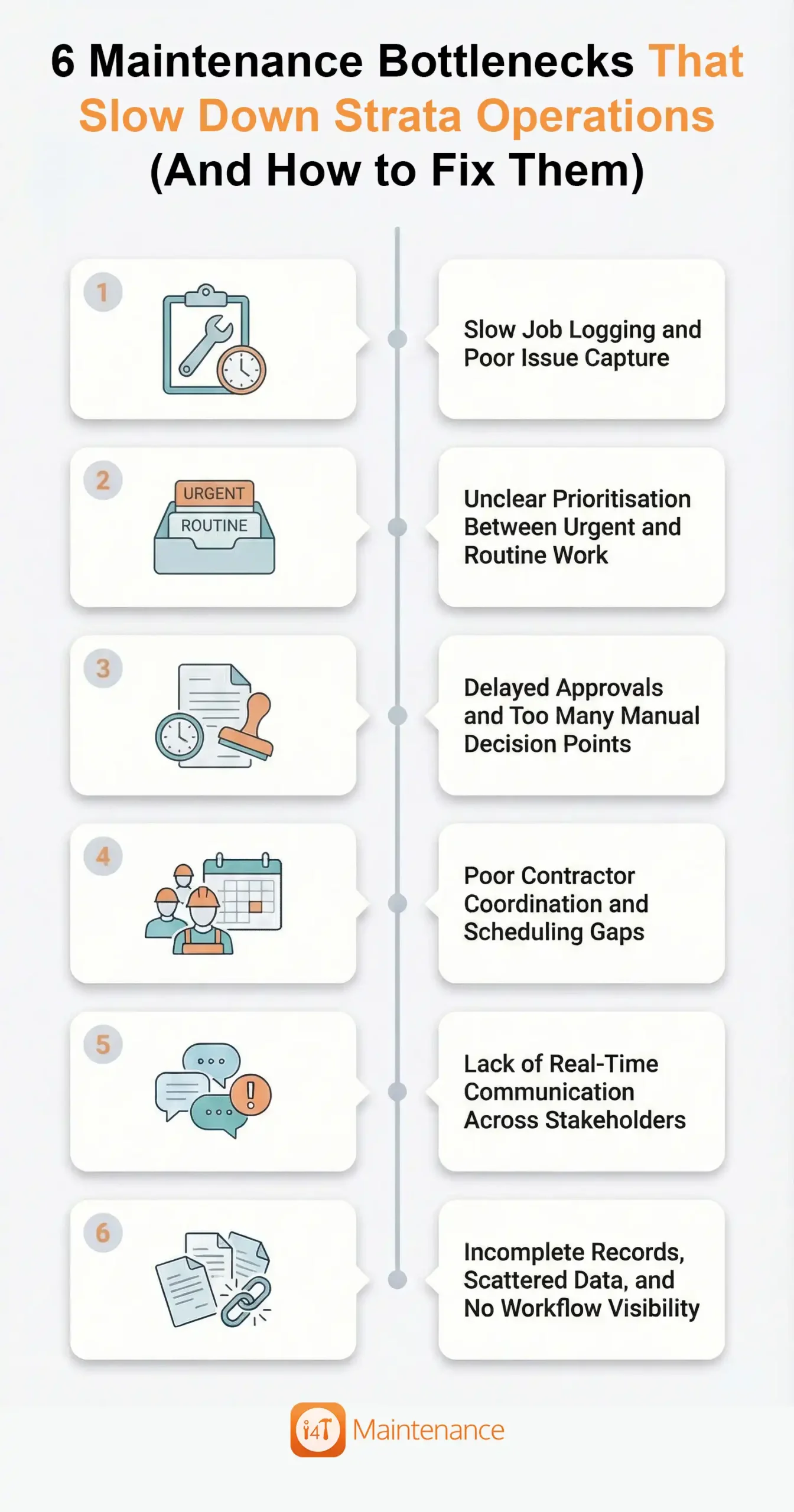
1. Slow Job Logging and Poor Issue Capture
Maintenance requests in strata often arrive from many different channels, emails, phone calls, texts, messages from site staff, or informal chats with residents. This scattered intake leads to incomplete or inconsistent details that slow down the triage and dispatch processes.
When requests lack essential information or photos, you spend extra time following up to clarify the problem before assigning a contractor. This delay cascades into longer wait times for repairs and increased frustration for tenants and owners alike.
This common maintenance bottleneck is a clear example of workflow inefficiency in property management. It stems from not having a centralised system to capture and standardise incoming requests.
Fixing this means implementing a single, digital platform where all maintenance requests are logged consistently with mandatory fields, photo uploads, and even automated categorisation. This approach speeds up issue capture, improves accuracy, and enables faster decision-making.
2. Unclear Prioritisation Between Urgent and Routine Work
Without a clear triage system, every maintenance task can start to feel urgent. This confusion often pushes preventive maintenance aside and floods your schedule with reactive jobs that eat up your time and budget.
The cost of poor prioritisation is significant. Emergency repairs tend to be more expensive, disrupt residents more, and leave planned maintenance unfinished, which can lead to bigger problems later on.
The key to overcoming this maintenance bottleneck is to categorise jobs effectively by urgency and impact. Having defined priority levels, service rules, and escalation procedures helps you allocate resources where they’re needed most.
By integrating these rules into your strata maintenance workflows, you make sure urgent safety issues get handled promptly, while routine and preventive tasks continue on schedule, preventing future breakdowns and controlling costs.
3. Delayed Approvals and Too Many Manual Decision Points
Waiting around for committee feedback, quotes, budget confirmations or owner approvals often stalls important maintenance tasks. Email threads and paper forms create bottlenecks as requests bounce back and forth, creating idle time that drags jobs out.
This slow-down harms contractor reliability, causes frustrated residents to escalate issues, and puts your budgets at risk through unforeseen cost overruns.
The solution lies in streamlining approvals with clear delegation and threshold rules. By setting delegated authority limits and pre-authorising routine spend bands, you can remove many manual decision points from the process.
FSM process optimisation also involves automating approval workflows and tracking status in real time so managers know exactly where a job stands, reducing bottlenecks and speeding up maintenance scheduling.
4. Poor Contractor Coordination and Scheduling Gaps
Many maintenance bottlenecks arise from the daily challenges of working with contractors. Missed appointments, unclear work orders, limited site access, and delayed updates cause repeated call-outs and a heavier admin load for your team.
For example, if a contractor turns up without the right details or finds no access to the site, they have to reschedule, delaying repairs and creating more resident complaints.
Improving contractor coordination requires clear work order documentation that includes specific job instructions, site access instructions, and contact points. Scheduling workflows must be designed to avoid clashes and allow for timely updates.
Using maintenance scheduling software with live status tracking enables better visibility for everyone involved, reduces no-shows, and minimises unnecessary disruptions.
5. Lack of Real-Time Communication Across Stakeholders
Maintenance involves multiple stakeholders, from strata managers, residents, and contractors, to committee members and site contacts. Without real-time communication, bottlenecks arise as everyone chases updates or duplicates efforts.
For instance, residents often call or email to ask about job statuses, delaying your day as you track down contractor updates. Contractors might miss important access windows if site contacts haven’t been informed promptly.
Automated notifications to stakeholders and shared job notes create transparency and help keep everyone on the same page. This boosts trust and reduces avoidable complaints or follow-up.
Strata maintenance software that integrates communication in one place supports a seamless experience, improving both efficiency and resident satisfaction.
6. Incomplete Records, Scattered Data, and No Workflow Visibility
Managing maintenance across spreadsheets, emails, invoices, and disconnected systems makes it hard to get a clear picture of recurring issues, delays, or budget trends.
Low visibility prevents you from diagnosing key bottlenecks or proving compliance and performance to committees. Without historical data, preventive maintenance planning suffers, leading to more reactive repairs and higher costs.
Centralising records with dashboards and custom reporting enables better FSM process optimisation. You can monitor job progress in real time, track contractor performance, and identify recurring maintenance problems.
This data-driven approach gives you better control and confidence to continuously refine your strata maintenance workflows.
The Real Cost of Maintenance Bottlenecks for Strata Managers
Maintenance bottlenecks may seem like small hiccups, but the hidden cost to strata managers is substantial.
Wasted admin hours chasing fragmented information or approvals reduce the time you can invest in strategic tasks. The dominance of reactive repairs inflates maintenance budgets and shortens asset lifespans.
Poor contractor accountability and unclear scheduling drive up costs and reduce operational control. Resident frustration over delays damages your reputation and can increase complaints or disputes.
These inefficiencies also hamper your ability to plan and budget accurately long-term, setting off a cycle of constant firefighting that drains resources and motivation.
How to Fix Maintenance Bottlenecks With a Smarter Strata Workflow
A stronger strata workflow begins with centralised job capture to ensure all maintenance issues are logged accurately and promptly. Next is prioritising jobs clearly so urgent matters get immediate attention while preventive work stays on track.
Faster approval loops, supported by pre-set delegation rules and digital authorisation, help reduce idle times. Smooth contractor coordination is achieved through scheduling tools that provide full clarity on tasks and access.
Clear communication channels with automated updates keep all stakeholders informed and engaged, reducing follow-ups and missed windows.
Finally, comprehensive visibility through dashboards and reports supports continuous improvement with solid data insights.
Technology, especially strata maintenance software — is the linchpin that brings all these improvements together in one streamlined system. It reduces workflow inefficiency in property management and supports effective FSM process optimisation, letting you manage facility operations with confidence and ease.
Conclusion
Most maintenance delays in strata are not due to a lack of effort but come from broken or fragmented workflows. Recognising and fixing these six common maintenance bottlenecks transforms your strata maintenance operations from reactive and frustrating to proactive and efficient.
By centralising requests, clarifying priorities, optimising approvals, improving contractor management, enhancing communication, and gaining real-time workflow visibility, you can reduce admin, cut costs, satisfy residents, and uphold compliance.
Using a dedicated system like i4T Maintenance – Maintenance Management Software offers strata managers the tools needed to overcome these challenges with smarter workflows and better FSM process optimisation. It’s the practical step to faster, smoother strata maintenance operations.
Frequently Asked Questions
Common bottlenecks include slow job logging, unclear prioritisation, delayed approvals, poor contractor coordination, lack of real-time communication, and scattered records.
Delays and poor communication frustrate residents, increase complaints, and lower trust in strata management services.
Inefficiencies stem from fragmented channels, manual approvals, poor coordination, and lack of centralised data and visibility.
Optimising workflows with clear delegation, automation, and real-time tracking reduces delays and improves job completion speed.
Manual, multi-step approval processes create bottlenecks by causing idle time while waiting for decisions and authorisations.
Implementing centralised maintenance software that streamlines job logging, prioritisation, approvals, contractor scheduling, and communication is the most effective approach.