

Managing maintenance across a large strata complex is no small feat. With multiple assets, strict compliance requirements, diverse resident expectations, and limited time, it demands focused and effective approaches. That’s why implementing solid preventive maintenance strategies is essential in ensuring smooth operations and long-term protection of your property’s common assets.
In this article, we’ll delve into six practical preventive maintenance strategies tailored for large strata complexes, empowering strata managers to reduce reactive repairs, improve planning, and coordinate contractors efficiently.
Why Preventive Maintenance Matters More in Large Strata Complexes
Large strata complexes face a unique set of challenges that make preventive maintenance more important and complex compared to smaller properties. Scale is a significant factor, there are simply more assets to oversee, from lifts and fire safety systems to pumps, lighting, and access control. The sheer volume of resident and visitor foot traffic also increases wear and tear, demanding more frequent maintenance.
Additionally, compliance requirements can be more stringent as these complexes are often under closer scrutiny for safety standards, fire regulations, and building codes. This raises the stakes when it comes to regular inspections and servicing.
Effective large property maintenance management also involves juggling multiple contractors, each specialising in different assets. Without clear planning, this can quickly become chaotic, leading to missed inspections and delayed repairs.
Perhaps most importantly, reactive maintenance carries a much higher cost in large strata sites; urgent repairs disrupt residents, increase contractor call-out fees, and can accelerate asset deterioration if issues aren’t caught early.
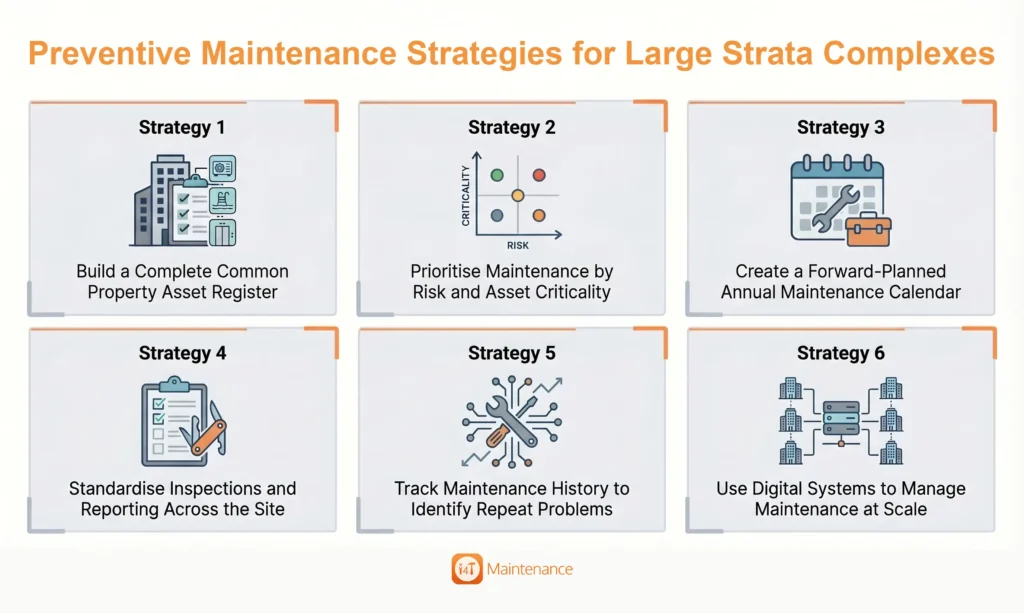
Strategy 1: Build a Complete Common Property Asset Register
One of the cornerstone preventive maintenance strategies for any large strata complex is creating and maintaining a complete common property asset register. This register should include every item under the strata’s control, from structural elements like roofs and drainage to mechanical and electrical systems including lifts, pumps, and lighting.
A thorough asset register improves visibility. It allows strata managers to know exactly what they manage, the age and condition of each asset, and what maintenance or compliance requirements apply.
With accurate asset details, planning becomes more targeted and budgeting more precise. It also establishes accountability ensuring nothing is overlooked during maintenance scheduling.
For example, if you know the exact manufacturer and model of every lift in your complex along with their service history, you can contract the right technicians proactively before costly failures occur.
Strategy 2: Prioritise Maintenance by Risk and Asset Criticality
Not all assets require the same level of urgency or frequency when it comes to preventive maintenance. This is why prioritising work by risk, compliance impact, and asset criticality is crucial.
Safety-critical assets such as fire suppression systems, emergency lighting, and access control gates must always come first. These directly impact resident safety and must meet strict compliance schedules.
Next, focus on high-use or high-cost assets such as lifts or car park lighting, where failure causes major inconvenience or financial loss. Lower-priority equipment might include non-essential landscaping features or decorative lighting.
By using risk-based prioritisation, strata managers can allocate resources smarter, ensuring compliance deadlines are met without overwhelming contractors with less urgent tasks.
Strategy 3: Create a Forward-Planned Annual Maintenance Calendar
Effective facility maintenance planning shines when managers look across the calendar year and schedule predictable, recurring jobs well in advance. This approach smooths contractor workloads and avoids bottlenecks that arise when everything clusters in busy periods.
Seasonal tasks such as roof inspections before the wet season, pump servicing before summer irrigation needs, or deep cleaning of car parks after winter rains fit neatly into this forward plan.
A clear annual maintenance calendar also aligns perfectly with compliance deadlines, making it easier to track due dates and avoid penalties.
Moreover, residents appreciate knowing maintenance times in advance, improving communication and minimising disruptions.
Strategy 4: Standardise Inspections and Reporting Across the Site
Inconsistencies in how inspections are performed and defects reported often lead to issues being missed or poorly addressed. For large strata complexes, standardising inspections and reporting is a game-changer.
Using uniform templates for inspections, incorporating photo capture, and logging defects consistently ensures all stakeholders see the same information clearly.
It also improves follow-up as maintenance teams can prioritise repairs based on consistent data rather than informal notes.
For example, a standard lift inspection checklist capturing wear, noises, and response times allows for objective comparisons over time and across different lifts.
Strategy 5: Track Maintenance History to Identify Repeat Problems
Maintenance records can sometimes feel like a mountain of paperwork or scattered spreadsheets. But tracking this history systematically reveals patterns that inform smarter decisions.
If certain assets show recurring faults, strata managers can decide whether ongoing repairs are worthwhile or if replacement is more cost-effective.
Keeping clear maintenance histories also aids warranty claims and ensures contractors are held accountable for repeated failures.
In large strata complexes where multiple units and systems interact, this historical insight is invaluable for building long-term stability and reducing emergency breakdowns.
Strategy 6: Use Digital Systems to Manage Maintenance at Scale
Trying to manage preventive maintenance in large sites with spreadsheets, emails, or paper can quickly become overwhelming. Digital maintenance management systems offer a much-needed solution by automating workflows and centralising information.
These platforms enable strata managers to assign tasks, schedule inspections, track assets, log defects, and communicate with contractors in one place.
Digital tools also provide real-time visibility into work order progress, upcoming maintenance windows, and budget status.
By adopting such systems, strata managers can reduce manual errors, improve coordination across multiple stakeholders, and free up time to focus on proactive tasks.
Common Preventive Maintenance Mistakes in Large Strata Schemes
Even experienced strata managers can fall into maintenance pitfalls if preventive measures are not properly structured. Common mistakes include poor recordkeeping which leads to lost asset histories and missed compliance deadlines.
Another trap is relying too heavily on reactive maintenance, fixing issues only once they break, which inflates costs and disrupts residents.
Missed service intervals caused by weak communication between contractors and site teams also undermine maintenance effectiveness.
Inconsistent inspections may let defects accumulate unnoticed, while lack of prioritisation wastes resources on low-risk assets.
Lastly, disconnected planning without integrating asset registers, scheduling, reporting, and contractor workflows reduces overall system efficiency.
How Strata Managers Can Start Improving Preventive Maintenance Now
For strata managers tackling large complexes, starting small but with clear focus can lay the groundwork for lasting improvements.
Begin by auditing existing asset records and consolidating them into a single register.
Next, rank assets based on compliance requirements and criticality to residents’ safety and convenience.
Use this list to draft an annual maintenance calendar, coordinating with trusted contractors to smooth workloads and avoid clashes.
Introduce standardised inspection procedures to improve defect detection and reporting clarity.
If your current tools feel scattered, consider moving to a digital system designed for strata maintenance planning and management—this will streamline workflows and provide valuable insights.
Remember, preventive maintenance is an ongoing commitment. Monitor results regularly and adjust priorities as site needs evolve.
Conclusion
In large strata complexes, well-executed preventive maintenance strategies are vital for reducing costly emergency repairs, protecting common property assets, ensuring compliance, and enhancing resident satisfaction.
By building comprehensive asset registers, prioritising by risk, adopting forward-planned calendars, standardising inspections, tracking maintenance history, and leveraging digital tools, strata managers can take control of complex site operations.
Taking action now makes your maintenance program more predictable, efficient, and resilient.
For a turnkey solution to support your strata maintenance workflows, preventive maintenance planning, contractor coordination and transparent reporting, consider i4T Maintenance – Maintenance Management Software. It’s designed to help large strata sites like yours run more smoothly every day.
Frequently Asked Questions
They are planned approaches to regularly inspect, service, and repair common property assets in order to prevent breakdowns and extend their lifespan.
Because of the scale, complexity, and compliance demands, preventive maintenance helps reduce costly disruptions and keeps residents safe and satisfied.
It should include an asset register, prioritised tasks, a scheduled calendar, standardised inspections, and a system for tracking work history.
By assessing risks, compliance impact, asset criticality, and usage levels to focus resources on the most important work first.
Digital tools centralise asset data, automate scheduling, enable clear communication with contractors, and provide real-time progress tracking.
Inspection frequency depends on asset type and risk but generally follows manufacturer guidelines and regulatory compliance, often quarterly or annually.