


Share this article

Table of Contents

7 Checks to Complete Before Turning a Tenant Request Into a Work Order

7 Checks to Complete Before Turning a Tenant Request Into a Work Order

Table of Contents

Key Takeaways

  • Standardising tenant request checks prevents unnecessary costs.

  • Verifying property details ensures accurate maintenance reporting.

  • Assessing urgency categorises tasks effectively, reducing risk.

  • Tracking duplicates prevents resource wastage in maintenance operations.

Key Answer

Perform 7 checks before converting a tenant request into a work order: verify details, assess urgency, check duplicates, confirm responsibility, gather evidence, define scope, and use a standard template. This process optimises efficiency and cost management in property maintenance.

In property management, converting tenant requests into work orders is a critical process. However, without proper checks, this can lead to inefficiencies and increased costs. Here we explore the 7 checks to complete before turning a tenant request into a work order, ensuring your operations run smoothly and your Net Operating Income (NOI) is protected. By standardising these checks, you can streamline your workflow and reduce unnecessary maintenance expenses.
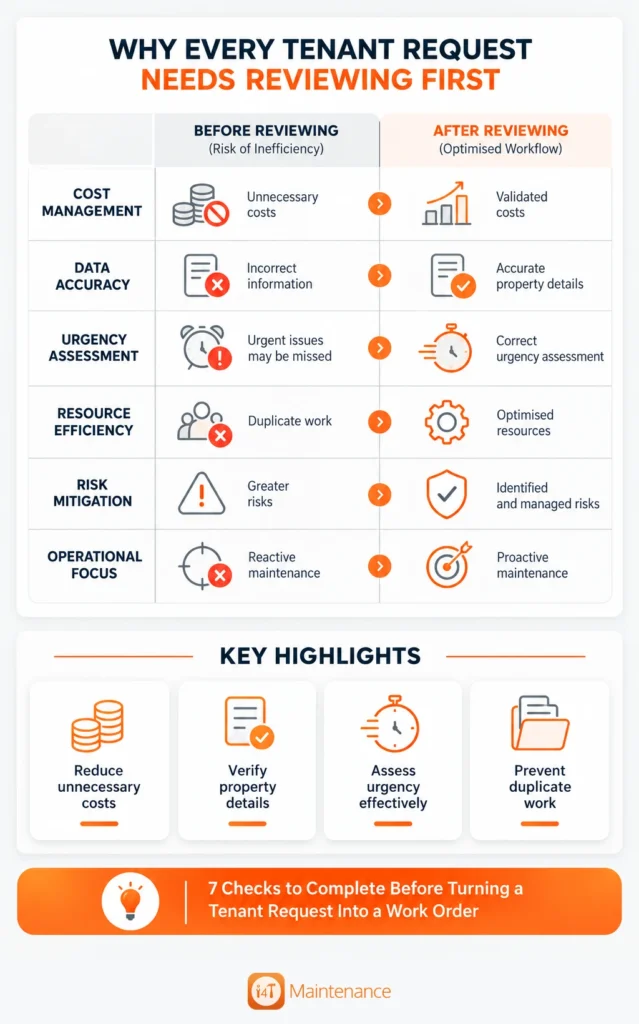
Why Every Tenant Request Needs Reviewing First

Reviewing tenant requests before they transform into work orders is essential to maintaining the integrity and efficiency of your property management operations. A meticulous review process helps avert unnecessary costs and ensures the correct prioritisation of maintenance tasks. Implementing a structured review system, supported by robust work order management software, equips you with a strategic advantage in handling various maintenance challenges.

infographic_XhXFNJRMIW.jpg

Check 1: Verify the Property and Maintenance Issue

The first check involves verifying both the property details and the maintenance issue reported. Confirm the property’s address and any unique identifiers to avoid confusion. Additionally, you should clarify the maintenance issue by consulting with the tenant, ensuring that what they perceive as a problem is accurately documented. Such due diligence helps avoid mistakes and lays a solid foundation for the subsequent steps.

Expert Perspective

Property Management Specialist

Having a rigorous checklist for tenant requests is more than just a formality; it’s an essential part of strategic property management. In my experience, this level of detail not only saves money but builds trust with tenants and vendors alike, ultimately enhancing the property’s value and operational efficiency.

Check 2: Assess Urgency and Safety Risks

Assessing the urgency and any associated safety risks is crucial in determining how quickly a maintenance request needs to be addressed. Not every request is an emergency; some can be scheduled for routine maintenance. However, any request that poses a safety risk to tenants should be prioritised. A clear system of categorisation, possibly integrated within your work order checklist, can assist in making these judgments swiftly and accurately.

Check 3: Check for Existing or Duplicate Requests

Duplicate requests can clutter your system and drain resources. Before proceeding with a new work order, check your maintenance request tracking system for any existing entries that might overlap with the current request. This check not only prevents duplication but also ensures that the resolution history is updated, providing a clear picture of the maintenance activities over time.

Check 4: Confirm Responsibility for the Repair

Understanding who is responsible for the repair is fundamental. Distinguish whether the repair falls under common property management or individual lot responsibility. This distinction will dictate who bears the cost and who approves the work. Refer to existing service contracts and warranties to determine if the issue is covered under an agreement, thereby avoiding unnecessary expenses.

Check 5: Gather Photos, Access Details and Supporting Information

Gathering visual evidence and access details can greatly enhance the efficiency of the maintenance process. Require tenants to provide photos or videos that accurately depict the issue. This visual documentation is invaluable for diagnosing the problem correctly and ensuring that your vendors arrive equipped with the necessary tools and parts. Additionally, confirming entry permissions and noting any safety hazards like pets or mould is imperative to avoid complications during repairs.

Check 6: Define the Scope Before Creating the Work Order

Defining the scope of work is a pivotal step before the creation of a work order. This involves outlining what needs to be done, estimating the time required, and identifying the necessary resources. A well-defined scope helps in assigning the correct priority level and selecting the appropriate vendor. Having a detailed compliance protocol ensures that vendors meet your set standards, thereby enhancing the overall maintenance process.

Check 7: Use a Standard Work Order Template Every Time

Finally, utilise a standard work order template to document all pertinent information consistently. This template should include property details, the maintenance issue, urgency level, scope of work, and vendor details. By standardising your templates, you ensure that each work order is clear, precise, and easily actionable. This consistency facilitates better tracking and management of work orders, ultimately boosting the efficiency of your operations.

Frequently Asked Questions

Verifying a tenant’s request ensures that the issue is accurately documented, prevents duplication, and helps in prioritising tasks correctly, saving time and resources.

A standard work order template provides consistency in documenting maintenance requests, making it easier to track, manage, and address each issue efficiently.

Maintenance request tracking ensures that all requests are logged, preventing overlaps and helping prioritise tasks based on urgency and importance.

Supporting information should include photos or videos of the issue, access details, and any existing warranties or service contracts to streamline the repair process.

Assessing urgency helps categorise tasks, ensuring that safety risks are prioritised, and resources are allocated efficiently to maintain tenant satisfaction.

Scroll to Top
i4T Maintenance  Australia
Privacy Overview

This website uses cookies so that we can provide you with the best user experience possible. Cookie information is stored in your browser and performs functions such as recognising you when you return to our website and helping our team to understand which sections of the website you find most interesting and useful.