

In Short
The questions you should be asking before approving a new supplier for strata maintenance work should cover the following:
- Supplier’s identity & stability
- Scope, pricing & SLAs
- Compliance & risk controls
- Quality & close-out details.
- Clear communication and escalation rhythm,
- Environmental/waste handling,
- System integration
- Supplier continuity/exit plan.
Approving a new supplier isn’t just a purchasing step; it’s a decision about risk, reliability, and how smoothly work will run once boots hit the site.
Strong Supplier management turns that decision into a clear, repeatable process: ask the right questions, look for practical proof, and set expectations you can enforce.
The 21 questions below are written for strata managers who juggle emergencies, routine maintenance and planned works on common property.
Use them to compare suppliers on substance, not sales gloss, and to build a clean audit trail that keeps committees, building managers and residents confident.
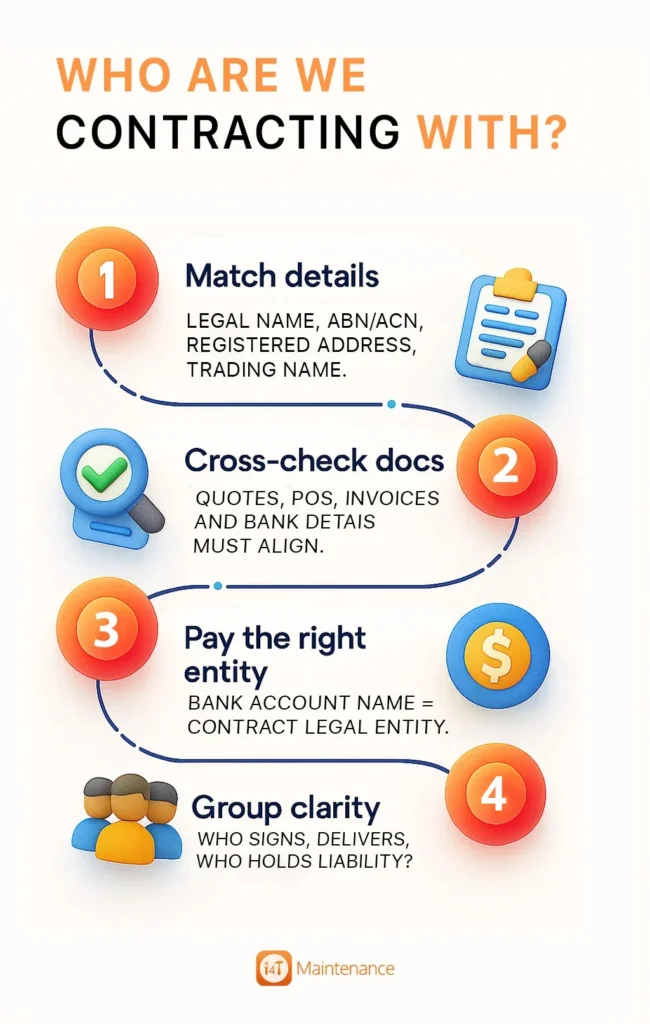
1.Who exactly are we contracting with?
Start by pinning down identity: the legal entity name, ABN/ACN, registered address and trading name must be consistent across quotes, POs, invoices and bank details. Mismatches create payment delays and weaken your position if you need to pursue warranties or insurance.
Ask for an ASIC/ABN extract and make sure the account name you’re paying matches the legal entity on the contract. If the supplier is part of a group, clarify which entity is signing and delivering the work, and who carries liability.
A clean identity at the start makes every downstream control faster.
2.Are they financially stable enough to support us long term?
You want a partner who can weather cost spikes, supply hiccups and seasonal peaks without dropping service.
Explore years trading, ownership, major client mix and how they handle warranty obligations. Listen for practical signals: sensible credit terms with their own suppliers, steady cash flow, and readiness to show trade references. A stable supplier won’t overpromise in the hope of bridging a cash gap; they’ll commit to achievable SLAs and honour them.
Continuity is part of Supplier management; it’s cheaper than re-onboarding a new vendor midstream
3.What precise scope do they cover, and what don’t they do?
Clarity here prevents scope creep and stops trades tripping over each other. Ask for a written scope that lists inclusions, exclusions and the common edge cases in your buildings. The best suppliers define acceptance criteria and explain what “done” looks like, including testing, commissioning and handover artefacts. They’ll flag adjacent work that belongs elsewhere and suggest logical interfaces.
When the scope is crisp, you can schedule confidently, control variations and brief residents without guesswork.
4.Do they have experience with sites like ours?
Experience is only relevant if it mirrors your reality: lifts and loading docks, noise windows, resident communications, permit rules.
Ask for recent examples with similar constraints and listen for detail, how they staged noisy works, coordinated with building managers or protected finishes in tight corridors.
Real stories beat glossy portfolios. The aim is to predict behaviour under pressure: timely updates, safe decisions and tidy handovers.
5.Who will actually do the work, employees or subcontractors?
Capability lives with people. You need to know the bench depth, who supervises, and how subcontractors are inducted and managed.
Good operators can name key technicians and describe their induction, competence checks and substitution policy. They’ll explain how they maintain standards when demand spikes or someone is off sick.
Transparent staffing plans reduce surprises on the day and make quality more repeatable.
6.Do they hold the right licences and tickets for this scope and location?
Licences and authorisations are the legal floor for safe work.
Confirm company trade licences and the individual licences of the people who will attend the site, along with high-risk work tickets such as EWP, working at heights, asbestos or confined spaces. Check expiry dates and licence classes align with the task and jurisdiction.
Mature suppliers maintain a licence register and can produce evidence quickly; this saves you time and reduces compliance risk.
7.Are their insurances current, and sized to our risk profile?
Insurance is your safety net when the unexpected happens.
Sight Certificates of Currency for Public Liability, Workers’ Compensation and, where applicable, Professional and Product Liability. Look beyond the headlines: verify coverage dates span the job period, and ask about exclusions or endorsements that might affect your building. For higher-risk works or tall buildings, confirm that limits meet your scheme’s standard.
Treat insurance like a living control, reconfirm before major or high-risk works, not just at onboarding.
8.How do they manage safety on the ground, not just on paper?
Safety that works is specific and visible.
Ask how they tailor SWMS/JSAs to your site, run toolbox talks, and record incidents and near misses. You want documents that mention your hazards, roof access, asbestos registers, switchboards, traffic flows, and a routine for learning from issues.
Suppliers who treat safety as part of delivery protect residents, reduce downtime and keep your audit trail strong.
9.What is their induction and site-access process?
Smooth access is half the battle in strata.
Understand how they sign in crews, control keys and fobs, manage lift bookings, and use permit-to-work for hot works, roof access and isolations. Ask about after-hours access and noise windows, and how they handle waste removal to keep common areas clean.
When inductions and permits are tight, residents notice less and your building manager spends more time managing, less time chasing.
10.How do they ensure quality and handle defects?
Quality needs a system with checkpoints.
Look for defined hold points, commissioning procedures and photo evidence tied to acceptance criteria. Ask how defects are logged, prioritised and closed, and how they prevent repeats, root cause, and corrective actions say more than a promise.
With clear quality controls, end-of-job disputes shrink, and you spend less time relitigating “what was agreed.”
11.What response and turnaround times can they commit to?
Service levels are where daily satisfaction lives.
Define response and completion targets for emergency, urgent and routine work, including after-hours coverage, and check how they resource seasonal peaks. A credible supplier can show recent performance against target and explain what happens if they miss, communication, escalation and recovery steps.
When SLAs are real, schedules hold, and resident notices stay accurate.
12.How are variations proposed, priced and approved?
Variations are inevitable; surprises aren’t. Ask for a simple process that triggers early when scope or site conditions differ, with written pricing, schedule impacts and options before work proceeds. Clarify who in your team can approve and any dollar caps.
When variations follow a tidy path, budgets stay predictable and relationships stay friendly—even when the plan changes.
13.What warranties apply, and how do we claim?
Warranties protect the whole-of-life cost and resident trust.
Clarify coverage for materials and workmanship, start dates, exclusions and transferability between owners. Ask for the practical claim path: contact points, evidence required and expected timeframes.
Suppliers who handle claims gracefully are often the ones who build things right the first time; either way, you’ll spend less time chasing and more time closing jobs.
14.What completion evidence will we receive at handover?
Evidence is how you prove compliance later.
Expect a clean package with before/after photos, test results, commissioning data, certificates, manuals and as-built updates. It should arrive promptly, be named logically by asset or job, and be easy to file.
This is gold when you brief committees, renew insurance, or onboard a new manager; your Supplier management record tells the story in minutes.
15.How is pricing structured so we can budget accurately?
Transparency beats lowballing.
Unpack call-out rules, minimum charges, hourly rates, travel, materials mark-ups and restocking fees. Ask how they choose fixed price vs time-and-materials and how they surface unforeseen costs before spending is approved. A sample invoice should match what they describe.
Clear pricing means fewer invoice disputes and faster payment cycles for everyone.
16.What are the payment terms, and what must accompany each invoice?
Tie dollars to deliverables to keep files clean.
Align milestones with completion evidence, require job references on every claim, and agree on retention or holdbacks for defect resolution where sensible.
Suppliers who are comfortable linking payment to proof are usually confident in their execution. You’ll spend less time verifying and more time approving.
17.How will they protect data, privacy and physical security?
When suppliers touch access codes, keys and resident details, sloppy handling can become your problem.
Ask how they store and restrict access to credentials, what happens when staff leave, and how incidents like lost fobs are reported. For digital data, check basic hygiene; who sees what, how it’s encrypted or segregated, and how long it’s kept.
Good security keeps reputations intact and audits painless.
18.What is their communication rhythm and escalation path?
Silence creates escalations; rhythm prevents them.
Establish a single point of contact, a predictable update cadence (weekly dashboard, post-visit notes or both), and a clear escalation ladder with response times.
Good communicators bring bad news early with options, not excuses. That habit lowers stress and lets committees feel informed rather than surprised.
19.How do they manage environmental responsibilities and waste?
Residents notice how trades treat their building.
Ask about waste segregation, recycling targets, hazardous waste handling and any take-back schemes with manufacturers. Responsible methods can reduce cost and risk while keeping optics positive.
It’s a practical marker of professionalism and part of a modern supplier management standard.
20.Can they integrate with our systems and ways of working?
Manual admin slows jobs and hides risk.
Check whether they can accept digital work orders, upload photos and test results, submit e-invoices, and work through your portal or API. Integration shrinks email chains, speeds payments and gives you a single source of truth for audits and handovers.
The less copy-paste, the faster everything moves
21.What’s the contingency if things go wrong, or if they need to exit?
Resilience is the final comfort check.
Ask about business continuity (backup technicians, alternate suppliers), their process during major disruptions, and how they support transitions if you change provider. You’re looking for a calm, documented plan and an example where continuity was maintained under pressure.
When a supplier can navigate the wobble, you can approve with confidence.
Make supplier management effortless
Approving a supplier is really about designing the next twelve months of your operations. These 21 questions turn supplier management into a practical rhythm: verify the entity, test stability and safety, lock scope and evidence, make pricing transparent, and agree on communication and continuity.
Apply them consistently and you’ll cut approval time, reduce variation creep, speed close-outs and keep residents on side, without adding red tape. The payoff is smoother days for your team and cleaner files for your auditors and committees.
Make this effortless with i4T Maintenance. i4T Maintenance is maintenance management software built for strata managers that makes supplier management simple from end to end. Centralise supplier profiles, licences and insurance with automatic expiry alerts. Book a demo today.
FAQs
Create a simple scoring matrix (0–5) across what matters most to your scheme: turnaround, quality history, documentation speed, price transparency, and communication. Weight the top two (e.g., turnaround ×2). The highest weighted score wins; fast, fair, defensible Supplier management.
Yes, run a short probation (e.g., 3–5 low-risk work orders). Set clear KPIs: response time, first-time fix, paperwork completeness, resident feedback. Review together at the end; either graduate to the panel or exit gracefully.
Include: your by-laws and noise windows, site contact tree, induction/permit instructions, sample work order and invoice format, photo/test upload rules, escalation ladder, and SLA definitions. This reduces back-and-forth and protects timelines.
Quarterly is practical. Track: SLA hit rate, first-time fix %, variation frequency, defect recurrence, documentation-on-time, and resident complaints per job. Use a one-page scorecard and share results; transparency improves performance.
Pause non-urgent work immediately, request updated evidence with a firm deadline, and redirect urgent jobs to a backup. Record the incident on the scorecard. Reinstate only when proof is current; repeated lapses justify panel removal.
Verify ABN, public liability and, if they employ anyone, workers’ comp. Confirm who covers the job when they’re unavailable, and ensure tickets/licences are in the individual’s name. Keep scopes tight and use clear variation rules to avoid surprises.
Use a “minimum-compliance + cap” model: require licence and insurance sighted before dispatch, cap the first visit (e.g., 2 hours + materials) to remove immediate risk, collect photos on arrival, then issue a follow-up work order with full documents
Name files by Scheme_Asset_Job#_YYYYMMDD_DocumentType. Store by Vendor → Jobs → Assets, and keep an index sheet with links. This makes Supplier management audits and handovers painless.
Yes, set a master service agreement with shared standards (SLA, evidence, pricing rules) and building-specific schedules for access, permits and contacts. One set of expectations, many sites; less admin, faster turnaround.
Keep contracts, licences/insurance, SWMS, test results and handover packs for the life of the asset plus several years (follow your insurer’s guidance). Store resident data and access credentials securely, restrict who can view them, and remove access when staff or suppliers change.