
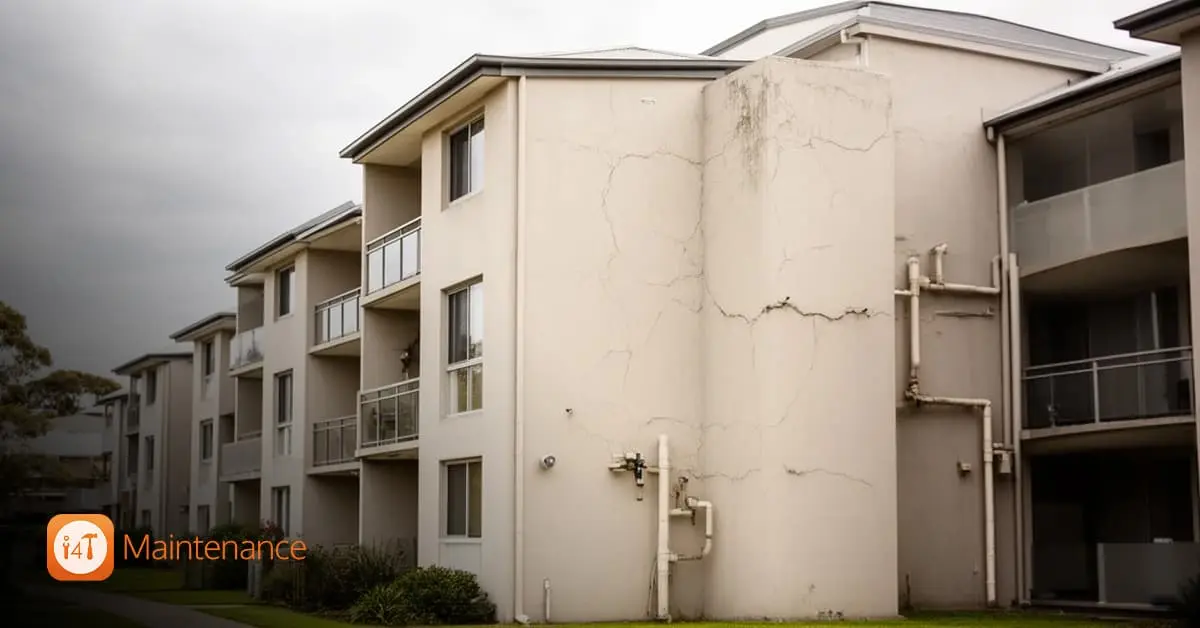
If you manage strata long enough, you start to recognise the same repair themes popping up again and again: roof leaks after a storm, water showing up where it absolutely shouldn’t, “urgent” electrical defects, and a slow creep of wear-and-tear through corridors and common areas. The tricky part isn’t identifying the issue; it’s answering the question everyone asks next: “Roughly what’s this going to cost?”
This strata repair costs Australia guide is designed to give you practical, defensible benchmarks you can use for early budgeting, committee conversations, and to sanity-check quotes.
The cost ranges below are primarily drawn from the Archicentre Australia Cost Guide 2026, which states it’s general advice, assumes typical conditions, and notes that its cost advice includes GST, helpful for strata discussions where people want “real-world” numbers.
One important reality check: many of these benchmarks assume reasonable access and for roofing up to two storeys. In strata, access requirements (height systems, confined spaces, traffic management, resident disruption, after-hours shutdowns) can push costs higher than a simple baseline.
Also, if you’re in NSW, it’s worth remembering that the NSW Government guidance is clear: the owners corporation is responsible for common property repairs (and it explicitly lists items like roof and gutters as owners corporation responsibility). That matters because getting the responsibility call right early can save a lot of back-and-forth when you’re preparing a common property repair cost estimate Australia.
Roof leaks and roof covering repairs
Roof issues tend to start small and annoying – a drip, a stain – and become expensive when they’re ignored, like wet insulation, mould, ceiling collapses, electrical risk. The benchmark you’ll often use is cost per square metre for repairing or replacing roof coverings.
Archicentre’s roofing benchmarks (noting “up to two storeys: fixed to existing roof frame”) include: concrete tiled roof $65–$85/m², terracotta tiled $105–$155/m², slate $390–$650/m², fibreglass $48–$70/m², polycarbonate $88–$450/m², and steel roofing $60–$130/m². Sarking is listed at $11–$16/m².
In strata, the difference between a “simple repair” and a “proper fix” is often access plus detailing around penetrations, gutters, and roof drainage. If the building is more than two storeys, treat these numbers as a floor, not a ceiling.
Gutters and downpipes - roof drainage failures
A surprising number of “mystery” water ingress issues are actually drainage problems: blocked or undersized gutters, failed joints, incorrect falls, or downpipes that simply can’t keep up in heavy rain. These are also classic common property items.
Archicentre’s benchmark for guttering and downpipes is shown per linear metre by material: PVC $43–$72/Lm, Zincalume $43–$102/Lm, Colorbond $49–$109/Lm, copper $138–$187/Lm, and stainless steel $120–$215/Lm.
Where costs blow out in strata is rarely the gutter itself; it’s safe access, edge protection, and the “make good” work once you start uncovering rusted fascia or water-damaged eaves.
Electrical defects: switchboards and safety switches
Electrical is one of those categories where you don’t get to “wait and see”. Defects, compliance notices, nuisance tripping, and ageing infrastructure can force your hand.
Archicentre’s benchmarks list replaces switchboards at $900–$3,000 and safety switches at $550–$1,100.
In strata, planning matters. If a board upgrade will require shutdowns, access to meter rooms, or coordination with essential services, that operational complexity can add cost even when the hardware is straightforward.
Common area lighting and power
Common property lighting is a constant source of “small-but-urgent” jobs: faulty fittings, upgrades for safety, or adding power and lighting in basements, plant rooms, foyers, and bin rooms.
Archicentre’s benchmarks include new light point $125–$150 each (plus cost of fitting) and add power points $125–$300 each.
In practice, strata pricing here is heavily influenced by how difficult the cable run is (concrete, fire-rated penetrations, limited ceiling access) and whether the work needs traffic control or after-hours scheduling.
Stormwater and surface drainage
Drainage failures are often the “silent budget killers” because they don’t always look dramatic, until a basement floods or a courtyard becomes a pond.
Archicentre’s drainage benchmarks include 90mm stormwater pipe (including trenching up to 900mm deep) $90–$130/Lm, stormwater pits and cover $560–$1,500 per pit, trench grates $320/Lm (plus varies by trench size and cover type), and agricultural pipe including trenching $45–$65/Lm.
In strata, reinstatement is the big swing factor. If the area is paved, landscaped, waterproofed, or part of a podium structure, the “repair” is really a layered system rebuild, and that’s where budgeting needs a bit of padding.
Water-damaged ceilings and walls
Once water has entered, you’re not just fixing the leak; you’re repairing finishes, restoring fire/smoke integrity where relevant, and making the space look normal again.
Archicentre lists plasterboard (including furring channels) at $81–$98/m², and patching holes/openings not exceeding 0.5m² at $290–$540/m².
On paper those are clean numbers; on site, the cost depends on how much “investigation” is required (opening up ceilings, tracing moisture paths, drying time) and whether decorative features (cornices, roses, mouldings) need matching.
Brickwork repointing and façade maintenance
Repointing is one of those unglamorous jobs that pays off. Failed mortar lets water in, accelerates deterioration, and can cause internal damp issues that look unrelated.
Archicentre’s benchmark for repointing face brick walls is $13–$22/m².
In strata, the real variable is access. The repointing itself may be straightforward, but working at height, containing dust, and staging works around residents can materially change your final cost.
Rising damp and ventilation fixes
Damp is rarely a single-fix problem in strata, but there are common remedial items that show up repeatedly: injected damp-proof courses in older masonry and adding vents to improve underfloor or cavity ventilation.
Archicentre benchmarks silicon injected damp-proof course at $55–$85/Lm, and new air vents at $55–$80 each.
These are useful “first pass” numbers for budgeting, but the key is diagnosis. If the moisture source is coming from failed drainage, bridging, or waterproofing issues, damp proofing alone may just delay the next complaint.
Common area painting and anti-graffiti coatings
Painting is one of the most visible ways a building “shows its age”, and it’s often where committees want strong value for money, because residents see it every day.
Archicentre’s benchmarks for painting (one undercoat, two finishing coats) include interior – plaster/brick/timber $20–$40/m², and exterior timber, depending on condition: $25–$60/m² (good condition) and $45–$80/m² (poor condition). It also lists an anti-graffiti shield at $25–$36/m².
In strata, the preparation standard is the difference between a job that lasts and one that looks tired in 18 months. If your building has older paint layers (and potentially lead paint), make sure the scope spells out surface prep expectations. Archicentre itself flags “allow extra for” items like lead paint removal.
Waterproofing failures in bathrooms, balconies, and podiums
This is the one that keeps strata managers up at night, because waterproofing failures can trigger a chain reaction: leaks into lots below, damaged ceilings, mould concerns, disputes over responsibility, and extended disruption while drying and rectification happen.
For a practical, on-the-ground signal, the Queensland Building and Construction Commission (QBCC) reports that each residential bathroom claim finalised under the Queensland Home Warranty Scheme during the 2024–25 financial year averaged almost $25,000 in rectification costs. That figure alone is a strong reference point when someone asks about waterproofing repair cost in strata apartment Australia.
From a broader regulatory/industry perspective, the Australian Building Codes Board (ABCB) impact analysis for waterproofing provisions notes that rectification costs for Class 2 buildings (apartments) are broadly in line across sources for balconies/podiums/external enclosures, costing around $24,000 per defect/balcony. It also highlights that, for Class 3–9 buildings, internal wet area defect rectification can range between $50,000 and $225,000 per defect, and balcony/podium defects can be around $40,000 per defect.
If rectification ends up requiring a full strip-out and rebuild of a bathroom (which is common when membranes have failed and substrates are compromised), Archicentre’s “wet area fit out” benchmark for a bathroom/en-suite is $17,500–$35,000.
And finally, a responsibility note that matters in real strata life: the NSW “Common property memorandum” includes original tiles and associated waterproofing affixed at the time of registration of the strata plan in owners corporation responsibilities, in the listed contexts. That doesn’t replace plan/by-law checks, but it’s a credible anchor when you’re navigating the “who pays?” question.
Conclusion
These benchmarks won’t replace a proper scope and competitive quoting—but they’re enough to stop budget conversations from derailing into guesswork. Use them to build a calm, defensible common property repair cost estimate in Australia, then tighten the numbers with site-specific quotes.
In NSW, the Government states the owners corporation is responsible for common property repairs, and schemes must obtain at least two independent quotes for work valued at $30,000 or more (with emergency exceptions). (nsw.gov.au) In Queensland, the Government similarly frames that the body corporate must maintain common property in good condition (and may be liable if failure causes damage to a lot). (qld.gov.au)
If you’d like to turn these benchmarks into faster, smoother maintenance workflows, complete with clear scoping, approvals, job tracking, and reporting, i4T Maintenance is a property maintenance management software built to help strata managers stay on top of reactive and planned works.
FAQs
Not always. They’re benchmarks for early budgeting. Height/access, after-hours work, compliance needs, and how “opened up” the issue becomes can change the final price materially.
The Archicentre CostGuide notes its cost advice includes GST, which is helpful for committee discussions. If your budget is ex-GST, adjust accordingly.
Because “waterproofing repair” can mean anything from targeted rectification to a full strip-out and rebuild. QBCC’s scheme data shows bathroom rectifications can average around the $25k mark, and ABCB analysis highlights significant rectification costs for defects depending on building type and location.
It depends on your strata plan and applicable rules. In NSW, government guidance and the common property memorandum are useful references for typical inclusions, but you should still confirm against your own scheme documents.
Provide a clear scope with photos, access details, and exactly what “make good” looks like (finish standard, paint matching, reinstatement). Then ensure each contractor is pricing the same inclusions so you can compare apples with apples.