

TL;DR
Most strata maintenance complaints aren’t caused by the delay; they’re caused by no updates.
Residents and committees want simple certainty: it’s logged, who’s responsible, what the current status means, what happens next, a realistic timeframe, and when the next update is coming.
Use clear status stages (logged, triaged, quote, approval, scheduled, in progress, completed/closed), send updates at key milestones, and if something stalls, send a short weekly check-in anyway.
Consistent, plain-English updates build trust, cut down chasing, and help reduce maintenance complaints with updates to the strata, and tools like i4T Maintenance make it easier to manage and communicate work orders in one place.
If you’ve been in strata long enough, you already know this pattern: a perfectly reasonable maintenance request turns into three follow-up emails, then a complaint, then a committee member forwarding the whole thread with “Can you please update everyone?”
Most of the time, it’s not because the fix is hard. It’s because the silence is hard.
When people don’t know what’s happening, they fill the gaps themselves: “They’ve ignored it.” “They’re dragging their feet.” “Nothing ever gets done.” And that’s how minor issues become major frustrations.
The good news? You don’t need to write novels. You just need a simple, predictable approach to resident communication for maintenance updates in strata, with clear statuses, realistic timeframes, and a consistent “next step” message.
And yes: done well, it really can reduce maintenance complaints with updates to the strata.
What do residents and committees actually want from work order status updates?
Residents and committees want certainty: confirmation that the request is logged, clarity on responsibility whether its a lot vs common property issue, a status update, a realistic timeframe, and a clear next update date, especially if things are delayed.
That’s the heart of strata work order status updates best practice. Everything else is just packaging.
Here are the 10 questions people are actually asking, whether they say them out loud or not.
1. “Has my request been received and logged?”
This is the first emotional speed bump. When someone reports a leaking tap in a common bathroom, a broken gate, or a flickering light in a corridor, they’re not just reporting a fault, they’re asking to be taken seriously.
A fast acknowledgement stops the spiral early. It’s the difference between “Thanks, got it” and “Hello???”
A strong acknowledgement includes just enough detail to reassure them: what you’ve logged, what the next step is, and how they’ll hear back.
If you want one small change that pays off quickly, it’s this: always send the first update quickly, even if you don’t have the solution yet.
2. “Is this common property or inside-the-lot responsibility?”
This one matters because it shapes expectations instantly. People get frustrated when they think strata is responsible, but it turns out the issue sits within the lot boundary, or vice versa.
Across Australia, the exact boundary rules vary by state and scheme documents, but the general principle is consistent: owners maintain their lot, while the owners corporation/body corporate maintains common property. NSW Fair Trading guidance is clear that the owners corporation/strata committee is responsible for repairing and maintaining common property. Queensland Government guidance likewise states a body corporate must maintain common property in good and structurally sound condition, while lot owners maintain their lots.
In practice, your update doesn’t need to sound legal. It just needs to be clear and helpful:
- If it’s common property: “We’ve logged this as common property and will arrange a contractor.”
- If it appears lot-based: “This looks like it may sit within the lot; we recommend the lot owner engage a licensed tradesperson. If you’d like, we can still help point you in the right direction.”
Even when you’re not 100% certain yet, you can say what you do know and what you’re checking next. That alone reduces back-and-forth.
3. “What does this status actually mean?”
A lot of status updates fail because the status is meaningless to a resident. “In progress.” Okay… does that mean someone is coming tomorrow, or that you emailed a contractor last week?
The trick is to use statuses that reflect real milestones; the points where progress actually changes.
Here’s a simple status set that works well in strata (and keeps everyone speaking the same language):
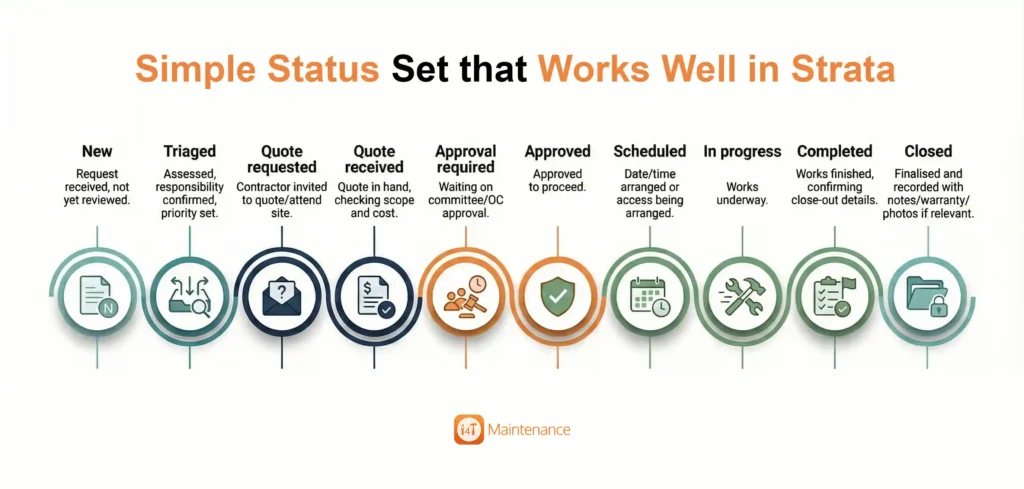
- New – request received, not yet reviewed
- Triaged – assessed, responsibility confirmed, priority set
- Quote requested – contractor invited to quote/attend site
- Quote received – quote in hand, checking scope and cost
- Approval required – waiting on committee/OC approval
- Approved – approved to proceed
- Scheduled – date/time arranged or access being arranged
- In progress – works underway
- Completed – works finished, confirming close-out details
- Closed – finalised and recorded with notes/warranty/photos if relevant
Notice what’s missing? Fluffy labels. Every status tells the reader what’s actually happening.
If you do nothing else, do this: make the status self-explanatory, then add one line explaining the next step.
4. “When will it happen, really?”
This is where trust gets built or broken.
Residents don’t necessarily demand speed. They demand honesty. Committees don’t necessarily demand perfection. They demand predictability.
The fastest way to create complaints is to promise an ETA you can’t control, then miss it, then go quiet. A better approach is to give a range and explain what it depends on.
Even when delays happen, your updates should sound calm and structured, because that’s what people are craving.
5. “What’s happening next, and who’s responsible for it?”
A status update without a next step feels like a dead end. That’s when residents and committees start pushing for more detail, more often.
The best updates answer three things:
- What’s done – mention if their request has been logged, triaged, a quote requested, or approved.
- What’s next – tell them what they can expect in the next 24 hours. Whether it’s a site visit, quote review, scheduling, or access)
- Who owns the next step – If its strata, contractor, committee, or resident access.
This doesn’t mean naming individuals or exposing internal deliberations. It means assigning responsibility to the role or party so expectations are clear.
Committees especially value this because it reduces “Can you chase this?” messages. If your update already explains what you’re waiting on, you’ve saved yourself a follow-up.
6. “Do you need access, and will this disrupt residents?”
People can tolerate inconvenience when they get fair warning. They get angry when disruption is a surprise.
If access is needed, say it early, and say it plainly, mentioning:
- Which areas
- When
- How long
- What residents need to do before the tradie arrives.
And if the work will affect the building with noise, water shut-offs, or restricted entry, treat that as its own mini-update. Not long. Just clear.
Remember, residents don’t want to manage your job; they just want to manage their day.
7. “Has it been approved, and what does that mean for cost?”
Residents usually care about impact. Committees care about governance, budget, and decision-making.
This is where your update tone matters. You don’t want to sound like you’re blaming the committee for delays, but you also don’t want to pretend approvals aren’t real.
A great middle ground is to explain the process neutrally:
- “We’ve received the quote, and it’s currently with the committee for approval.”
- “This work requires approval under the scheme’s spending limits. Next update by Friday.”
That one line telling when the next update will be does a lot of heavy lifting. It gives committees breathing room and gives residents a predictable check-in.
Also worth remembering: transparency and clear communication are core expectations in professional complaint handling frameworks, including industry body guidance around transparent processes and outcomes being communicated clearly.
8. “Is this urgent or safety-related, and what happens differently?”
Strata is full of “urgent vs important” debates. A dripping pipe in a riser cupboard can become a major issue quickly, while a cosmetic item might be annoying but stable for months.
Residents want to know you’ve taken the risk seriously. Committees want to know priority decisions are consistent and defensible.
So define your urgency approach in plain terms:
- Safety/security risks and active water ingress get escalated
- You communicate more frequently
- You may proceed under emergency arrangements, then report back transparently
When you say how you have categorised a request, people relax when they can see your logic.
9. “How do I follow up without chasing three people?”
This is where many strata teams accidentally create chaos: updates go out via email, the portal, a phone call, a committee member’s WhatsApp, and then someone posts on the building Facebook group.
The outcome is predictable: confusion, duplicated work, and the feeling that “no one is in charge”.
Strata work order status updates best practice means having one official pathway for requests and one consistent place where the status lives.
You can still be friendly and responsive, just consistent. A good update gently nudges behaviour:
This is also one of the most reliable ways to reduce maintenance complaints with updates to the strata, because complaints often start as people trying and failing to be heard through the right channel.
10. “How do we know it’s finished, and properly recorded?”
Closing the loop is underrated. Lots of complaints don’t start at “nothing happened”; they start at “they say it’s done, but…”
A strong close-out update confirms:
- What work was done
- When it was done
- Any follow-up actions like monitoring, return visit, or parts on order.
- Any practical notes like warranty details, contractor report, and photos, where appropriate.
Committees also appreciate closure because it protects the scheme long-term: good records make future decisions easier, help with pattern spotting, recurring faults, and support better budgeting.
And from a relationship point of view, it’s simple: when people feel kept in the loop to the end, they’re much less likely to assume neglect.
The update rhythm that keeps everyone calm
A common fear is that more updates creates more admin. In reality, the right updates reduce admin, because they prevent the follow-ups.
Here’s a practical cadence that works in most schemes:
- Acknowledgement: same business day or within 24 hours
- Triage update: within 1–2 business days, including responsibility and next step
- Milestone updates: whenever the status changes from quote received, approved, or scheduled
- Delay updates: a planned check-in, even if nothing has moved
Better updates aren’t “extra”, they’re the work
Residents and committees don’t expect miracles. They expect communication that feels human, consistent, and honest.
When you standardise your statuses, explain the next step, and set a predictable update rhythm, you make maintenance feel managed, even when timelines are tight. And that’s how you build trust, reduce escalations, and keep your inbox from turning into a daily negotiation.
If you want to make this easier and more consistent across every scheme, i4T Maintenance – Maintenance Management Software helps you manage work orders end-to-end, standardise statuses, record history, and send clear updates without reinventing the wheel each time. It’s a simple way to tighten up work order management and deliver the kind of visibility residents and committees actually want.
FAQs
At key milestones (logged, triaged, quote received, approved, scheduled, completed) and at least once a week if it’s delayed.
The work order reference, current status, what happens next, a realistic timeframe, and the next update date.
Only what affects them: whether approval is required, if it’s approved yet, and when you’ll update them next.
Send a quick acknowledgement, use clear status labels, and keep a predictable update rhythm, especially when there’s no progress.
Use one main channel for tracking (ideally a portal/work order system) and send brief notifications via email/SMS when the status changes.