

TL;DR
A preferred contractor panel can save strata managers a stack of time by giving you a ready-to-go shortlist of vetted contractors for common maintenance work.
It works best when you keep it competitive and transparent:
- Do basic checks (licences, insurance, WHS approach),
- Issue clear job briefs, and
- Use a strata quote comparison checklist so the committee can see you’re comparing scope and risk.
Panels backfire when they become “set and forget”, leading to price creep, quality drift, capacity issues, or perceived favouritism. The fix is simple:
- Refresh the panel regularly,
- Benchmark prices occasionally,
- rotate where practical, and
- Keep a clean audit trail of quotes and decisions.
Use i4T Maintenance to store your preferred contractor list, track compliance expiries, and keep all quote comparisons and work orders in one place.
If you manage strata long enough, you’ll see the same pattern repeat: a burst pipe at 7 am, a committee member asking for three quotes by Friday, a resident who wants updates every two hours, and a tradie who swears they never received the work order.
In that chaos, a preferred contractor panel can feel like the ultimate life hack; a pre-vetted group of contractors you can call on with confidence.
When it’s done well, a panel helps you move faster, get more consistent workmanship, reduce admin, and make approvals smoother because your committee already trusts the providers. When it’s done poorly, it can backfire spectacularly: price creep, perceived favouritism, “same mates” politics, or a quiet drop in quality because nobody’s really being compared anymore.
This article walks through a practical, strata-friendly way to build a preferred contractor panel that’s fair, defensible, and genuinely useful, plus the warning signs that tell you it’s time to refresh it.
What is a preferred contractor panel in strata, and why do people use one?
A preferred contractor panel is simply a shortlist of contractors, usually by trade, who have been pre-checked and agree to work within your expectations; things like response times, quoting format, insurance requirements, reporting, and site rules.
It’s not a permanent exclusive arrangement, and it’s not meant to override good procurement habits. Think of it as your “ready list” for common property maintenance.
Strata managers use panels for a few straightforward reasons: they reduce the scramble when something urgent happens, they make quote comparisons easier because you’re working with familiar formats, and they improve consistency across recurring work (fire services, plumbing, electrical, lifts, cleaning, gardens).
Most importantly, panels help you build a repeatable process that committees can understand, instead of reinventing the wheel every time.
The key is remembering this: a panel is a tool to help you get better outcomes, not a shortcut that replaces oversight.
When should you build a panel, and when is it overkill?
Panels shine when your scheme or portfolio has a steady flow of similar work.
If you’re regularly issuing work orders for the same categories, a panel can cut decision time dramatically because you’ve already set the baseline requirements. It also helps when you have multiple sites, and you want contractors who can deliver consistently across locations.
Where panels are often overkill is in specialist or high-complexity work, major remediation, engineered solutions, heritage constraints, waterproofing disputes, or anything where the scope needs deep investigation before you can even ask for a meaningful price. In those cases, a wider market approach, can be safer than defaulting to a familiar name.
A simple rule: if the scope is hard to define and the risk is high, rely less on the panel and more on a structured procurement approach. A panel should support your judgement, not replace it.
How many contractors should you have on a panel per trade?
Too few contractors and you’ll end up with capacity issues, rushed work, or the same provider winning by default. Too many, and the panel becomes a messy phonebook that nobody maintains.
For most strata teams, a practical starting point is 2–4 contractors per trade, with a small set of specialists you can call on for uncommon work. That number gives you options without creating admin overload.
It also helps you avoid single-supplier dependency.
What matters more than the exact number is coverage:
- Can they respond when your main contractor is slammed?
- Do they service your area consistently?
- Do you have at least one contractor who can do after-hours or emergency response?
A healthy panel gives you choice in the moments you actually need it.
What minimum checks should you do before adding anyone to the panel?
If you want your panel to hold up under committee scrutiny, audits, or disputes, you need a consistent baseline. NSW guidance on getting quotes highlights the value of clear job briefs and managing changes to avoid unexpected costs, the same principle applies to your contractor checks: clarity upfront prevents problems later.
Here’s a sensible, strata-ready set of minimum checks (keep it simple, but consistent):
- Relevant licences/registrations
- Insurance currency
- WHS approach
- References and recent strata experience
- Capacity and responsiveness
- Quoting discipline
Just as important: track expiry dates for insurance/licences and set a routine to re-check. Panels don’t fail because people choose the wrong contractor once; they fail because nobody revisits the checks for two years and assumes everything is still fine.
What should you give contractors so that quotes are genuinely comparable?
The fastest way to end up with messy quotes is to send a vague request like “please quote to fix the leak”. You’ll get three prices that look wildly different, and the committee will be stuck arguing about cost when the real issue is scope.
Instead, treat your quote request like a mini brief. NSW guidance on getting quotes recommends writing a clear job brief and being careful about changes, because variations and ambiguity are where budgets blow out.
A strong strata job brief usually includes:
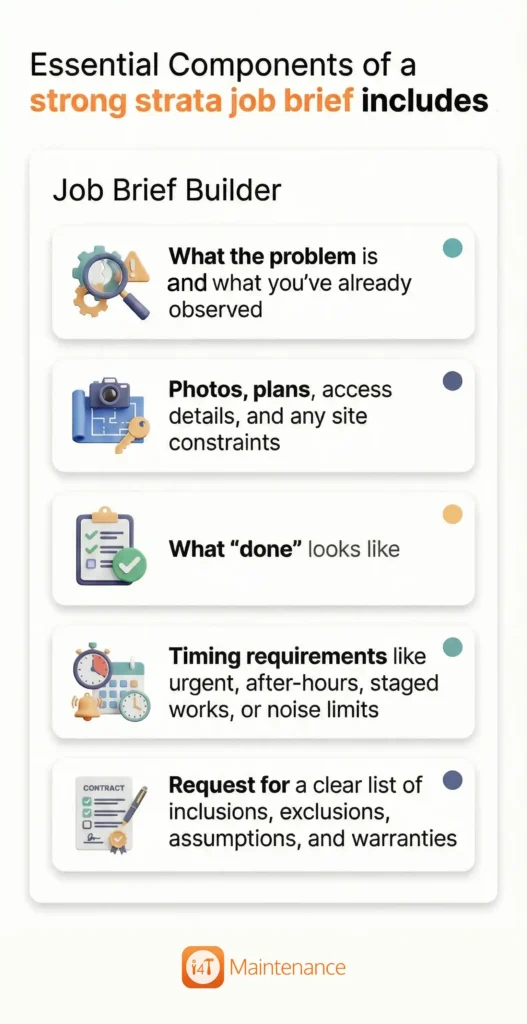
- What the problem is and what you’ve already observed
- Photos, plans, access details, and any site constraints
- What “done” looks like
- Timing requirements like urgent, after-hours, staged works, or noise limits
- Request for a clear list of inclusions, exclusions, assumptions, and warranties
When contractors quote off the same information, you’re finally comparing value, not just guessing which quote is “more honest”.
What should be on a strata quote comparison checklist?
Committees often ask for three quotes as if the number itself guarantees fairness. It doesn’t. Fairness comes from comparing like-for-like, documenting the reasoning, and making sure you’re weighing scope and risk properly.
Here’s a practical strata quote comparison checklist you can reuse across most trades:
- Scope match: does it cover every item in the brief and any compliance requirements?
- Assumptions: what are they assuming about access, shutdowns, materials, or faults found on the day?
- Exclusions: what’s not included and what will become a variation?
- Materials and method: are they specifying quality/brand/standard or keeping it vague?
- Timeframe: lead time, duration on site and any staging
- Warranty/defects liability: what’s covered and for how long?
- Reporting: photos, completion notes, compliance docs if relevant
- Risks: any red flags like big allowances, unclear line items, or “TBC” everywhere
Notice what’s missing from that list: “cheapest”. Price matters, but it’s only meaningful once you know you’re comparing the same job.
How to compare maintenance quotes in a strata committee without defaulting to “cheapest wins”?
If you’ve ever sat in a committee meeting, you’ll know the pressure points: someone wants to save money, someone wants “the best”, and someone thinks the last contractor was a disaster. Your job is to make the decision feel simple and defensible.
When you’re explaining how to compare maintenance quotes in a strata committee, a helpful approach is to present three things:
- A short scope summary,
- What’s different between the quotes?
- Your recommendation and why.
This keeps the conversation anchored on outcomes rather than emotion.
A simple way to frame it is: value for money = scope certainty + competence + risk management + price transparency.
If a quote is cheaper because it excludes key items or relies on vague allowances, it isn’t really cheaper; it’s just incomplete.
Committees usually respond well when you show the “hidden cost” risk in plain language: delays, variations, repeat call-outs, and resident frustration.
The goal isn’t to make the committee feel “sold to”. It’s to make the trade-offs visible so they can decide confidently.
How do you evaluate contractor quotes on price vs scope in strata?
This is where panels either earn their keep or cause trouble. A mature panel process helps you evaluate contractor quotes on price vs scope in strata in a repeatable way, not a gut-feel way.
A clean method is a lightweight scoring check:
- Scope match (40%): Does it fully align with the brief?
Quality and capability (25%): evidence of similar work, clarity of method, supervision - Risk and safety (20%): site approach, constraints, documentation, willingness to clarify
- Price transparency (15%): clear line items, sensible allowances, realistic labour/materials
You’re not trying to turn it into government procurement. You’re simply giving the committee a rational basis for choosing something that isn’t the cheapest, without sounding vague.
One practical tip: when the scope doesn’t line up, don’t force the committee to choose anyway. Go back to the contractor, ask targeted clarifying questions, and request a revised quote. That one extra step can save months of dispute later.
What governance stops panels from becoming a conflict-of-interest headache?
Even when everything is above-board, panels can look suspicious if you can’t explain why the same names keep appearing. That’s why governance matters: it protects you, the committee, and the contractors who are doing the right thing.
In NSW, strata managing agents have specific disclosure requirements around conflicts, gifts, and interests, and those transparency expectations are a useful benchmark even if you operate in other states.
A practical governance set-up for panels usually includes:
- A written panel intake process, including what checks you do, and where it’s recorded
- A rule for when you seek multiple quotes vs direct engagement
- A rotation approach is reasonable, so it’s not “same contractor by default”
- Documentation: store briefs, quotes, comparison notes, and approval decisions
- A clear process for declaring and managing any conflicts/benefits (even perceived ones)
When the paper trail is tidy, meetings are calmer. People argue less when they can see how the decision was made.
When does a preferred contractor panel backfire, and how do you fix it?
Panels usually backfire quietly at first. The warning signs are small: quotes start arriving with less detail, a contractor is suddenly “too busy” when you need them, or pricing drifts upward because there’s no real benchmarking happening.
It can also backfire on safety and accountability. Safe Work Australia’s guidance on WHS duties in a contractual chain emphasises that duties can’t simply be contracted out, and that PCBUs in the chain need to consult, cooperate and coordinate. That’s highly relevant to strata sites where multiple parties and contractors overlap.
Common backfire signs:
- Price creep: the panel becomes the only quoting circle, and competition fades
- Complacency: contractors assume they’ll win and stop being thorough
- Quality drift: more call-backs, more complaints, more “we’ll come back next week”
- Capacity issues: your “preferred” contractor can’t actually respond
- Perceived favouritism: committee trust erodes because the process isn’t visible
Fixes that work in the real world:
- Refresh the panel on a cadence like annually or every 18 months
- Run a benchmark quote round occasionally, even if you like your current providers
- Add new entrants to keep the panel competitive
- Tighten your quote brief and comparison notes so the scope stays consistent
- Set clear expectations for safety coordination and documentation on-site
A strong panel isn’t a locked club. It’s a living list that stays sharp because you maintain it.
Build a panel that’s trusted, not just familiar
A preferred contractor panel can be one of the best ways to reduce churn and speed up maintenance decisions in strata. The trick is to keep it fair and fresh: do the basic checks, issue clear briefs, compare quotes based on scope and risk (not just price), and maintain a simple governance trail the committee can follow.
If you want the panel to stay helpful long-term, treat it like any other asset in the building: it needs routine review, not “set and forget”.
If you’re ready to make panels easier to manage, i4T Maintenance – Maintenance Management Software helps you keep a preferred contractor list in one place, store quote requests and comparisons, track compliance/expiry dates, and maintain an audit trail that supports confident committee decisions.
FAQs
No. A panel is a shortcut for common work, not a rule. For specialist or high-risk jobs, it’s smart to go broader and get fresh quotes.
It depends on the job and your approvals. For most non-urgent work, 2–3 comparable quotes is common, but only if they’re based on the same scope.
Scope match, inclusions/exclusions, assumptions, timeframe, warranty, and any risk flags like vague allowances, then compare price after scope is aligned.
Ask: Does it meet the scope? Is the method clear? What’s likely to become a variation, and what’s the risk of call-backs? Then decide on value for money, not just the headline price.
At least annually (or every 12–18 months), and sooner if you see price creep, quality drop-offs, or repeated delays. Also re-check licences/insurances when they expire.