
Property maintenance in strata schemes is notoriously complex. Strata managers often juggle maintenance requests coming from scattered emails, phone calls, texts, committee messages, resident complaints, and contractor updates. Without a proper system, maintenance quickly becomes reactive, difficult to track, and a headache to report on.
That’s where work order software comes in. Work order software helps strata managers create, assign, track, approve, and report on maintenance jobs from request to completion, bringing much-needed order to the chaos.
Why Property Maintenance Is So Challenging for Strata Managers
Property maintenance in strata settings goes beyond just fixing broken taps or repainting walls. Strata managers bear responsibility for common property, often dealing with urgent repairs that can affect resident safety or comfort. Coordinating with contractors, securing committee approvals, controlling budgets, and communicating effectively with owners and residents all add layers of complexity.
Moreover, compliance records need to be diligently maintained to meet regulatory standards, and long-term planning for scheduled and preventative maintenance is essential to preserve property value. The juggling act requires clear processes and reliable systems to avoid bottlenecks and frustration.
Before Work Order Software: The Manual Maintenance Problem
Before adopting work order software, the maintenance process is a patchwork of disconnected tools. Requests arrive scattered across emails, spreadsheets, phone calls, and texts. There’s often inbox overload, leading to duplicate reports or lost messages. Missing photos and unclear access instructions slow contractor follow-ups.
Approval trails depend on memory or cumbersome email chains, and reporting is manually collated from various sources. This creates delays, confusion, and a mountain of administrative work for strata managers, while residents and committees get frustrated with a lack of transparency and slow progress.
After Work Order Software: A More Controlled Maintenance Workflow
With work order software in place, every maintenance request becomes a trackable work order. The software captures essential details such as location, type of issue, photos, priority, assigned contractor, due date, current status, notes, quotes, invoices, and evidence of completion.
This creates one source of truth accessible by the strata manager, contractors, and authorised committee members. Updates are timely, access to records is seamless, and accountability is improved. It replaces guesswork with clarity, enabling managers to stay on top of maintenance effortlessly.
How a Work Order Management System Supports the Full Maintenance Lifecycle
A work order management system guides the maintenance process smoothly from start to finish. When a maintenance issue is reported, the request is logged with full details, making triage simpler. The system helps identify whether the issue falls under strata responsibility or a specific owner’s obligation.
Once the scope is clear, managers can request quotes easily through the software, and track responses. Quotes can be submitted for committee approval digitally, ensuring a transparent record of decisions.
Following approval, contractors are assigned directly within the system and receive notifications. Progress updates, completion photos, and job notes maintain clear communication. After work completion, invoices are linked to the corresponding work order, simplifying payment processes.
Finally, all data gathered throughout the lifecycle feeds into reporting tools, enabling insightful analysis of maintenance activity and contractor performance over time.
Key Benefits of Work Order Software for Strata Managers
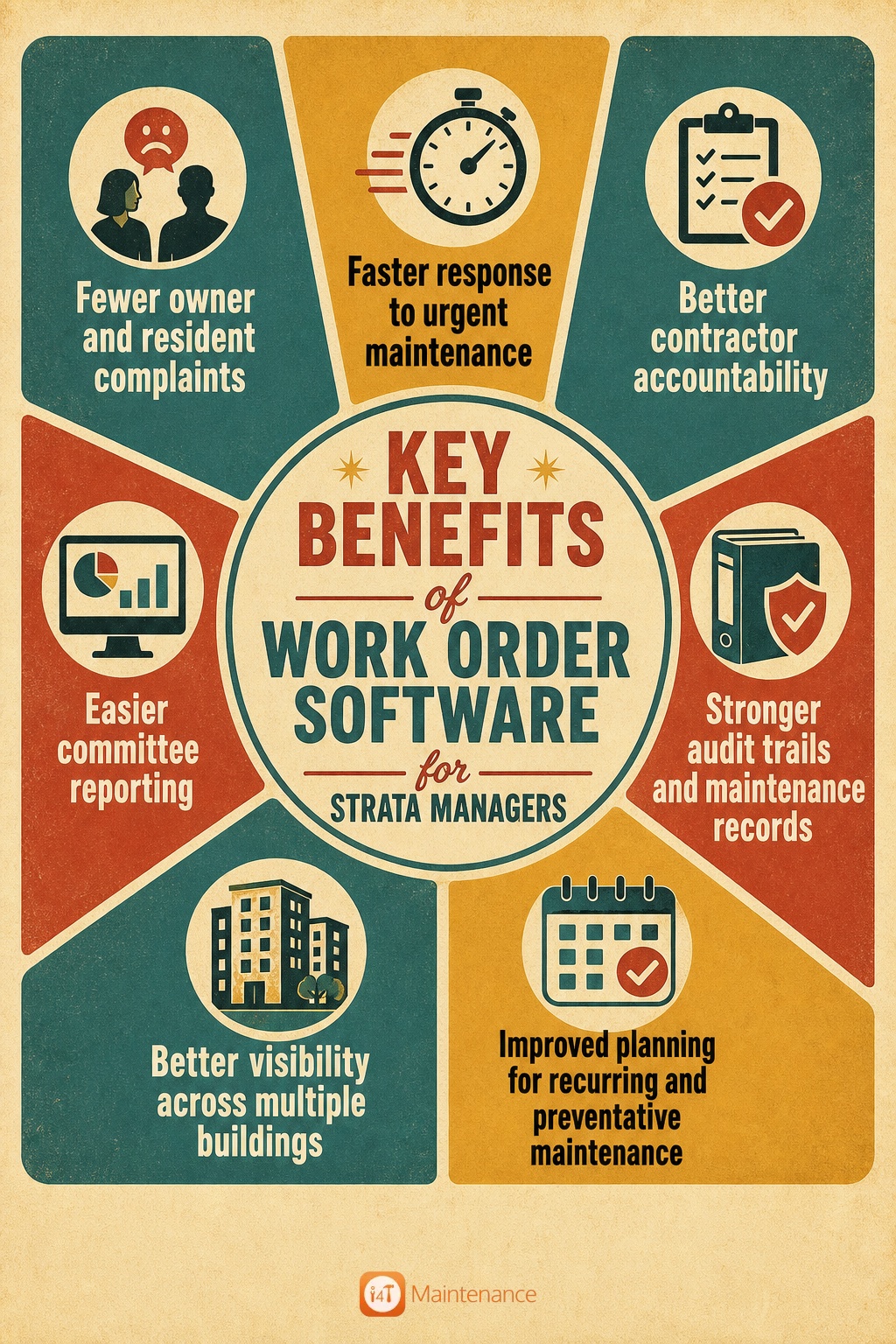
Adopting work order software delivers powerful benefits for strata managers. Residents and owners enjoy fewer complaints because urgent maintenance is prioritised and transparently tracked. Response times improve, minimising disruptions caused by unresolved repairs.
Contractors become more accountable with clear assignment and progress monitoring. Committee reporting is streamlined with accessible, organised records and audit trails that satisfy compliance needs.
Visibility across multiple strata sites enhances with consolidated dashboards, helping managers balance workloads effectively. Better planning for recurring and preventative maintenance emerges from historical data, reducing costly emergency fixes.
Overall, work order software supports a professional, proactive maintenance culture that reinforces confidence in strata management.
- Fewer owner and resident complaints
- Faster response to urgent maintenance
- Better contractor accountability
- Easier committee reporting
- Stronger audit trails and maintenance records
- Better visibility across multiple buildings
- Improved planning for recurring and preventative maintenance
Work Order Software vs Property Maintenance Management Software
While related, work order software and property maintenance management software serve distinct purposes. Work order software primarily focuses on creating, assigning, tracking, and closing maintenance jobs efficiently.
A work order management system extends those capabilities by adding structured workflows, approvals, notifications, and comprehensive reporting features.
Property maintenance management software is broader still. It often includes features like asset history tracking, preventative maintenance scheduling, compliance record keeping, property inspections, and reporting at a portfolio level.
Meanwhile, maintenance management software can apply across various property types, facilities, and asset categories, not limited to strata schemes. Understanding these differences helps strata managers select the ideal solution that matches their operational needs.
What Strata Managers Should Look for in a Work Order Management Solution
When choosing a work order management solution, strata managers need practical features that simplify instead of complicate maintenance tasks. This includes easy capture of maintenance requests with photo uploads and clear priority settings.
The system should allow quick assignment of contractors and manage quote submissions and approvals from committees digitally. Notifications for stakeholders and a robust audit trail support accountability and transparency.
A reporting dashboard that offers insight into maintenance status and contractor performance is vital, along with mobile access to field staff for real-time updates.
Recurring maintenance scheduling helps automate preventative tasks, while integrated invoice record management keeps finance tidy. For strata managers handling multiple properties, the software must provide consolidated visibility to avoid juggling separate systems.
The best work order management solution reduces admin effort rather than adding more complexity.
Example: Managing a Leaking Roof With and Without Work Order Software
Without work order software, a leaking roof maintenance request often begins with a vague email from a resident or committee member. Photos might be missing, and the strata manager must chase contractors repeatedly by phone or email.
Committee approvals may be confused by scattered emails, causing delays while residents grow frustrated with repeated follow-ups.
Visibility for all parties is poor, with no single source of truth. Invoices and completion proofs are stored separately, complicating reporting.
Contrast this with a work order software process: the roof leak is logged promptly with photos and an urgent priority tag. Contractors receive automatic assignment and the quote is uploaded for committee approval within the platform.
Once approved, the contractor completes the job and uploads completion photos, with the invoice linked to the work order. Residents and committee members access clear updates through the system. The entire process is efficient, transparent, and well documented.
Why This Matters for Committee Trust and Resident Satisfaction
Committees and residents don’t just want repairs done; they want clarity about maintenance matters. They want to know what’s been reported, what action is underway, who approved the work, how much it costs, and when it will be finished.
Clear maintenance records backed by work order software help strata managers answer these questions confidently and reduce repetitive queries. This transparency builds trust, reinforces professionalism, and improves overall satisfaction with strata management.
Why Choose i4T Maintenance Management Software
i4T Maintenance Management Software offers a user-friendly, practical solution tailored for strata managers. It centralises maintenance requests in one platform, streamlining contractor coordination and tracking job progress effortlessly.
The software supports easy committee approvals and robust reporting features, providing clear audit trails to meet compliance needs.
Designed to reduce administrative burdens, i4T helps managers gain better visibility and control over maintenance across multiple strata sites. It focuses on practical benefits, making the work order management experience straightforward and efficient.
Moving From Reactive Maintenance to Managed Maintenance
The shift from reactive, inbox-driven maintenance to a managed, structured approach is transformative for strata managers. Work order software delivers the visibility and control needed to keep maintenance activity transparent and orderly.
Strong records, clearer communication, and streamlined workflows reduce admin stress and enhance trust with owners and committees.
Using i4T Maintenance Management Software to manage work orders in one place is a smart move to reduce admin, improve visibility, and simplify property maintenance across your strata portfolio.
Frequently Asked Questions
Work order software for strata management is a digital tool that helps strata managers create, assign, track, approve, and report on maintenance jobs efficiently from start to finish.
It streamlines maintenance requests by centralising communication, improving contractor coordination, enabling committee approvals, and providing transparent tracking and reporting of all maintenance activities.
Work order software focuses on managing individual maintenance tasks, while property maintenance management software includes broader functions like asset history, compliance tracking, inspections, and portfolio-level reporting.
A work order management system helps strata managers organise maintenance requests, streamline approvals, allocate contractors efficiently, and maintain clear audit trails to improve transparency and control.
Yes, by automating request logging, prioritisation, contractor assignment, and approval tracking, work order software accelerates maintenance response times and reduces delays.
They should seek features like easy maintenance request capture with photos, prioritisation controls, contractor management, quote handling, committee approval workflows, reporting dashboards, mobile access, and multi-property visibility.