
Forecasting annual maintenance costs for residential properties is a critical task for strata managers and body corporate managers across Australia. With multiple properties to oversee, ageing assets, fluctuating contractor rates, and compliance obligations, having a clear, predictable maintenance budget is essential to avoid unexpected expenses and to communicate confidently with owners committees. A maintenance calculator is a practical tool that helps turn asset data, service history, contractor pricing, and risk allowances into clearer, more reliable forecasts. This guide dives into how strata managers can successfully forecast annual maintenance costs and maintain control over their property budgets.
What Is a Maintenance Cost Forecast for Residential Properties?
A maintenance cost forecast is an estimate of the total expenses expected to maintain a residential property throughout a year. It helps strata managers plan the upkeep of common areas, essential amenities, and shared equipment by predicting the costs associated with various maintenance activities. Importantly, it distinguishes between routine maintenance such as cleaning and landscaping, preventative maintenance which aims to stop faults before they occur (like servicing lifts or fire systems), reactive repairs that address unexpected faults, emergency maintenance for urgent, unforeseen breakdowns, and capital works that include large-scale replacements or major upgrades. Understanding these categories enables better budgeting and strategic planning.
- Routine maintenance covers regular tasks such as gardening, waste management, and cleaning.
- Preventative maintenance involves scheduled inspections and servicing to avoid costly breakdowns.
- Reactive repairs respond to sudden issues like plumbing leaks or electrical faults.
- Emergency maintenance deals with urgent repairs requiring immediate attention.
- Capital works are significant replacements or upgrades like roof reroofs or lift overhauls.
Why Strata Managers Need Accurate Annual Maintenance Forecasts
Accurate annual maintenance forecasts bring several practical benefits for strata managers. They create a solid foundation for yearly budgets, reducing the likelihood of surprise repairs that strain cash flow or levy collection.
Clear and accurate forecasts also support transparent communication with owners committees, building confidence during levy discussions. Planning with precision helps schedule contractors effectively, ensuring maintenance activities comply with safety standards and regulatory requirements, which minimises risk and protects the value of the property. Ultimately, good forecasts reduce the risk of costly emergency maintenance and improve overall asset management.
What Costs Should Be Included in Residential Property Maintenance?
When preparing a residential property maintenance forecast, strata managers must consider a wide range of cost categories. These include cleaning of common areas, gardening and landscaping, waste management, and lighting for shared spaces. Maintenance of roofs, gutters, plumbing systems, electrical networks, lifts, fire safety equipment, and access control systems all form part of the routine upkeep. Pest control, drainage, painting, pathway repairs, car park maintenance, and general repairs to communal facilities also add to the overall maintaining cost. Including all these elements ensures forecasts are comprehensive and realistic, helping to avoid unexpected shortfalls.
Using a Maintenance Calculator: Key Inputs Strata Managers Need
A good maintenance calculator requires detailed and accurate information to deliver a reliable forecast. Essential inputs include:
- the number of individual lots within the property
- the building’s age
- overall asset condition.
The size of common areas affects maintenance volume, while service frequency determines how often tasks like cleaning or inspections happen.
Reviewing repair history helps predict likely future expenses, and understanding current contractor rates is crucial to estimate costs fairly.
Compliance obligations with local regulations must be factored in, alongside inflation and contingency allowances to buffer for rising prices or unexpected repairs. Identifying known defects and any deferred maintenance helps highlight areas requiring urgent or planned attention.
How to Calculate Annual Residential Property Maintenance Costs
Calculating the annual maintenance cost involves adding together various components to get a full picture of expected expenses. The formula is:
Annual maintenance forecast = recurring maintenance + expected repairs + compliance servicing + capital works allocation + contingency.
Strata managers can start by building a detailed asset register to catalogue all common property assets and their conditions. Reviewing past maintenance invoices helps understand fixed versus variable costs and aids in spotting trends. Allowing for inflation ensures the budget remains realistic over time. Once all these figures are combined, the total can be converted into a per-lot or per-unit estimate to support levy calculations. Having a property maintenance price list available ensures pricing estimates are grounded, noting that actual costs will vary by location, building, and contractor.
Property Maintenance Cost Calculator vs Spreadsheet
While spreadsheets can serve as a basic tool for forecasting, a property maintenance cost calculator offers greater efficiency and accuracy. Spreadsheets may cope with simple buildings where asset numbers, contractors, and tasks are limited. However, as the complexity grows—with multiple assets, recurring maintenance schedules, diverse contractors, compliance records, and detailed committee reporting requirements—a dedicated calculator manages the data dynamically. This reduces manual errors, allows for better tracking of maintenance requests and costs, and supports more timely updates reflecting recent repairs or price changes.
Common Mistakes When Forecasting Maintenance Costs
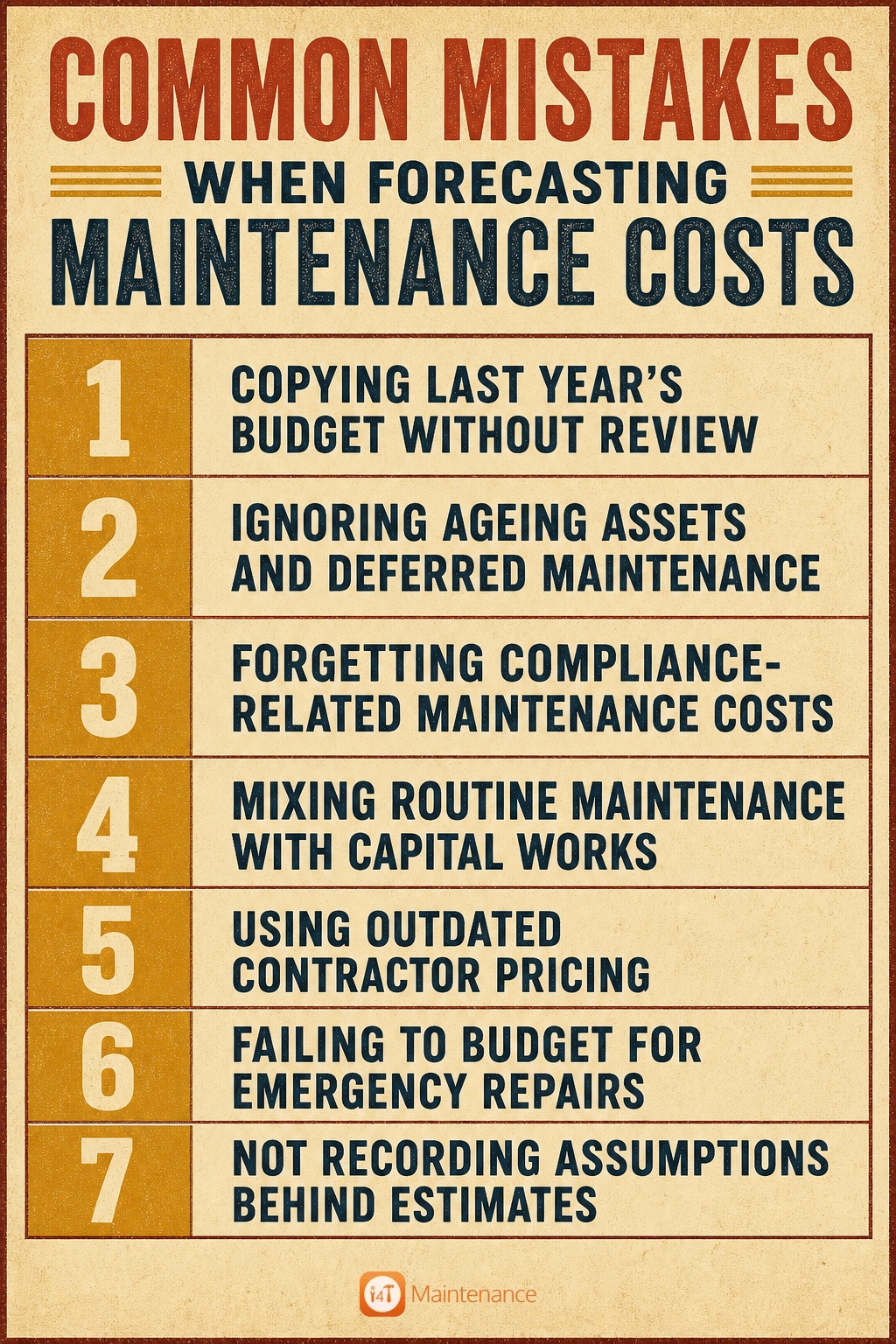
Many strata managers fall into common pitfalls when forecasting maintenance costs. Copying the previous year’s budget without adjustment overlooks ageing assets and changing conditions. Ignoring compliance-related expenditures risks legal and safety breaches. Mixing routine maintenance with capital works creates confusion and inaccurate forecasts, as these matters have different funding sources and planning horizons. Relying on outdated contractor rates can underestimate expenses, while failing to allow contingency for emergencies means sudden repairs derail budgets. Lastly, not documenting assumptions makes it harder to explain costs or revise forecasts effectively in future years.
- Copying last year’s budget without review
- Ignoring ageing assets and deferred maintenance
- Forgetting compliance-related maintenance costs
- Mixing routine maintenance with capital works
- Using outdated contractor pricing
- Failing to budget for emergency repairs
- Not recording assumptions behind estimates
How Often Should Strata Managers Review Maintenance Forecasts?
Maintenance forecasts should ideally be reviewed annually to ensure they remain accurate and relevant. Significant events such as major repairs, discovery of new defects, changes in compliance requirements, insurance claims, contractor rate adjustments, or noticeable asset deterioration should trigger updates. Strata managers must also revisit long-term capital works and sinking fund assumptions regularly to keep plans aligned with actual property conditions and market realities. Frequent reviews help maintain budget accuracy and build confidence among owners committees.
How to Explain Maintenance Forecasts to Owners Committees
Effectively presenting maintenance forecasts to owners committees involves clarity and transparency. Breaking down costs by category helps highlight where money is being spent and why. Separating urgent compliance items from future improvements ensures committees understand priority areas versus discretionary projects. Using photos, inspection reports, and quotes as evidence adds credibility. Explaining the risks of deferring maintenance—including escalating costs or safety hazards—helps justify budgets. Finally, showing the maintaining cost per lot aids owners to see their individual financial responsibility, making levy discussions smoother.
Example Annual Maintenance Forecast for a Residential Strata Property
Imagine a medium-sized residential strata building with 30 lots and common areas including gardens, a swimming pool, lifts, and car parks. A typical maintenance forecast might estimate annual costs as follows: cleaning and gardening $15,000, waste and common lighting $5,000, lift servicing and repair $7,000, fire safety compliance $4,000, plumbing and electrical repairs $6,000, painting and general repairs $10,000, plus a capital works allocation of $8,000 and a contingency of $3,000. This brings the total forecast to $58,000 per year. Of course, actual costs vary widely with location, building age, asset condition, contractor pricing, and site complexity.
How i4T Maintenance Management Software Helps Strata Managers Control Maintenance Costs
i4T Maintenance Management Software transforms how strata managers handle residential property maintenance, shifting from reactive fixes to strategic planning. The platform offers maintenance request tracking that keeps jobs organised, contractor management tools to streamline communications and pricing, recurring task management to schedule preventative maintenance reliably, and detailed asset records to monitor condition and lifecycle. Access to service history and cost tracking provides better visibility over budgets, enabling faster reporting and clearer committee updates. i4T Maintenance empowers strata managers to plan confidently, avoid surprises, and manage ongoing residential property maintenance costs more efficiently.
Frequently Asked Questions
A maintenance calculator is a tool that helps strata managers estimate annual maintenance costs by analysing asset data, service requirements, contractor rates, and risk factors for residential properties.
They combine recurring maintenance, expected repairs, compliance servicing, capital works, and contingency amounts, often using an asset register and historical data to build a clear forecast.
Residential property maintenance includes cleaning, gardening, lighting, plumbing, electrical, lifts, fire safety, painting, pest control, and repairs of common areas and shared assets.
Routine maintenance covers regular upkeep such as cleaning and servicing, while capital works involve major replacements or upgrades like roof renewals or lift overhauls.
Maintenance forecasts should be reviewed at least annually and updated after major repairs, compliance changes, or contractor price modifications.
It is a specific tool or software that helps strata managers predict the costs of maintaining residential properties by integrating asset conditions, maintenance schedules, and pricing data.
Costs rise due to ageing assets requiring more repairs, inflation impacting contractor rates and materials, and evolving compliance standards demanding more frequent servicing.