

Strata managers across Australia face immense pressure juggling maintenance demands, resident expectations, contractor schedules, and compliance requirements daily. The shift towards digital solutions promises to ease these burdens, but what does that really look like in practice? This article explores the practical differences strata managers experience before and after adopting FSM software, focusing on the FSM benefits in property management. By comparing day-to-day challenges and improvements, we’ll highlight how digital maintenance transformation is changing the game for strata operations — from handling requests and tracking work orders to improving reporting and overall efficiency.
The Reality of Strata Property Management Without FSM Software
Managing strata properties without FSM software often means relying on a patchwork of manual processes. Many strata managers juggle spreadsheets, email chains, phone calls, and paper notes to coordinate maintenance tasks. Resident maintenance requests might be logged in an inbox or physical forms, leaving plenty of opportunity for items to be missed or delayed.
Contractor coordination becomes particularly challenging when work orders are sent out without a centralised tracking system. Follow-ups rely heavily on phone calls and emails, increasing the risk of miscommunication. Keeping maintenance compliance records up to date is often a manual task, which can lead to errors or incomplete documentation — a significant risk for regulatory audits.
Additionally, reporting to committees and owners can be time-consuming and error-prone, as data needs to be compiled manually from various sources. The lack of visibility over property operations creates a barrier to effective planning, preventative maintenance, and budgeting.
Common Inefficiencies and Risks in Manual Strata Maintenance Management
Without automation, strata managers often deal with reactive maintenance rather than proactive planning. Work orders might only get issued when something breaks, leading to rushed repairs and increased costs. Manual processes slow down service response times, frustrating residents and potentially escalating minor issues into major repairs.
Disconnected tools and systems spreadsheets here, email there create delays and lose vital maintenance history. This fragmentation makes contractor performance hard to monitor and accountability unclear.
Compliance risks also rise when records are incomplete or stored in multiple formats. Missing or inaccurate maintenance reporting complicates audits and can expose strata corporations to fines.
Overall, manual strata maintenance management strains resources, reduces strata workflow efficiency, and impacts resident satisfaction.
How FSM Software Transforms Strata Property Management
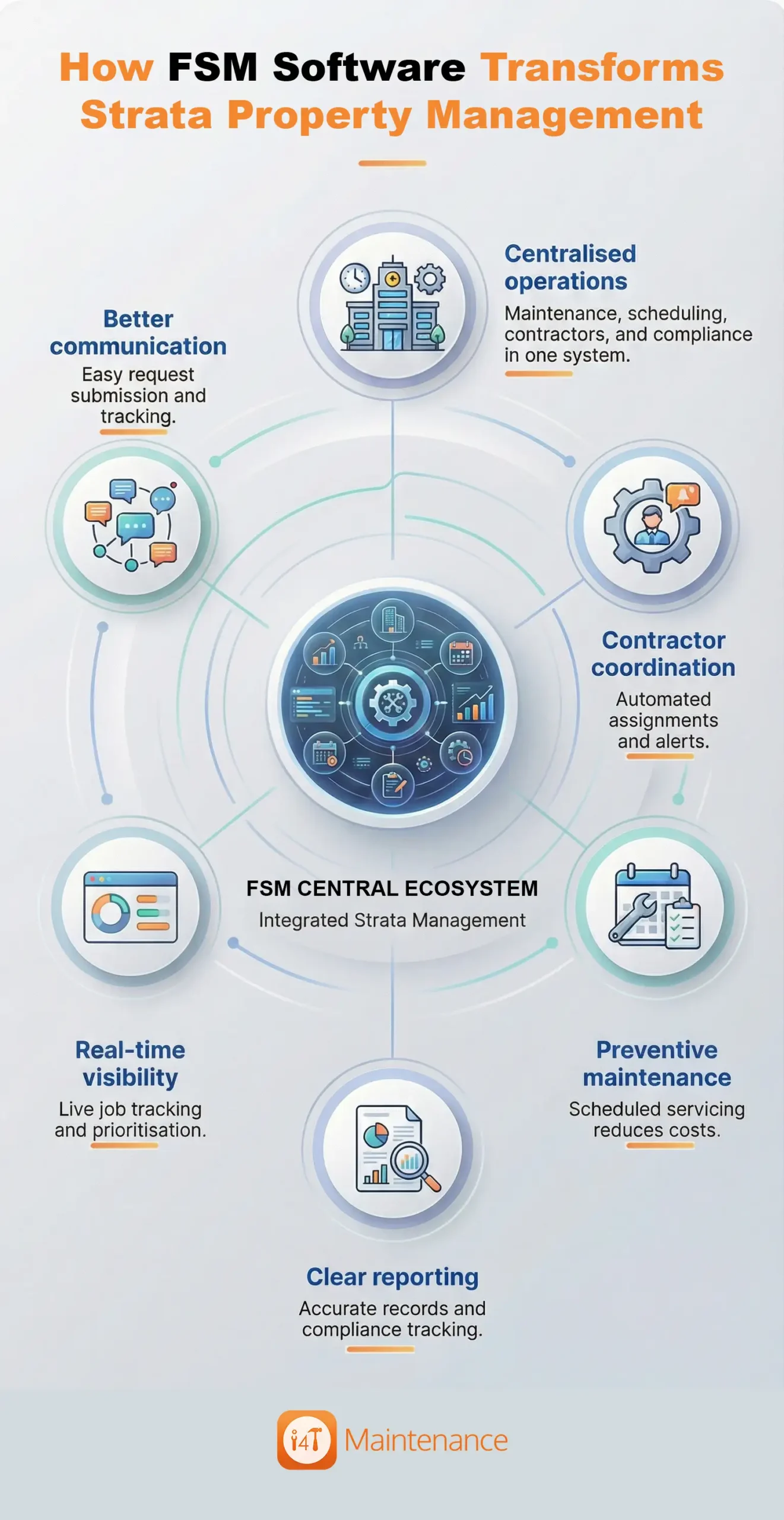
Introducing FSM software leads to a digital maintenance transformation that touches every part of strata operations. At its core, FSM software centralises maintenance requests, work orders, scheduling, contractor coordination, and compliance management within a single platform.
Communication with residents becomes streamlined through integrated portals or apps allowing easy submission and tracking of maintenance requests. Managers get real-time visibility of active jobs, enabling them to prioritise tasks based on urgency and resources.
Contractor coordination improves drastically. FSM software automates work order assignments, sends alerts, and tracks job status in real-time. Managers can monitor contractor performance and respond swiftly to delays or issues.
Preventive maintenance scheduling becomes simpler and more effective, reducing reactive maintenance costs. Automated reminders and task assignments ensure regular inspections and servicing are never missed.
Reporting is fast and accurate, with digital logs of all maintenance activities, compliance records, and financial data. This transparency builds committee and owner confidence while easing audit processes.
FSM Benefits in Property Management: A Side-by-Side Comparison
The differences between managing strata maintenance before and after FSM software adoption are striking. Before FSM software, typical workflows involve chasing paperwork, risking lost requests, and struggling to keep everyone informed. After FSM, everything is logged digitally, visible at a glance, and tracked throughout the maintenance lifecycle.
Service response times are often halved, while resident satisfaction improves thanks to consistent updates and faster resolutions. Admin workload lightens as many manual tasks are automated, freeing managers to focus on strategic planning.
Preventive maintenance shifts from an overlooked schedule to a well-managed plan, extending the lifespan of property assets and lowering emergency repair costs. Compliance documentation is generated automatically, reducing regulatory risks and easing reporting obligations.
Contractor coordination becomes simpler and more measurable, improving quality and accountability. Overall, strata workflow efficiency increases, and property operations visibility rises, enabling more informed decision-making.
The Financial and Operational Impact of Moving from Manual to FSM Software
Adopting FSM software involves upfront investment, but the operational savings and improved service delivery quickly justify the cost. With automated maintenance workflows, strata managers reduce time spent on paperwork and chasing updates, translating into labour cost savings.
Fewer emergency repairs and better asset care mean long-term cost reductions, while improved contractor management limits overspending and fraud. Digital compliance tracking prevents costly fines or legal issues.
Furthermore, happier residents and committees contribute to a better community atmosphere and fewer complaints, indirectly supporting property values. The improved operational visibility also helps in accurate budgeting and financial forecasting.
This digital maintenance transformation turns maintenance from a reactive burden into a proactive strategic function, enhancing the overall value and reputation of strata properties.
Signs Your Strata Portfolio Has Outgrown Manual Maintenance Processes
If your maintenance workload feels overwhelming, with frequent missed tasks or last-minute fire-fighting, it might be time to consider FSM software. Other common red flags include losing track of resident requests, inconsistent contractor follow-ups, and difficulty producing reliable reports for committees.
When spreadsheets and paper logs no longer provide the clear overview you need, or compliance records are scattered and incomplete, manual processes are likely holding your team back.
If you’re struggling with slow service response times or escalating maintenance costs driven by emergency repairs, a digital maintenance transformation can bring much-needed control.
For strata managers juggling multiple sites or large portfolios, FSM software offers the visibility and operational insight essential for scaling efficiently.
Choosing the Right FSM Software: What Strata Managers Should Look For
Not all FSM software is the same, so consider your strata operation’s specific needs. Look for solutions that offer intuitive interfaces to minimise training time and support both managers and residents in submitting and tracking requests easily.
Features such as maintenance workflow automation, preventive maintenance scheduling, real-time work order tracking, and contractor coordination tools are key.
Strong reporting capabilities that compile maintenance compliance records and financial data will simplify your governance responsibilities.
Integration options with other strata management systems and mobile accessibility improve usability and flexibility.
Lastly, consider provider support and local relevance to Australian strata regulations and standards to ensure smooth implementation and ongoing compliance.
A Realistic Before-and-After Example: Managing a Major Repair
Imagine a burst water pipe in a common area. Without FSM software, a resident rings the strata office, leaving an urgent message that gets recorded on a note. The manager has to manually contact contractors, send emails, and track responses, all while juggling other tasks. Updates to residents and the committee happen sporadically, with no clear records of timelines or costs. The repair might take longer due to communication delays, and the paperwork piles up after the fact for reporting.
With FSM software in place, the resident lodges a maintenance request via an app immediately logged in the system. The software automatically notifies available contractors, assigns the job, and tracks progress in real time. The manager receives instant updates and can proactively inform stakeholders with a few clicks. Compliance and cost details are recorded during the process, and final reports generate automatically post-repair.
This scenario highlights how FSM software enhances service response times, reduces management workload, improves documentation accuracy, and boosts resident satisfaction.
Overcoming Common Objections to FSM Software Adoption
Cost is often the first concern, but remember the long-term savings from improved efficiency, fewer emergency repairs, and better contractor management. The investment pays off in less downtime and lower overall maintenance spend.
Some managers worry about the learning curve. However, user-friendly FSM software with local support eases onboarding for both staff and residents.
There can also be scepticism about change disruptions. Implementing FSM software incrementally, with good training and clear communication, minimises risk.
Remember, the risk lies in staying with outdated manual processes that cause stress, errors, and missed maintenance shifting to FSM software is a practical step forward.
Frequently Asked Questions
FSM software, or Field Service Management software, is a digital tool that streamlines maintenance workflows by centralising requests, work orders, scheduling, contractor coordination, and reporting specifically tailored for strata properties.
FSM benefits in property management include faster service response times, easier contractor management, automated preventive maintenance, improved compliance tracking, and less manual paperwork, all of which ease daily operational pressures.
Digital maintenance transformation means shifting from manual, fragmented workflows to a cohesive, automated system that offers real-time visibility, efficient communication, and proactive maintenance scheduling, dramatically improving operational control.
Most modern FSM software features easy-to-use resident portals or apps that simplify submitting and tracking maintenance requests, improving communication without adding complexity for residents.
Yes, FSM software automatically keeps detailed maintenance compliance records and generates reports that simplify audits and committee reporting, reducing admin time and the risk of errors.
When manual processes lead to missed maintenance, slow response times, scattered records, or rising costs, it’s a clear sign that an FSM software solution can bring efficiency and control.
Absolutely; by enabling preventive maintenance scheduling and automated reminders, FSM software shifts strata management from reactive fixes to proactive care, saving money and extending asset life.