

TL;DR
If you want the most practical approach, think in three moves: qualify once, verify automatically, allocate fast.
When vendors are pre-approved (by trade and risk level), and compliance stays current through expiry tracking, your team isn’t scrambling at the exact moment an urgent job lands. Instead, when the work order is raised, you already know who is safe to allocate to, and the system can help enforce it.
Do these three things:
- Pre-qualify vendors by trade and risk level (once)
- Track supplier compliance (expiry + documents) in one place
- Use allocation rules so only compliant vendors can be assigned
That’s the shortest path to cutting risk and staying fast.
Strata maintenance lives in the real world, not in a perfect process map.
Jobs come in fast, residents want updates now, committees want certainty, and urgent issues don’t wait for a tidy paper trail.
That’s why vendor risk often creeps in: not because strata managers don’t care about compliance, but because speed pressures you to “just get someone onsite.”
The problem is that vendor risk rarely announces itself upfront. It shows up later as a safety incident, a complaint, a disputed invoice, a defect that returns two weeks later, or a committee question you can’t answer confidently because the evidence is scattered across emails and screenshots.
The good news is you can absolutely reduce vendor risk in strata without slowing work orders. The trick is to stop treating supplier compliance as a manual step you repeat for every job, and start treating it as a baseline condition that’s maintained in the background, so work orders can move quickly inside guardrails.
What vendor risk looks like in strata
In strata, vendor risk usually comes from gaps between what you thought you were buying and what you actually got. Sometimes it’s compliance-related. Other times it’s operational. And often it’s financial.
This matters because strata is uniquely exposed: you’re coordinating shared assets, lots of stakeholders, and high expectations, often with limited time and inconsistent information. When something goes wrong, it can become a portfolio-level problem fast.
There are way too many things that can go wrong and expose you to vendor risk.
- Insurance gaps and expired certificates
- Incorrect or expired trade licensing/qualifications
- Missing SWMS where required
- Scope creep and unapproved variations
- Poor quality leading to repeat work
- Resident friction due to communication, access, and behaviour
- Weak paper trail (no photos, no timestamps, unclear approvals)
If you recognise even two of these, you’re not behind, you’re normal. The point of this article is to make them systematically less likely.
Why do compliance checks slow down work orders
Compliance itself isn’t what slows work down; manual compliance does. The delay happens when your team has to “go hunting” for proof right when you need to allocate. That’s when you’re searching inboxes, texting vendors for certificates, and trying to remember whether someone’s licence was current last time.
In other words, the problem isn’t that compliance exists. It’s that the process is timed badly and stored badly.
When compliance is stored centrally, attached to vendors, and tracked with expiry dates, the “check” becomes a yes/no status at allocation time. That removes the bottleneck without removing the protection.
What typically creates the slowdown:
- Compliance docs scattered across emails/folders
- Re-requesting the same docs repeatedly
- Discovering gaps only when allocating urgent work
- No clear minimum standard by trade/job type
Fixing those is how you keep speed without gambling.
Step 1: Set a supplier compliance standard once
The quickest way to reduce risk without slowing down is to define what “compliant” means for your portfolio, and make it consistent. That doesn’t mean creating bureaucracy. It means deciding what you’ll accept as minimum evidence for each trade and risk level, so your team isn’t making judgment calls under pressure.
In practice, most strata portfolios don’t need complicated standards. They need a simple baseline that vendors understand and that your team can enforce without debate.
Typical supplier compliance requirements include:
- Current insurance
- Relevant trade licences/qualifications
- WHS capability and SWMS for higher-risk work
- Agreement to site rules like access, noise windows, and resident comms
- Clear expectations for quotes, variations, and invoicing
Once this exists, you stop starting over with every vendor and every job.
Step 2: Tier your vendors so low-risk jobs stay fast
One reason compliance feels slow is that teams apply the same seriousness to every job. But a $220 tap repair shouldn’t trigger the same workflow as high-risk work at height or major remediation.
That’s why vendor tiers work so well. They let you keep everyday jobs moving quickly while tightening controls where risk truly spikes.
A simple tier model also makes it easier to explain decisions to committees: you’re not being picky, you’re being proportionate.
A practical 3-tier approach:
- Tier 1: low-risk, low-value work such as routine repairs
- Tier 2: licensed trades / moderate risk, such as plumbing, electrical, HVAC
- Tier 3: high-risk or major works such as heights, hot works, and large projects
This is one of the cleanest ways to reduce vendor risk in strata without drowning in admin.
Step 3: Track supplier compliance automatically
Even the best standard won’t help if it relies on human memory. Portfolios move too fast, vendors change, and certificates expire at inconvenient times. If your system doesn’t remind you, you’ll discover expiry at the worst moment, when you need someone on-site.
What you want is a world where compliance stays current by default. That means expiry dates are recorded, reminders go out, and vendors can’t quietly slip into non-compliance while still being used.
Good compliance tracking gives you:
- A visible compliant / not-compliant status
- Expiry tracking and reminders
- A single place for docs and versions
- An audit trail, in case anyone asks later
At that point, compliance stops being a task and becomes a condition of assignment.
Step 4: Use rules-based allocation to keep work orders moving
Strata teams often think rules mean less flexibility. In reality, rules reduce the number of decisions you have to remake repeatedly, and prevent risky exceptions from becoming normal.
The most effective rules are simple: they protect you from the obvious failures while still letting you move quickly. The aim is not to micromanage vendors; it’s to make sure the wrong vendor can’t be allocated to the wrong work under time pressure.
Examples of allocation rules that work:
- Only compliant vendors can be assigned
- Certain job types require specific docs before attendance
- Spend thresholds trigger quote/approval requirements
- Variations must be approved before proceeding (where practical)
When this is in place, your team allocates faster because the safe options are already filtered.
Step 5: Make emergencies fast-but-safe
Emergencies are where vendor risk explodes, because urgency encourages shortcuts. Instead of pretending emergencies can follow the same workflow, build a separate path that prioritises immediate harm reduction while still keeping you protected.
In an emergency, you’re not trying to perfect the paperwork; you’re trying to make the site safe and stop damage. But once the situation is stabilised, you need a structured follow-up so the job doesn’t drift into expensive, undocumented work.
Some emergency lane basics to remember:
- Pre-approved emergency vendors who are always compliant
- Immediate allocation and attendance expectations
- Post-job reconciliation within 24-48 hours (docs, scope, approvals)
This approach keeps response times sharp while still reducing vendor risk in strata when it matters most.
Step 6: Keep scope and variation clear
A huge chunk of vendor risk is financial, not technical. Even good vendors can create headaches when the scope is vague, and variations are handled informally.
What committees hate most isn’t spending money; it’s not understanding why costs changed. You protect trust by making scope and approvals visible early, and handling changes consistently.
You don’t need to slow work orders to do this. You just need a lightweight rule: changes get agreed before they become invoices, except when safety demands immediate action.
Simple controls that prevent invoice pain:
- Clear job scope notes
- Quote thresholds that match job type
- Variation requests with reason + price impact
- Approval before continuing
Do this well, and you’ll reduce disputes, reduce committee friction, and reduce repeat explanations.
Step 7: Strengthen the paper trail
The best risk control isn’t another form; it’s evidence captured as part of completing the job. A reliable paper trail doesn’t need long notes. It needs consistent proof.
Photos, timestamps, and short completion notes protect you when something is questioned later. They also make vendor performance measurable, so you can make better supplier decisions over time.
Minimum evidence that pays off:
- Before/after photos
- Completion note
- Timestamps for milestones
- Quote/invoice attachments
This is how you defend decisions without relying on memory.
Step 8: Track a few KPIs that reveal vendor risk early
You don’t need a complicated scorecard. You need signals that tell you when risk is rising. When you measure the right things, you spot issues before they become repetitive work, disputes, or safety problems.
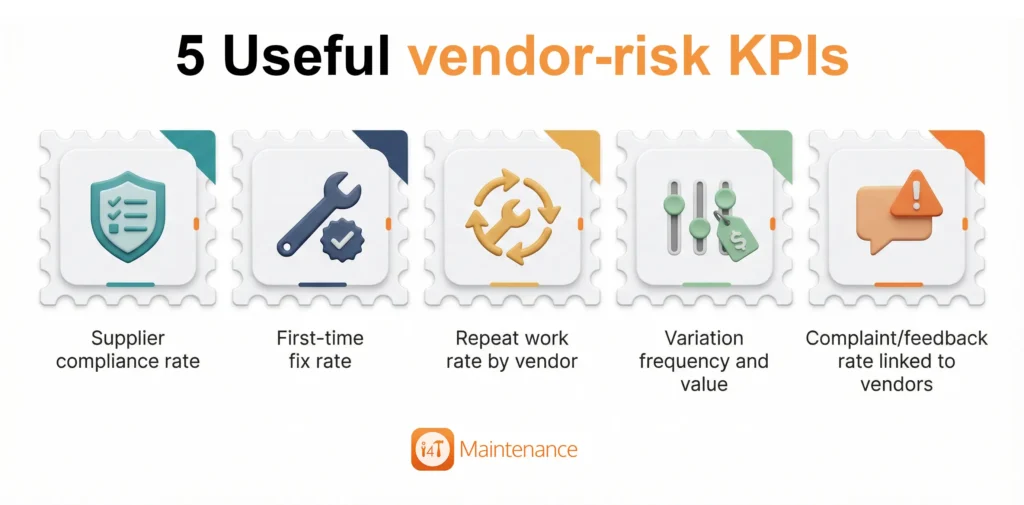
Useful vendor-risk KPIs:
- Supplier compliance rate
- First-time fix rate
- Repeat work rate by vendor
- Variation frequency and value
- Complaint/feedback rate linked to vendors
Once you see patterns, you can improve outcomes without adding workload.
Cut vendor risk by making compliance the default
You don’t have to choose between fast work orders and safe vendor management. You only have to stop doing compliance manually at the moment of allocation.
When you pre-qualify suppliers, maintain supplier compliance in the background, and allocate work using sensible rules, you reduce vendor risk without slowing response times. Your portfolio becomes calmer: fewer disputes, fewer repeat jobs, fewer committee escalations, and better resident trust.
Reduce vendor risk in strata with i4T Maintenance
i4T Maintenance helps strata teams reduce vendor risk in strata without adding admin by bringing supplier compliance and work order allocation into one workflow. You can track compliance status and expiries, enforce compliant-only allocation, keep a clean audit trail, and measure vendor performance across quality, speed, and compliance, so work orders keep moving, safely.
FAQs
Vendor risk is the chance that a supplier causes compliance, safety, quality, or cost issues that impact the owners corporation and residents.
Pre-qualify vendors once, track supplier compliance with expiry visibility, and only allocate work to compliant vendors using simple rules.
Supplier compliance usually includes current insurance, relevant licences/qualifications, and WHS requirements appropriate to the work.
Emergencies increase vendor risk because work is allocated faster, so having a compliant emergency vendor list and a post-job check is critical.
Use a system where compliance status is visible and enforced at allocation, so non-compliant vendors can’t be selected until they’re compliant.