

TL;DR
To build a 12-month maintenance calendar for a strata scheme:
- List your common property assets
- Assign each one a service frequency (monthly/quarterly/annual)
- Group tasks by season
- Lock them into a month-by-month plan with lead times for quotes, access and approvals.
That calendar becomes your working annual strata plan, and you can reuse it each year as a 12-month maintenance schedule template.
If strata maintenance feels like you’re always “on the back foot”, it’s usually not because you’re disorganised. It’s because the building is running on memory, emails, and whoever complained most recently.
A solid maintenance calendar changes that. It turns maintenance from reactive to predictable. It gives committees confidence, helps contractors plan ahead, and stops those annoying (and expensive) “why didn’t we know about this sooner?” moments.
This guide walks you through a practical way to build a 12-month calendar that works in the real world of strata: multiple stakeholders, approvals, budgets, access issues, and the occasional emergency that blows up the week.
Why a maintenance calendar works
Most strata schemes aren’t failing because nothing gets done. They’re failing because maintenance is happening in bursts: a few urgent jobs, a couple of big-ticket surprises, then long gaps where nothing is planned until something breaks.
A calendar fixes three common pain points:
- Predictability for owners and committees
When there’s a visible plan, decisions feel less like spending money, and more like following the plan everyone agreed on. - Fewer emergencies
Preventive servicing and seasonal checks reduce the likelihood of after-hours callouts, water ingress surprises, and sudden complaints. - Smoother supplier management
Trades are easier to book when you’re scheduling ahead, not pleading for same-week availability.
A good calendar doesn’t eliminate reactive work, but it dramatically reduces the amount of avoidable chaos.
Step 1: Build your asset list
A calendar isn’t a list of chores. It’s a schedule for maintaining assets. If you don’t know what you’re maintaining, you’ll default to whatever gets the most noise.
Start by writing down your common property assets and systems. In most strata schemes, this includes things like:
- lifts
- fire safety systems and equipment
- access control, intercoms, garage doors and gates
- pumps
- roofing, gutters, downpipes, waterproofing zones
- HVAC / ventilation systems (common areas, basement ventilation)
- lighting
- pools, spas, gyms
- gardens and irrigation
- common area finishes
You don’t need a perfect asset register on day one. What you need is an “asset register lite” that’s good enough to drive planning.
You can pull the information from the last 12–24 months of invoices and work orders, compliance certificates and reports, and warranties, manuals, and installer recommendations. A quick walkthrough of the property with someone who knows the building can also help.
Capture just enough detail to be useful. This includes asset/area name and location, preferred contractor or trade type, service frequency, last service date, and compliance evidence required.
This step matters because it’s the difference between a calendar that’s a living tool and a calendar that’s a generic checklist nobody follows.
Step 2: Sort tasks into three main buckets
The fastest way to build a calendar that gets ignored is to shove everything into it at the same level of importance.
Instead, sort tasks into three buckets. This keeps your plan realistic and makes prioritisation obvious.
1. Statutory and compliance tasks
These are the tasks that have clear requirements and deadlines. They’re not optional, and they shouldn’t be “scheduled when we get around to it.” Your calendar should protect these items first, because the risk of missing them is higher, such as safety, liability, insurance, and governance.
2. Preventive maintenance
This is where most savings live. These tasks reduce breakdowns, extend asset life, and make budgeting less spiky. Preventive work is also the easiest category to schedule in advance because it’s recurring and predictable.
3. Seasonal and condition-based tasks
This bucket includes things like gutter checks before heavy rain seasons, external cleaning when conditions suit, garden and irrigation adjustments, waterproofing spot checks, and building fabric inspections.
A good annual strata plan normally prioritises the first bucket, stabilises the second, and then uses the third bucket to stop weather and wear-and-tear from turning into nasty surprises.
Step 3: Assign frequencies and lead times
Scheduling the “work month” is only half the job. Strata maintenance often needs a run-up: quotes, approvals, access coordination, notices to residents, and sometimes multiple contractor visits.
So when you assign a task to a month, also assign the lead time that makes it achievable.
Common frequencies
Some tasks are monthly, some quarterly, some annual. The “right” frequency depends on asset type, manufacturer guidance, building usage, and local conditions.
Rather than overthinking it, start with sensible defaults and improve over time.
Simple lead time rules that work in real strata:
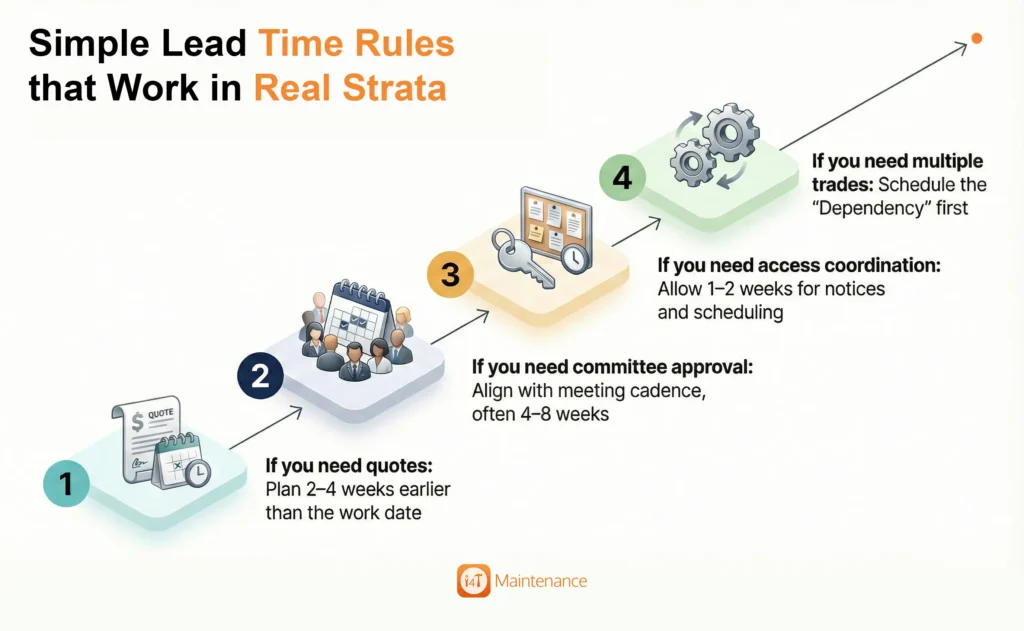
- If you need quotes: plan 2–4 weeks earlier than the work date
- If you need committee approval: align with meeting cadence, often 4–8 weeks
- If you need access coordination: allow 1–2 weeks for notices and scheduling
- If you need multiple trades: schedule the “dependency” first
There is a small habit that makes a huge difference. For bigger jobs, schedule two entries: ‘quote month’ and ‘do month’. Quote month is when you scope, obtain quotes, and compare options. ‘Do’ month is when you execute the work.
That alone makes your maintenance calendar feel dramatically more achievable.
Step 4: Build the month-by-month framework
Now you’re ready to actually build the calendar. A simple, strata-friendly month structure covers compliance tasks due, preventive tasks scheduled, seasonal checks, and buffer space.
If you try to plan every possible reactive scenario, you’ll drown in detail. But if you leave zero slack, your calendar will fall over the first time a pipe bursts or a gate motor dies.
A realistic calendar assumes some reactive work and keeps a little breathing room.
The 12-month maintenance calendar
Below is a practical month-by-month structure you can adapt. The point isn’t that every scheme must do the same tasks in the same months. The point is to create a rhythm that owners, committees, and suppliers can rely on.
1. January: set the year up properly
January can be tricky: holidays, reduced availability, and buildings running hot in summer.
Use it to lock in the plan, confirm recurring bookings, and do the quick checks that prevent summer issues from escalating.
Keep it light and focused:
- Confirm recurring service dates for the quarter
- Check common-area ventilation and overheating risks
- Get a quick “visible leaks and drainage” scan after storms
2. February: small problems become big problems if you ignore them now
This is a great month for a tidy-up style maintenance run: minor defects, access control issues, door closers, lighting failures, loose fixtures, and anything that’s annoying residents but hasn’t become urgent yet.
Good February habits:
- Review the last 60 days of work orders and tag repeat issues
- Schedule minor repairs as a bundled job
- Confirm any compliance documentation that’s due soon
3. March: the first quarterly servicing block
March is a natural time to run a “quarterly block” for preventive servicing and safety checks, particularly as seasons start shifting.
Aim for a clean quarterly rhythm:
- Schedule recurring quarterly services
- Inspect gutters and roof drainage readiness
- Check external lighting and signage before the darker months
4. April: water management and building fabric attention
Autumn is a smart time to focus on water pathways: gutters, downpipes, stormwater drains, basement seepage points, and known waterproofing risk areas.
Keep it practical:
- Inspect roof penetrations and obvious waterproofing weak points
- Check drainage grates and pits
- Review any “mould/damp” complaint patterns from summer
5. May: prepare for winter performance
May is about reducing winter pain: leaks, heating issues, slippery surfaces, and lighting.
Useful May checks:
- common area lighting performance and replacements
- door seals and drafts in shared corridors
- slip hazards at entries, stairs and ramps
6. June: winter readiness and leak vigilance
June is the month when “minor water entry” becomes “major damage” if left alone. If your scheme sees heavy rain in winter, this is your early warning window.
Keep the approach simple:
- Prioritise leak reports and investigate quickly
- Check basement ventilation/drainage systems
- Review contractor response times and adjust if winter load increases
7. July: mid-year review
By July, you have enough data to see whether the calendar is realistic.
This is where you turn your annual strata plan from “a plan we wrote” into “a plan we actually run.”
Mid-year review items:
- budget vs actuals
- overdue preventive tasks
- recurring issues
8. August: plan spring work now
August is perfect for lining up bigger spring jobs because you can scope and quote now, then execute when conditions suit.
Common August focus areas:
- external works that benefit from better weather
- façade and painting touch-ups
- landscaping and irrigation planning
9. September: spring maintenance momentum
September is where you want execution to start feeling smooth: booked ahead, minimal delays, fewer “we’ll come back next week” problems.
Try bundling tasks:
- external clean-ups and minor repairs
- garden and irrigation adjustments
- common area cosmetic improvements
10. October: storm prep and risk reduction
In many regions, October is a sensible month to prepare for storm season and the “sudden heavy rain” events that expose drainage and roof issues.
Simple October wins:
- Get the roof and gutter checked
- Ensure stormwater pathways are clear
- Confirm emergency contact and contractor escalation process
11. November: compliance close-out and contractor scheduling for next year
November is the month to prevent December chaos. It’s about getting certificates, finalising reports, and booking ahead.
November to-dos:
- Chase outstanding compliance documentation
- Confirm contractor availability for early next year
- Begin drafting next year’s maintenance calendar using this year’s learnings
12. December: close the loop and set up next year
December shouldn’t be a mad rush to “finish everything. It should be a tidy close-out and a handover into the next calendar cycle.
December works best when it’s reflective:
- Final reporting and committee summary
- Review what slipped and why
- Create a draft 12-month maintenance schedule template for the next year so January isn’t starting from scratch
Step 5: Tie the calendar to budgets and meetings
A calendar becomes an annual strata plan when it connects to the way decisions and money actually move in strata.
Here’s how to make it real:
Align tasks to the right funding bucket
Not every job comes from the same pool of money. Preventive servicing is typically predictable and can be budgeted as operational spend. Major replacements and lifecycle upgrades may sit in longer-term capital works planning (depending on scheme structure and practices).
Even if your scheme doesn’t formally separate them, you can still tag each calendar item as routine/recurring, minor repairs, or major works.
Match the calendar to the committee meeting cadence
If the committee meets monthly, you can run a tighter approval loop. If meetings are less frequent, your calendar needs to build in the time lag.
A simple approach:
- Schedule “quote month” items to land before a committee meeting
- Schedule “do month” items after approval windows
Add reporting checkpoints
Committees don’t need daily updates. They do need confidence that the plan is progressing.
A good rhythm includes monthly task status on what’s completed, scheduled, and overdue, quarterly review of costs, vendor performance, and recurring problems, and an annual wrap-up of what improved and what needs next year’s focus.
That reporting layer is what turns your calendar from an internal tool into a governance tool.
Step 6: Make the calendar operational
A calendar fails when it lives as a nice document nobody executes.
To make it operational, each calendar item needs to become a real action: a work order, a booking, a record, and a closed loop.
Convert calendar items into work orders
Instead of telling someone to remind you to service the pumps quarterly, you want:
- a recurring work order that triggers automatically
- clear scope notes
- supplier allocation
- due date and lead time reminders
- documentation requirements for photos, certificates, reports
Assign suppliers and standardise expectations
When suppliers don’t know what “done” looks like, you get vague invoices and incomplete jobs.
For recurring tasks, standardise:
- What’s included in the service
- What evidence is required
- What’s the expected turnaround times
- What are the communication expectations
Track overdue items
A calendar only works if you can see what slipped and why. The basic questions you should always be able to answer:
- What’s due this month?
- What’s overdue?
- What’s blocked
- What’s been completed, and where’s the evidence?
If you can answer those quickly, your maintenance system is healthy.
Common pitfalls
Most strata maintenance calendars fail for predictable reasons. The good news is they’re easy to prevent.
The calendar is too detailed
If you try to schedule every tiny task with perfect precision, you create admin overhead that’s worse than the maintenance itself.
Keep it actionable. If it can’t become a work order, it’s probably too detailed.
No lead times are built in
If everything is scheduled in the same month it’s meant to happen, you’ll constantly be late.
Use “quote month + do month” for anything that needs approvals or multiple quotes.
The calendar isn’t updated after reactive work
Reactive work changes asset condition and timelines.
Do a quick monthly review to adjust future tasks based on what happened.
Compliance documentation isn’t captured properly
Even when the work is done, missing evidence creates risk.
Add the evidence required to the task and make it part of the close-out, not an afterthought.
Your maintenance calendar is the backbone of calm strata management
A strong maintenance calendar doesn’t mean you’ll never get an emergency call again. But it does mean you’ll stop living in constant reaction mode.
When you build your calendar around assets, prioritise compliance, schedule preventive servicing in a quarterly rhythm, and bake in lead times for quotes and approvals, you end up with a plan that’s actually executable. That’s what turns a calendar into one of those rare things in strata: a reliable annual strata plan that owners can understand and committees can stand behind.
If you’d like to run your 12-month plan without chasing emails, spreadsheets, and missing certificates, i4T Maintenance helps strata managers set up recurring work orders, allocate suppliers, track progress, store compliance documentation, and report clearly to committees and owners, so your calendar becomes a system, not just a document.
FAQs
A strata maintenance calendar should include compliance tasks, preventive servicing, seasonal inspections, and recurring common property maintenance, each linked to an asset and a month.
To turn a calendar into an annual strata plan, add budget expectations, approval steps, meeting timing, supplier allocation, and reporting checkpoints so the plan can be executed and tracked.
Review your 12-month maintenance schedule template monthly for overdue items and update it quarterly based on reactive work, contractor availability, and changing building risks.
Start with the last 12-24 months of invoices and work orders, then add compliance reports and a quick site walkthrough to create an “asset register lite” that’s enough to build your calendar.
Keep the calendar focused on compliance, safety and repeatable preventive tasks, use lead times, and avoid adding low-value tasks that won’t realistically become work orders.