
TL;DR
Most residential strata buildings tend to run with these servicing rhythms for essential services maintenance:
Fire systems are almost never just annual. Routine servicing commonly happens across multiple intervals, often monthly, 6-monthly, annual, plus longer-cycle major servicing, depending on which fire safety measures your building has and what its documentation requires.
Lifts are typically serviced monthly or quarterly, depending on usage, age, and the scope of the contract. Lifts are also treated as safety-critical plant equipment, so inspections and recordkeeping sit alongside routine servicing.
HVAC for common areas is typically managed with lighter checks more frequently, like filters, or obvious faults, and deeper servicing performed annually. But if mechanical systems are tied to smoke control or other safety measures, the servicing cadence is driven by your building’s essential safety requirements rather than comfort preferences.
That’s the typical pattern. Your building’s real answer starts with one thing: your building documentation.
If strata maintenance had a personality, it’d be that mate who’s totally fine, right up until they’re not.
Most buildings don’t fall apart because people don’t care. They fall apart because servicing happens irregularly, paperwork ends up scattered across inboxes, and the one person who knows the dates goes on leave. Then suddenly you’re dealing with lift downtime, fire defects, or HVAC complaints during the first proper heatwave of the year.
Here’s a practical guide to how often you should service fire, lifts, and HVAC in Australian residential strata, and how to turn it into a system you can run year-round as part of your essential services maintenance.
The one thing that decides frequency
Before anyone argues about whether something should be quarterly or 6-monthly, make sure you’ve got your source of truth sorted.
In Australia, servicing frequency for safety systems is usually anchored to building documentation and state-based compliance frameworks.
For example, NSW uses Annual Fire Safety Statements, and if a building has critical fire safety measures, supplementary statements can be required at intervals of under 12 months, depending on the schedule.
In Victoria, essential safety measures obligations are tied to ESM documentation and an annual reporting process.
Put simply: you’re not making up a maintenance frequency. You’re aligning your calendar to what the building is required to maintain, then layering in manufacturer and usage realities.
A good strata habit is to keep a neat compliance pack for each building: fire schedules/permits/ESM lists, current service contracts, and a clean asset register. Once you’ve got that, the rest gets much easier.
Fire systems: Why “annual” is rarely the full story
Fire is where committees and managers get caught out most often. not because they’re careless, but because fire maintenance is genuinely layered.
A residential building might have things like detection and alarms, extinguishers, hose reels, hydrants, emergency lights and exit signs, fire doors, and sometimes smoke control systems. The exact mix depends on the building design, age, and classification.
What’s important is that fire servicing usually doesn’t happen in one neat annual visit. Servicing programs aligned to Australian Standards-based routines involve tasks happening across different timeframes.
Here’s the easiest way to think about it as a strata manager: your fire programme usually has four layers that need to show up on your calendar, not just one.
- Routine checks: These are recurring, often monthly or similarly regular.
- Mid-cycle servicing: These are commonly 6-monthly for many measures.
- Annual compliance activity: This is the “big” annual rhythm that gets attention.
- Major servicing cycles: There are multi-year tasks that are easy to forget.
If your calendar only tracks the annual statement/report date, you’re more likely to miss the recurring visits and the longer-cycle tasks, and those are exactly the ones that become last-minute stress later.
The other big “gotcha” with fire is defects. Fire inspections are great at finding issues. But if the defects aren’t closed out fast, you’re left with compliance risk and a cranky committee wondering why this is suddenly urgent.
Lifts: Preventing “repeat breakdown” cycles
Lifts are basically your building’s mood ring. When they’re working, nobody mentions them. When they’re not, it’s all anyone talks about.
Most residential lift contracts include scheduled preventive maintenance. The most common rhythms you’ll see are monthly servicing in higher-use buildings and quarterly servicing in lower-use or newer setups. Which one is “right” depends on trips, age, and the building’s failure history.
But lifts also sit in a safety/plant category. SafeWork NSW, for example, notes that lifts and escalators are registrable plant and highlights inspection/maintenance recordkeeping.
So lift management is really two things at once: keeping uptime high, and keeping oversight and documentation tidy.
If you’re dealing with frequent lift complaints, it’s rarely helpful to just keep running the same schedule and hoping for the best. A very practical approach is to look at where failures cluster and adjust the servicing scope or frequency before it becomes a permanent callout loop.
Also, if your lift contractor is doing regular visits but you’re still getting breakdowns, it’s worth checking whether the contract is genuinely preventive maintenance, or more of a “we’ll show up and tick a box” arrangement. The frequency might be fine; the scope might not be
HVAC: Separating comfort maintenance from safety
Not all HVAC maintenance is the same job.
In many residential schemes, HVAC is mostly about comfort and ventilation in common areas: keeping lobbies, gyms, corridors, and plant rooms running nicely. In those cases, the most common and sensible approach is regular light checks plus annual deeper servicing, adjusted for environment and complaints.
But some mechanical systems that look like HVAC are actually part of life safety, for example, smoke control, pressurisation, or mechanical systems linked to smoke hazard management. When those appear in essential safety measures documentation, they’re no longer “nice to have”. They’re part of essential safety obligations.
This distinction is important because it changes how you schedule and how you document. Comfort HVAC can be optimised based on resident satisfaction and cost. Safety-linked mechanical systems need to be maintained to the building’s compliance requirements, with a clear proof trail.
A simple strata-friendly way to manage HVAC is to treat it as two buckets: comfort HVAC (resident amenity) and safety-linked mechanical systems (compliance).
Turning three systems into one calendar that actually works
The magic isn’t memorising intervals. The magic is getting to a place where you can open one calendar and say, “Here’s what’s due, here’s what’s overdue, here’s the evidence, and here are the defects we’re closing out.”
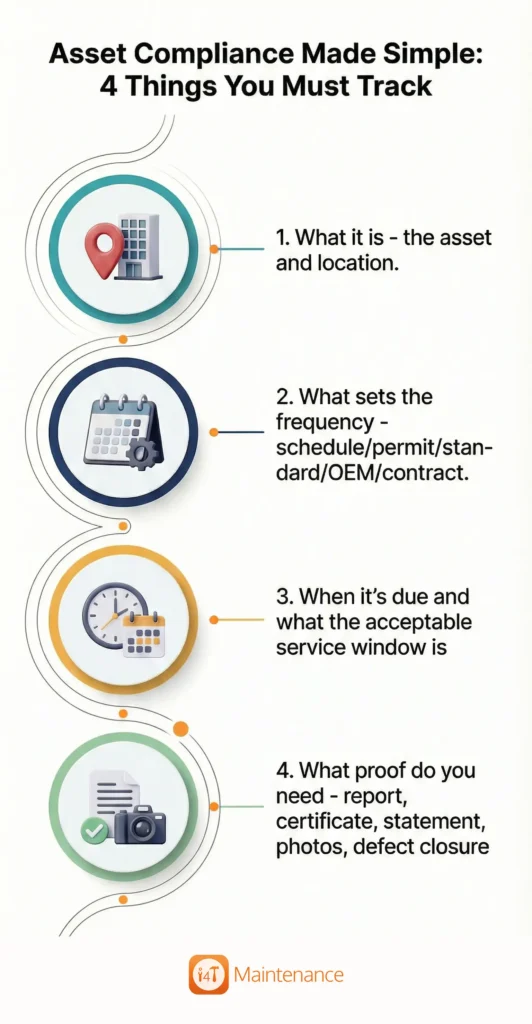
A reliable essential services maintenance workflow usually treats each asset as having four pieces of information:
- What it is – the asset and location.
- What sets the frequency – schedule/permit/standard/OEM/contract.
- When it’s due and what the acceptable service window is
- What proof do you need – report, certificate, statement, photos, defect closure
Once you have that, the maintenance calendar becomes predictable instead of reactive.
At a minimum, your calendar should capture the next due date and frequency, contractor and access needs, required deliverable (report/cert/statement) and defects identified and close-out status.
That’s enough to keep you in control without drowning you in admin.
The paperwork you should be able to pull up in 60 seconds
Most strata compliance stress isn’t about doing the maintenance; it’s about scrambling for evidence when someone asks for it.
A tidy record set usually includes:
- Service reports and test results
- Defects register and rectification evidence
- Annual statements/reports
- Contractor compliance documents as required
- Basic maintenance history by asset
When those are centralised and easy to retrieve, you’ll notice your committee meetings get calmer too. You’re not debating whether something happened; you’re making decisions with confidence.
Common mistakes
The fire mistake is assuming “annual” means “done”. Fire maintenance commonly spans multiple intervals, and longer-cycle major servicing can disappear if it’s not on the calendar.
The lift mistake is using a one-size schedule for every building. If a building is high-use or older, quarterly servicing can turn into a repeat breakdown pattern. Match frequency and scope to usage and failure history.
The HVAC mistake is treating all mechanical systems as comfort maintenance. If a system is linked to essential safety measures documentation, it needs compliance-level scheduling and evidence.
The best frequency is the one you can repeat and prove
When strata maintenance feels stressful, it’s usually because the system relies on memory. When it feels calm, it’s because the building has a rhythm, and that rhythm is documented, scheduled, and easy to audit.
If you want fire, lifts, and HVAC to run smoothly across a portfolio, treat essential services maintenance as a year-round process: obligations first, calendar second, defects closed quickly, and evidence stored in one place.
Want to make that easier? i4T Maintenance – strata maintenance management software helps strata teams centralise essential service assets, auto-schedule recurring servicing, manage work orders end-to-end, track defect close-outs, store reports and certificates, and keep your compliance trail tidy, without the inbox chase.
FAQs
It’s the scheduled servicing and documentation for safety-critical building systems like fire measures, lifts, and some mechanical systems.
Usually not. Fire measures often have tasks across multiple intervals, depending on the building’s schedule and systems.
Often monthly or quarterly depending on usage and equipment, plus inspection/recordkeeping obligations under safety frameworks.
A common baseline is regular filter/visual checks and an annual deeper service, adjusted for environment and complaint history.
Use one calendar that tracks due dates, required reports/certificates, defects, and close-out evidence, and store everything in one system.