

If you’ve ever had a resident ring you with that familiar mix of frustration and disbelief: “I reported this last week, why hasn’t anything happened?”, you already know the real challenge in strata isn’t maintenance. It’s the experience of maintenance.
Most complaints don’t start because the building is falling apart. They start because someone feels ignored, left in the dark, or forced to chase. A minor issue turns into a major gripe when there’s no acknowledgement, no timeline, and no visible progress. The frustrating part is that these complaints often have very little to do with the complexity of the job and everything to do with the process around it.
The encouraging bit? You can meaningfully reduce complaint volume in 30 days without reinventing your entire operation.
When you tighten up work order management, communicate more consistently, and get ahead of seasonal triggers, residents notice quickly. Not because everything becomes perfect overnight, but because it becomes reliable, less “What’s going on?” and more “Okay, someone’s on it.”
This is a practical, human, real-world guide to how to reduce strata complaints in a month, while improving tenant satisfaction and making strata maintenance feel calmer for everyone involved, including you.
What “reducing complaints in 30 days” really means
Let’s set expectations properly: you won’t eliminate all maintenance issues in 30 days. Buildings are living things; something will always need attention. But you can dramatically reduce the number of follow-ups, escalations, and “why hasn’t this been done?” messages.
That shift happens when residents experience three things consistently:
- They get a quick acknowledgement
- They get a clear next step and timeframe
- They see a job closed out properly
When those basics are delivered, complaints fall away because people stop needing to chase.
1. Start with a complaint audit
In strata, complaints often feel like a constant drizzle; one here, one there, always something. But the moment you pull your last 30–90 days of requests into one view, you usually see patterns. The same corridor light fittings. The same garage gate that jams. The same leak reappears after heavy rain. The same bin room mess that triggers the same email every fortnight.
This first step isn’t about blaming anyone. It’s about getting your arms around reality so you’re not playing whack-a-mole all month.
The fastest complaint reduction comes from fixing repeat offenders early, because you’re not just solving one request, you’re removing a recurring frustration that multiple people are experiencing.
A quick audit also helps you spot seasonal patterns. In Australia, some problems reliably flare up at certain times; stormwater issues around summer downpours, mould complaints during winter, and air con grumbles during hot spells. If you can name those patterns, you can get ahead of them.
Quick audit checklist :
- Pull the last 30–90 days of maintenance requests and complaints.
- Group them into 6–8 categories (leaks, lighting, access/security, bins, pests, lifts/HVAC, general defects).
- Highlight repeat locations and repeat issues.
- Choose the top 3 complaint drivers for your 30-day focus.
2. Create a simple two-speed triage system so urgency feels fair
One reason strata complaints escalate is that urgency is subjective. To a resident, a broken door closer might feel “urgent” because it slams all night. To a strata team, it may sit behind safety and water ingress. Without a clear triage system, residents assume their issue is being ignored, even when you’re managing it responsibly.
A two-speed triage approach helps you respond consistently and explain decisions calmly. It also helps your internal team allocate work faster, because you’re not debating priority every time a new request lands.
The key isn’t creating a massive policy document. It’s making sure everyone knows what counts as urgent versus routine, and what your response targets are. When you communicate that clearly, residents don’t have to guess how the system works.
Simple triage guide:
- Urgent: safety hazards, water ingress, electrical issues, security/access failures.
- Routine: general repairs, minor leaks, lighting, door hardware, and non-safety defects.
- Planned: preventative tasks and non-urgent works scheduled into maintenance runs.
3. Acknowledge fast, even if you can’t fix it fast
If you want the most immediate impact on complaint levels, this is it: respond quickly and kindly.
People don’t expect you to teleport a plumber to the site in ten minutes. But they do expect you to acknowledge their message and tell them what happens next.
A fast acknowledgement does two powerful things. First, it reassures residents that their request didn’t vanish into a black hole. Second, it reduces follow-ups, because the resident isn’t left wondering whether they should email again.
The trick is to keep acknowledgements warm but realistic. Overpromising creates bigger complaints later. A simple “we’ve got it” message, plus a realistic timeframe for the next update, is often enough to lower tension dramatically.
What a good acknowledgement includes:
- Confirmation that you received it
- What is the next step going to be (triage, allocating a supplier, requesting access)
- When they hear from you next
4. Standardise request intake so jobs don’t stall on missing basics
It’s hard to explain this to residents without sounding defensive, but a surprising number of delays come from missing details.
“The light is out” sounds simple, until you realise there are twelve lights in that corridor and the contractor needs to know which one. “It’s leaking” is useful until you don’t know if it’s a ceiling leak, a balcony leak, or a pipe leak.
If you collect the right info upfront, you stop the slow email ping-pong that turns small maintenance into big frustration. This is where good work order management shines: it creates a consistent intake process so every job starts with enough detail to move.
This also helps suppliers. The clearer the request, the more likely the right trade gets sent, with the right expectations and the right tools. That reduces failed visits and “we need to come back,” which residents absolutely hate.
Minimum intake details to reduce delays:
- Exact location (building/level/area)
- Clear description of the problem
- Photos if relevant
- Access notes (keys, time windows, resident availability)
- Safety risk indicator
5. Allocate the right supplier the first time

Nothing chips away at resident trust like a string of half-steps. Someone comes out to “have a look,” then nothing happens. Or the wrong trade arrives and says they can’t fix it. Or the contractor turns up without the right parts because the scope wasn’t clear.
The biggest “wow” improvement you can create in 30 days is increasing first-time resolution.
That doesn’t mean every job is fixed on the first visit, but it does mean your allocations are smarter and your work orders carry enough context for the supplier to act.
When the right supplier is chosen quickly and the job is properly scoped, residents feel momentum. That alone reduces the emotional temperature around maintenance.
A practical way to do this is to maintain a small “reliability panel” of suppliers who communicate well and can meet your response targets. If your main contractor is great but overloaded, it’s better to have a backup who can show up and do a tidy job than to keep residents waiting for weeks.
Fast allocation habits that cut complaints:
- Choose suppliers based on fit and performance, not just availability
- Attach photos and clear scope notes every time
- For complex issues, request an assessment first, then schedule the fix
6. Get supplier compliance sorted early so jobs don’t get stuck at the worst time
Compliance rarely feels urgent until it blocks a job that residents are already angry about. Then suddenly you’re chasing documents, the contractor can’t be allocated, and you’re trying to explain why “admin” is the reason nothing is happening.
If you want fewer complaints, you need fewer hidden bottlenecks. Compliance is one of the easiest bottlenecks to remove because it’s predictable. You can proactively keep supplier insurance and licensing up to date and avoid last-minute scrambles that make you look disorganised.
This also reassures committees, because compliance and risk management are always in the background of strata decisions. When you can confidently say suppliers are compliant, you reduce the side conversations that can turn into formal escalations.
Compliance essentials to keep flowing:
- Current public liability insurance on file
- Relevant licences and certifications
- A clear record of compliance checks before allocation
7. Communicate in a rhythm, not in random bursts
Most complaint emails are really progress requests. Residents aren’t necessarily angry about the maintenance issue; they’re anxious about the silence. The moment you create a predictable update rhythm, the chasing drops.
Think of it as removing uncertainty. When people know the system and know when they’ll hear from you, they don’t feel the need to escalate. This is especially true for tenants, who often feel they have less power and less visibility than owners.
You don’t need long messages. Short updates at key stages are enough. The key is that they happen reliably.
A simple update rhythm that works:
- Receipt confirmed
- Supplier allocated and booking underway
- Attendance scheduled
- Job completed and closed out
8. Close the loop properly
A work order isn’t finished when the contractor leaves. It’s finished when the resident understands what happened and agrees the issue is resolved, or understands what the next step is.
Poor close-outs create a huge amount of complaint volume. People report the same thing again because no one told them it was fixed. Or they assume it wasn’t fixed because they didn’t see the outcome. Or the job was “completed” but didn’t address the root cause, so it reappears.
Strong close-outs are one of the most underrated tools for boosting tenant satisfaction because they create confidence. They also reduce reopening rates, which reduces workload.
A good close-out is simple: what was done, when it was done, and whether there’s any follow-up.
Close-out essentials:
- Completion notes in plain English
- Before and after photos
- Any follow-up clearly stated
- Resident notified that it’s complete
9. Start rating supplier service so you can improve outcomes quickly

Suppliers play a massive role in how residents experience strata maintenance. Even if your internal process is solid, one contractor who doesn’t communicate, arrives late, or leaves a mess can spark a fresh wave of complaints.
Service ratings don’t need to be complicated. In fact, the simpler they are, the more likely they’ll be used consistently. What matters is that you start capturing a signal, who is helping you reduce complaints, and who is quietly creating them.
Once you have that signal, you can shift work toward your best performers. Over a month, those small shifts add up. You get fewer call-backs, fewer misunderstandings, and better resident interactions.
Quick supplier rating criteria:
- Communication
- Timeliness
- Quality of work
- Tidy/respectful on site
- Good documentation
10. Reduce predictable complaints with seasonal planning aligned to Calendar Australia
Some complaints are almost scheduled events. When the weather changes, buildings react. Residents notice.
This is why seasonal planning matters so much. It’s not just “nice to have” preventative maintenance, it’s complaint prevention. If you handle the predictable seasonal issues before they flare up, you reduce reactive callouts and avoid the “this always happens” frustration.
In Australia, the two big complaint waves often align to summer and winter. Summer brings storms, heat, pests, and drainage issues. Winter brings leaks, mould, lighting concerns, and safety hazards from slippery surfaces and reduced daylight.
A short seasonal sweep, built around a summer winter building checklist, can create noticeable results within 30 days, especially if you focus on the items that most commonly generate resident emails.
Seasonal maintenance tasks that strata teams can knock over quickly:
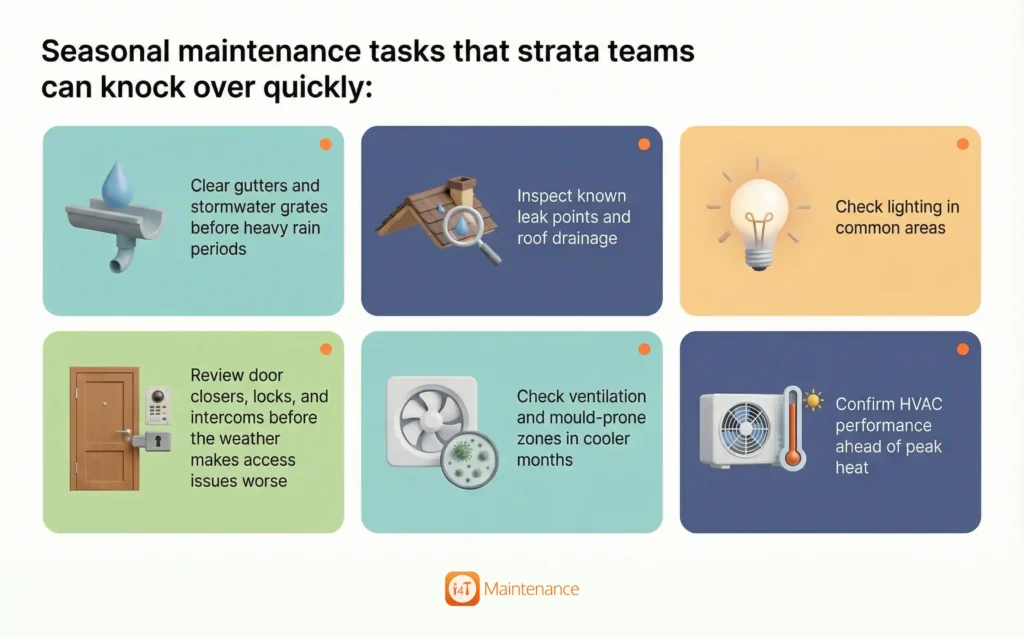
- Clear gutters and stormwater grates before heavy rain periods
- Inspect known leak points and roof drainage
- Check lighting in common areas
- Review door closers, locks, and intercoms before the weather makes access issues worse
- Check ventilation and mould-prone zones in cooler months
- Confirm HVAC performance ahead of peak heat
This is also where considering the Australian calendar helps. Residents understand seasonal preparation. If you communicate that you’re doing a seasonal sweep, it signals competence and care, and that perception alone reduces complaints.
Fewer complaints come from better work order management, not magic
If you want to know how to reduce strata complaints in 30 days, focus on the resident experience from start to finish.
Quick acknowledgement, consistent updates, smart supplier allocation, proper close-outs, and a bit of seasonal planning will reduce complaint volume faster than any “please be patient” message ever will.
And if you want this to run smoothly across multiple buildings, without relying on sticky notes, spreadsheets, and memory, strong work order management makes the difference.
i4T Maintenance helps strata teams manage end-to-end strata maintenance workflows, from request handling and supplier selection to allocation, tracking, tenant communication, supplier compliance, supplier invoices, and service ratings. If your goal is fewer complaints and higher tenant satisfaction, i4T Maintenance helps you turn everyday maintenance into a smoother, more transparent experience.
FAQs
Respond fast, set clear expectations, and provide regular updates so residents don’t feel ignored.
Delays and lack of communication. People get frustrated when they don’t know what’s happening.
It keeps requests, supplier allocation, updates, and progress in one place, so jobs move faster and don’t get lost.
Use a summer/winter building checklist: gutters and drainage, leak checks, lighting, HVAC, pests, ventilation, and safety hazards.
Fix the root cause, close out jobs properly with clear notes, and shift work toward suppliers who deliver quality and communicate well.