Tracking contractor performance can be a real challenge for strata managers juggling multiple properties. With the need to manage various trades, residents, committees, urgent repairs, quotes, invoices, and recurring issues, it’s easy for contractor updates to slip through the cracks. Having reliable contractor insights at your fingertips is crucial for keeping maintenance running smoothly and keeping the owners corporation informed. This is where property maintenance management software becomes an indispensable tool, bringing everything together in one place.
Strata managers can track contractor performance by measuring response time, attendance time, completion time, first-time fix rate, repeat callouts, quote turnaround, invoice accuracy, communication quality, and documentation. Property maintenance management software makes this easier by keeping work orders, updates, photos, quotes, approvals, and invoices organised across multiple jobs and sites.
Why Contractor Performance Tracking Matters in Strata Maintenance
Simply marking a job as ‘completed’ is no longer enough in strata maintenance. Managing common property often involves complex tasks where quality, speed, clear documentation, and effective communication are essential to avoid repeat issues and budget blowouts. Fast, clear communication benefits residents and committees alike, while good record-keeping protects the maintenance history your portfolio depends on.
Tracking contractor performance gives strata managers clear evidence about how well contractors meet their obligations — from how quickly they respond to a maintenance request to the accuracy of their quotes and invoices. It also helps control costs by identifying inefficiencies early, improving resident satisfaction by reducing delays, and making committee reporting more transparent and reliable.
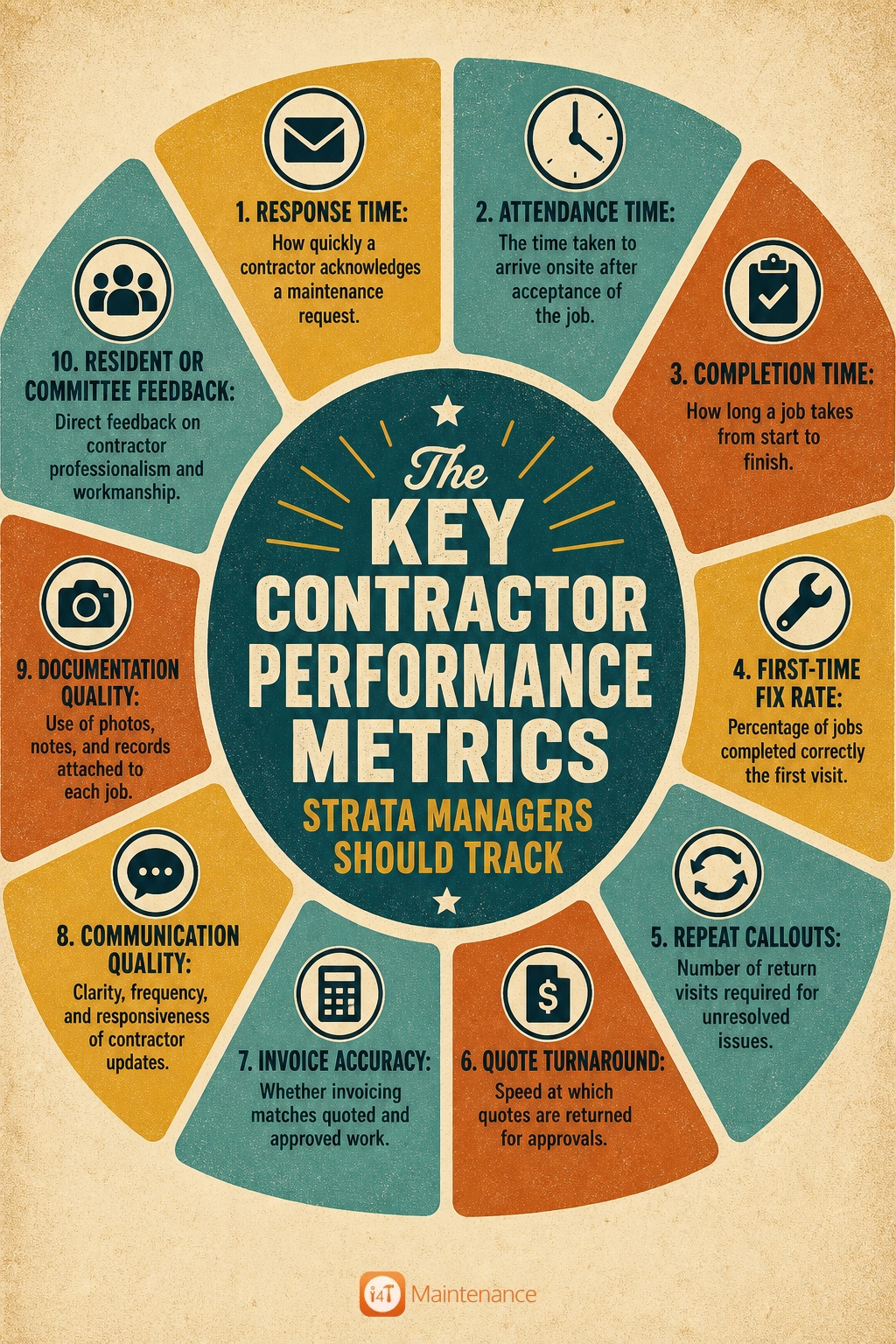
The Key Contractor Performance Metrics Strata Managers Should Track
To fairly assess contractors across multiple maintenance jobs, these are the main metrics to consider:
- Response time: How quickly a contractor acknowledges a maintenance request.
- Attendance time: The time taken to arrive onsite after acceptance of the job.
- Completion time: How long a job takes from start to finish.
- First-time fix rate: Percentage of jobs completed correctly the first visit.
- Repeat callouts: Number of return visits required for unresolved issues.
- Quote turnaround: Speed at which quotes are returned for approvals.
- Invoice accuracy: Whether invoicing matches quoted and approved work.
- Communication quality: Clarity, frequency, and responsiveness of contractor updates.
- Documentation quality: Use of photos, notes, and records attached to each job.
- Resident or committee feedback: Direct feedback on contractor professionalism and workmanship.
How Property Maintenance Management Software Improves Contractor Visibility
Property maintenance management software is key to gaining real-time visibility on contractor performance. Instead of chasing emails or juggling spreadsheets, strata managers can instantly see work order tracking progress across all sites and trades from one dashboard.
This software centralises contractor updates, historic quotes, approvals, detailed job photos, invoices, and documents. It provides instant status checks for each maintenance request and job, so you know if a contractor is delayed due to access issues or parts delays, rather than just assuming poor performance.
With everything in one place, communication improves between strata managers, contractors, residents, and committees. It reduces misunderstandings and helps keep maintenance moving swiftly and transparently.
Manual Tracking vs Maintenance Management Software
Many strata managers start by tracking contractors manually using spreadsheets, emails, phone calls, and paper records. While this can work for small portfolios, it quickly breaks down as the number of buildings, contractors, and maintenance requests grows.
Manual tracking makes it harder to consolidate job status, compare contractor response times fairly, and store all related documents in one spot. Information may get lost across inboxes or phone messages, and updates can come late or be incomplete.
Maintenance management software solves these issues by automating workflows, syncing updates in real time, and centralising all relevant job information. This reduces admin time and increases accuracy and accountability.
A Practical Workflow for Tracking Contractors Across Multiple Jobs
A streamlined workflow is essential when managing contractor performance across multiple maintenance jobs. It starts with standardising every maintenance request to ensure consistent recording of issues and priority levels, whether it’s an urgent repair or a routine check.
Next, use one central system to assign jobs to contractors, which prevents confusion and overlapping requests. Each job should have consistent status stages such as ‘assigned’, ‘in progress’, ‘completed pending approval’, and ‘closed’. These statuses make it easy to track job progress and identify delays.
It’s important to require contractors to upload photos and completion notes for every job, providing clear evidence of the work done. All quotes and approvals should be tracked within the same system, so there’s a detailed audit trail for costs and decisions.
Regularly reviewing overdue jobs helps identify bottlenecks early. By comparing performance by contractor and trade type, strata managers can identify the most reliable contractors and those needing improvement.
Finally, detailed reports generated from the system enable clear communication back to strata committees, providing transparent maintenance histories that support budgeting and decision-making.
How Work Order Tracking Helps Strata Managers Compare Contractors Fairly
Work order tracking is essential for fair comparisons between contractors. Rather than relying on memory, frustration, or isolated bad experiences, consistent data from work orders provides objective insights into contractor responsiveness and reliability.
Tracking each job’s progress highlights if delays are contractor-related or due to external factors like access issues, approval delays, part availability, unclear scopes, or resident unavailability. This context avoids unfair blame and helps target improvements where they matter most.
Work order tracking also supports accountability by providing a detailed audit trail from maintenance request through to invoice, giving strata managers confidence in managing contractors fairly and effectively.
What to Include in a Contractor Performance Scorecard
A contractor performance scorecard is a practical tool for strata managers to summarise key performance areas in a simple format. Categories to include are responsiveness, reliability, job quality, communication, documentation, cost control, and stakeholder experience.
Regularly updating and reviewing this scorecard helps guide preferred contractor panels and empowers transparent discussions with strata committees. It also integrates well with contractor management software that automatically pulls in relevant metrics, making scorecard maintenance straightforward and objective.
Common Mistakes to Avoid When Tracking Contractor Performance
Tracking contractor performance can be tricky. Here are some common pitfalls to avoid:
Only tracking whether a job was completed misses quality and efficiency details.
Ignoring repeat callouts results in repeat problems like signal poor workmanship or incorrect fixes.
Confusing contractor delays with committee approval delays. It’s important to separate these to give fair feedback.
Accepting vague completion notes. Clear, detailed notes and photos are essential for transparency.
Not attaching photos and documents to jobs. Without documentation, it’s difficult to prove work quality or resolve disputes.
Separating jobs, invoices, quotes, and maintenance records across different systems. This leads to disorganisation and loss of critical information.
Choosing the Right Property Maintenance Software for Contractor Tracking
When selecting property maintenance software for contractor tracking, strata managers should look for key features tailored to their workflows. Core functions include contractor assignment, real-time job status tracking, quote management, and approval workflows to keep maintenance moving.
The software should support photo uploads and document storage linked to each job to provide clear evidence of work done. Automated reminders help prevent overdue jobs from slipping through the cracks.
Invoice matching is another critical feature, ensuring costs reconcile with approved quotes and work completed.
Most importantly, the software must provide comprehensive reporting and maintenance history visibility, enabling strata managers to confidently track contractor performance across properties.
Why i4T Maintenance Management Software Is Built for Contractor Tracking
i4T Maintenance Management Software is designed specifically to help strata managers handle the complexities of managing contractors across multiple jobs and properties. It allows assignment, work order tracking, and real-time monitoring of contractor updates all from one dashboard.
With i4T Maintenance, you can store photos, completion notes, quotes, approvals, invoices, and maintenance histories in a centralised location. This boosts visibility and accountability while cutting down time spent chasing information or managing paperwork.
The software supports better communication between strata managers, contractors, and committees by streamlining workflows and ensuring detailed records are always ready for review. In short, i4T Maintenance helps strata teams take control, save time, and improve maintenance outcomes with confidence.
Final Takeaway
Tracking contractor performance is far more than just chasing updates — it’s about building a reliable maintenance record across contractors, jobs, properties, approvals, documents, and invoices. Property maintenance management software makes this task achievable and efficient for strata managers, giving clear visibility into contractor work, improving job management, and strengthening communication with all stakeholders.
Using the right software, such as i4T Maintenance Management Software, equips strata managers to track work orders, monitor contractor performance, manage approvals, and keep detailed maintenance history all in one place. This enhances accountability and lets strata teams manage property maintenance with more confidence and control.
Frequently Asked Questions
It involves monitoring key indicators like response time, job completion, quality, communication, and costs to assess how well contractors perform maintenance tasks.
Strata managers should track response time, attendance time, completion time, first-time fix rate, repeat callouts, quote turnaround, invoice accuracy, communication, and documentation quality.
It centralises work order tracking, contractor updates, quotes, approvals, photos, invoices, and documents, improving visibility and making performance monitoring easier.
Work order tracking provides consistent data to fairly evaluate contractors, separating delays caused by contractors versus external factors, and supporting accountability.
Contractor management software focuses mainly on contractor assignments and communications, whereas property maintenance software offers wider features including work order tracking, approvals, documentation, invoices, and reporting.
By using consistent metrics and data collected through work order tracking and contractor performance scorecards rather than relying on memory or isolated experiences.