

If you’re new to strata, welcome to the most interesting mix of calm routines and sudden curveballs. One morning you’re scheduling routine lift maintenance; that night you’re dealing with a burst pipe. Across both, the same backbone keeps you safe, insured and trusted, contractor compliance.
This guide explains Contractor Compliance for Strata Managers in clear, friendly language, then adds short, targeted checklists only where they genuinely help. By the end, you’ll have a practical, repeatable approach to everyday Strata Compliance.
What contractor compliance actually means
Contractor compliance is proof, before anyone touches common property, that the person you hire is qualified, insured, safe and properly briefed for your site. It sits under your broader Strata Compliance duties (WHS, by-laws, insurer expectations) and turns “we think it’s fine” into “we can show it’s fine.
Good compliance doesn’t slow jobs; it prevents rework, protects residents and keeps your committee calm when things get busy.
Use this when you need a quick refresher:
- Confirm licence, insurance and relevant tickets are current.
- Brief the site rules, hazards and access properly.
- Capture the job scope, approvals and completion evidence in one place.
The essentials you should always hold on file
Treat a contractor’s file like a passport plus boarding pass: identity, permission and conditions of travel. You can keep it lean and still be safe.
Minimum must-haves (keep current and easy to find):
- Legal details: ABN, trading name, contacts including after-hours.
- Licences & tickets: trade licence; EWP/working-at-heights/confined spaces as needed; white card.
- Insurance: Public Liability (match risk; many schemes expect $10–20m), Workers’ Comp, Professional Indemnity. Sight Certificates of Currency.
- Safety & completion: SWMS for high-risk work; permits, compliance certificates and test/commissioning reports after the job.
Right-size your controls
Not every job needs the same intensity. Bucket jobs by risk so your checks match the work. Height, live services, hazardous materials, structural or fire systems usually push you up a tier. Basic repairs at ground level are low risk but may still need licence, public liability, building induction and a clear scope.
Standard plumbing/electrical/roof are medium risk, requiring managed access, workers’ compensation, relevant tickets, and SWMS where risk warrants.
Vendor Pre-qualification
Pre-qual happens before the first work order. It’s a one-time deep breath that prevents last-minute scrambles during emergencies. Keep it warm but firm: safety and paperwork first, then speed.
A simple pre-qual flow includes inviting vendors, collecting, reviewing, verifying and approving documents and tagging them to trade, risk, and area. Set auto-reminders for expiries, and pause approval when documents lapse.
Onboarding contractors
Approval says, “Yes.” Onboarding says, “Here’s how we work.” A five-minute conversation (or one-pager) turns strangers into partners and eliminates half your follow-up emails.
Set up clear access rules, mention what needs to be communicated and when, and have an escalation plan in place, with after-hours numbers or when something goes wrong.
Detailed job briefs
Most headaches start with a fuzzy scope. Describe the problem, the desired outcome and the exact location. Add two photos, one wide to orient, one close-up of the issue. If there are hazards or permits, flag them.
Make every brief crystal-clear with outcome, access, time window, SLA, evidence required, and who approves it.
What Compliance means on the day of work
You don’t need to hover on the site. You do need a short paper trail that shows basics were done right, especially for high-risk tasks.
Ensure everything from sign-in and out is captured, SWMS, PPEs are reviewed and acknowledged on site for high-risk work, work is tracked in real time with before and after photos, and if conditions change, they are timely reported and taken care of.
What “complete” really means
Completion means quality, safety and paperwork lining up. Treat it as a package so future you can prove what happened.
Don’t sign off until you have:
- Tidy, safe area; systems reset; residents informed if affected.
- Photos showing the fix; test/commissioning results where required.
- Compliance certificates (electrical/plumbing) and warranty details.
- Invoice with job ID, agreed rates, and approved variations attached.
Make sure you file everything from vendor details to job summary in one place.
Three playbooks you’ll use every week
Emergencies, routine work and recurring maintenance each need a slightly different rhythm. Define them now so you don’t improvise later.
Emergency: Keep a short list of genuine after-hours contractors, and keep minimal documentation before attendance.
Routine jobs: Lay out a standard brief, checks and completion pack. Keep photo evidence every time, and a simple variation path if something changes.
Recurring maintenance: Map assets and service frequencies; lock your calendar for the year. Track attendance, SLA performance and rolling compliance renewals so approvals never lapse mid-contract.
Keeping all stakeholders onboard
Compliance is a team sport, and it works best when everyone knows the plan.
Start by setting friendly, factual expectations with each group and keep communication short and regular.
For committees, share simple snapshots that show what’s in progress, what’s complete, how spend tracks against budget, and where you need a decision. Clear, consistent updates build trust and speed up approvals.
On the ground, equip building managers to succeed: give them a concise induction pack for each site, keep a live permit log they can check at a glance, and map a straightforward escalation path so they know exactly who to call when conditions change.
Residents value respect and clarity more than anything. Send notices that spell out dates, times and likely impacts, include a direct contact, and stick to agreed noise windows. Do those basics well and collaboration becomes easy, issues are resolved faster, and the whole scheme feels calmer and more professional.
Vendor metrics to keep track of
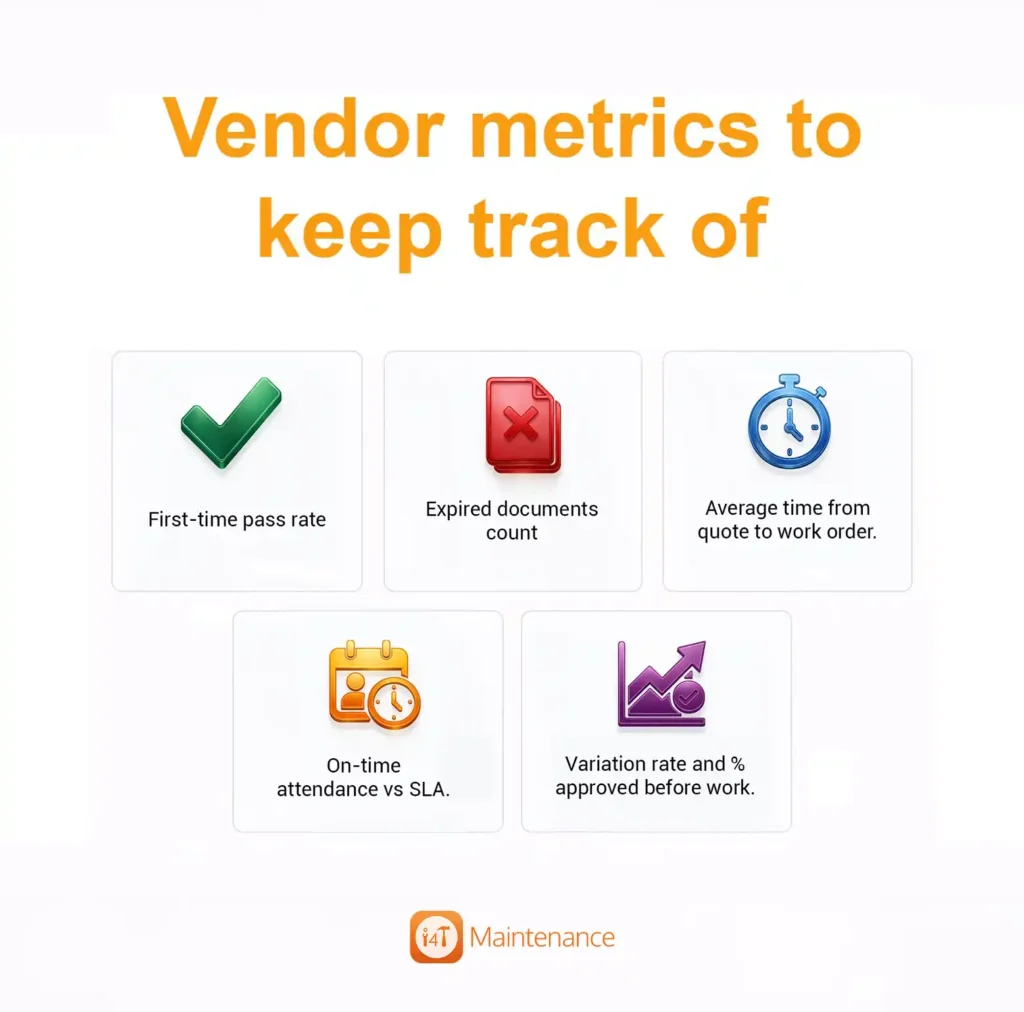
You don’t need a wall of gauges, just a few numbers that drive better conversations with vendors and committees.
- First-time pass rate (jobs closed without rework).
- Expired documents count (aim for zero).
- Average time from quote to work order.
- On-time attendance vs SLA.
- Variation rate and % approved before work.
Choosing software that makes compliance easier
You can manage a handful of buildings with folders and spreadsheets. As your portfolio grows, software keeps everything in one calm place and cuts your admin in half.
Look for tools that offer:
- Central vendor profiles with licence/insurance tracking and auto-expiry alerts.
- Pre-qualification workflows and document approvals.
- Job briefs with photos, access and safety in one screen.
- Mobile sign-in/out, permits and on-site evidence capture.
- Variation approvals with a clear, time-stamped trail.
Asset histories, recurring schedules and simple dashboards you can show a committee without a lecture.
Over to You
Contractor Compliance for Strata Managers is not about chasing people for paperwork. It’s about setting a fair, repeatable way to bring safe, qualified people onto common property and give them the information to do quality work, the first time.
Right-size your controls by risk, pre-qual and onboard properly, brief clearly, keep day-of-job checks sensible, and treat completion as a package with photos, tests, certificates and a clean invoice. Do that consistently and you’ll deliver calm, predictable outcomes, and real-world Strata Compliance, even when the phone rings at odd hours.
Want the process without the juggle?
Run pre-qualification, onboarding, job briefs, on-site checks, completion packs and renewals in one place with i4T Maintenance – Maintenance Management Software. Built for strata teams who want compliant, high-quality work done right the first time.
FAQs
No. Use a SWMS for high-risk construction work (heights, EWPs, hot works, confined spaces). For standard tasks, a sensible risk assessment and site induction usually suffice.
Match the job risk and your insurer’s advice. Many schemes expect $10–20m Public Liability; go higher for significant height, major plant or complex systems.
For make-safe, authorise up to a cap with minimum docs (licence + Public Liability). If the work is high-risk, requires a quick SWMS and permits from the site, then collect the full pack next business day.
Keep them for the life of the asset, plus what your insurer/regulator recommends. File by vendor, building, and job, so audits take minutes, not days.
Stagger start times, book lifts properly, nominate a lead if tasks overlap and run all updates/variations through one agreed channel.