

TL;DR
A solid quote comparison in strata means:
- Standardising the job brief
- Checking inclusions/exclusions, and
- Scoring each quote on scope fit, pricing transparency, and risk controls (licences/ABN, insurances, WHS approach, timeframe, and variation rules).
This is the backbone of a practical strata quote comparison checklist you can use with your committee.
If you’ve ever sent three contractors to the same building and somehow received three completely different “quotes”, you’re not imagining things. In strata, quote comparison is rarely a straight price-versus-price decision. It’s a mix of scope clarity, site realities, resident impact, safety obligations, and the risk of variations landing later like an unwanted surprise.
The simple truth: the best outcome usually comes from comparing like-for-like scope first, then weighing price against risk. That’s exactly what this guide is built for.
Here are the 10 questions strata managers need to ask before assigning the job:
Are we giving every contractor the same scope to quote on?
Before you even look at numbers, ask: did all contractors quote the same job?
In strata, vague job descriptions create “quote soup”. One contractor may include traffic control and rubbish removal. Another may assume the building provides access equipment. A third may price a basic repair, not the full make-good. Then the committee sees one figure that looks cheaper, but it’s only cheaper because half the work isn’t in it.
A clear, written job brief is the great equaliser. NSW Government guidance on getting quotes for building work stresses the value of a clear brief and being specific, because it helps you get more accurate quotes and avoid unexpected cost changes later.
What same scope looks like in strata:
- A short problem description and the outcome you want, such as repair, replacement, compliance, or upgrade.
- Site details: address, access notes, parking/loading, lift restrictions, work hours/noise windows
- Photos, drawings, prior reports, and known constraints like water ingress history or asbestos register, where relevant.
- Requirements around resident communication, such as notice periods, signage, tidy-up expectations.
- Any mandatory compliance: SWMS for high-risk tasks, permits, isolations, and inductions
When you standardise these inputs, you’re already halfway to a decision you can defend confidently.
Does each quote separate the scope from assumptions?
Contractors don’t just price what they know; they price what they think is true. If assumptions aren’t made explicit, the risk doesn’t disappear; it just moves to the variation stage.
In strata, the big assumption traps usually relate to access and unknowns behind walls or under floors. If a quote says “subject to inspection” or uses vague allowances without explaining what’s included, that’s not automatically bad, but it’s a flag to clarify.
The goal is to turn assumptions into documented facts wherever possible. Sometimes that means arranging a joint site inspection. Sometimes it means sharing photos or a short condition report. And sometimes it means asking the contractor to price two options for best-case and likely-case, so you can show the committee what drives the cost.
A quick way to test clarity: If you can’t explain the quote to a committee member in 30 seconds without hand-waving, it needs more detail.
Are we comparing inclusions and exclusions, or just reading totals?
This is where quote comparison in strata most often goes sideways. The committee sees totals. You see the fine print.
A quote can look cheaper while excluding items that are almost guaranteed in a strata environment, like protecting common areas, after-hours work restrictions, or making good around penetrations. The real cost then appears later as a chain of “reasonable” extras.
Here’s the practical move: pull inclusions/exclusions into a quick comparison view so the committee can see what’s truly comparable.
Common strata exclusions worth checking:
- Access equipment and permits
- Rubbish removal, tip fees, and clean-up standards
- Making good, such as patching, repainting, regrouting, and resealing
- Traffic/pedestrian management in shared areas
- After-hours work, call-out charges, or lift booking constraints
- Testing and commissioning, especially for fire, electrical, and mechanical systems
This is the heart of how to compare maintenance quotes strata committee style: not by nitpicking, but by showing what the building actually receives for the spend.
What’s the variation risk, and how will changes be priced?
Variations in strata are common. Buildings are lived-in, access is unpredictable, and hidden conditions are real. The mistake isn’t that variations happen; it’s approving a quote that doesn’t define how they’ll be handled.
A strong quote makes variation rules boring, in a good way.
It explains how changes will be raised, who approves them, and what the pricing method is. NSW guidance on getting quotes also flags managing changes and avoiding unexpected costs as part of the quoting process.
Look for these variation basics:
- Variation approval pathway
- Hourly rates and minimum call-out time
- Material mark-ups and how they’re calculated
- Clear boundaries: what triggers a variation vs what’s part of the fixed scope
When committees worry about blowouts, this is usually what they mean: loss of cost control. Clear variation rules restore that control.
Is the pricing transparent enough to evaluate value?
You don’t need every quote to be a 10-pager, but you do need enough structure to judge whether the price matches the job.
Consumer Protection WA explains the difference between estimates and quotes and discusses expectations around pricing clarity. In simple terms, a quote is typically a more committed price than an estimate, assuming the scope doesn’t change.
In strata, you’ll often see a mix: a fixed price for the known works, and allowances for unknowns. That can be appropriate, especially in remedial works, but it must be clearly labelled.
Pricing transparency usually means:
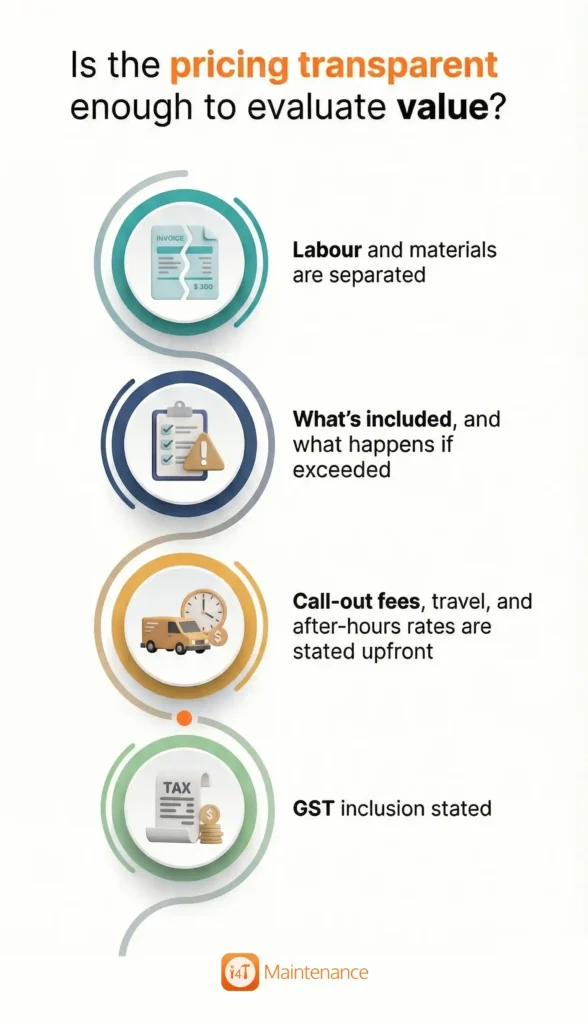
- Labour and materials are separated
- What’s included, and what happens if exceeded
- Call-out fees, travel, and after-hours rates are stated upfront
- GST inclusion stated
If you can’t tell what the contractor is actually providing for the dollars, it’s hard to evaluate contractor quotes price vs scope strata in any meaningful way.
Are the contractor’s details legitimate and easy to verify?
Strata managers sit in the messy middle between urgent building needs and governance expectations. Your best protection is a clean verification habit.
This isn’t about assuming the worst. It’s about making due diligence routine, especially when the works are high value, high risk, or resident-facing.
At a minimum, ensure the quote includes accurate business details. Consumer Protection WA’s guidance on estimates and quotes is a useful baseline for what should be documented in writing.
Minimum checks:
- ABN and correct legal entity name
- Licence details where the trade requires it
- A physical business address and reliable contact details
- Clear terms: payment timing, warranty/defects approach, cancellation rules
If a contractor can’t provide basic documentation, it’s a clue that the admin side may become painful later, especially when you need certificates, compliance evidence, or warranty follow-up.
Does the insurance match the risk profile of the job?
Insurance is one of those topics committees don’t love, until they really, really need it.
For strata, the key is not just “do they have insurance”, but “is it appropriate for the work being done in an occupied building”. Public liability is common, but you’ll also want to be sure they can cover the kinds of incidents that could arise from the job: damage to common property, damage to resident lots, injury in shared areas, or mistakes that cause water ingress and secondary losses.
Good practice is to request current certificates of currency and store them with the quote pack, so you’ve got an audit trail if questions come up later.
Typical documentation to request:
- Public liability
- Workers compensation
- Any specialist cover if the works demand it
Even if your building has its own insurance, contractor insurance matters because it helps manage “who pays if something goes wrong”
What’s their WHS approach for an occupied strata building?
Safety isn’t optional in strata. It’s also not something you can fully outsource.
Safe Work Australia explains that in a contractual chain, there can be multiple duty holders, and the parties need to consult, cooperate and coordinate on WHS matters. That matters in strata because you’re often coordinating building access, resident movement, common area controls, and sometimes multiple contractors on the same site.
For quote comparison, WHS shows up as risk controls: how the contractor plans to protect residents, manage hazards, and keep the site orderly. A cheaper quote that ignores the realities of an occupied building can become expensive in disruption, complaints, or incidents.
WHS signals that reduce risk:
- Site-specific SWMS for higher-risk tasks
- Clear plan for isolations, barricading, signage, and spotters
- Induction readiness
- Housekeeping and end-of-day site security plan
This is one of the biggest “price vs risk” levers. If the job has any meaningful hazard profile, WHS maturity should influence the selection.
Are timeframes, access requirements, and resident impact clearly stated?
In strata, the timeline is part of the cost, especially if the job affects lifts, car parks, balconies, services, or noise.
Two quotes can look similar on price, but one causes twice the disruption due to longer duration or messy staging. Committees care about this more than they sometimes realise, because resident experience lands back on them and you.
When comparing quotes, capture these points in plain language:
- Proposed start date and lead time
- Duration and staging
- Access needs
- Noise/dust controls and protection of common areas
Resident communication requirements
A contractor who spells this out is usually a contractor who has actually thought about how the job will run in a real building.
Can you justify the recommendation with a simple scoring method?
This is the part that makes life easier, because it turns a messy conversation into a structured decision.
If your committee tends to focus on the cheapest number, a scorecard helps you show value without sounding like you’re “talking them into” a more expensive option. It also creates a consistent process you can use again and again, which is gold for governance.
Here’s a simple scoring approach you can lift straight into your next quote pack.
Simple strata quote comparison checklist scorecard
|
If you want the committee to engage with the logic, write one or two sentences under the table explaining the recommendation in everyday terms, including scope, disruption,and risk. That keeps the conversation grounded.
This is also where you can phrase the decision exactly the way committees understand it:
We’re not choosing the cheapest quote. We’re choosing the quote that delivers the right scope with the lowest chance of variations, disruption, or defects.
Bringing it all together: Price matters, but risk decides the outcome
When strata managers talk about quote comparison, what they often mean is: how do I make this decision defendable, fair, and least likely to blow up later?
The answer is a repeatable process:
- Standardise the scope so you’re comparing like-for-like.
- Pull inclusions/exclusions into view so the real differences are obvious.
- Check variation rules, insurance, WHS approach, and delivery plan.
- Use a simple scorecard so the committee sees value, not just totals.
Do that, and you’ll reduce the two biggest strata headaches: choosing a quote that doesn’t cover the real job, and approving a price that looks fine until variations start rolling in.
Make quote comparison easy with i4T Maintenance
If you’re currently juggling quotes across inboxes, PDFs, and committee threads, it’s way too easy for key details to get missed.
i4T Maintenance – Maintenance Management Software for quote comparison helps you standardise scopes, request and store quotes in one place, compare them side-by-side, and keep supporting documents attached to the job, so you can present a clean, committee-ready recommendation with an audit trail.
FAQs
Usually at least two to three for most maintenance jobs, and more for high-cost or high-risk works.
A clear scope, itemised pricing, stated inclusions/exclusions, timeframes, and the variation process.
Because it may exclude key items (like access equipment or making good), which can lead to costly variations later.
Standardise the brief, ask contractors to re-quote on the same scope, and use a simple scorecard to compare like-for-like.
At minimum: ABN, relevant licences (where required), insurance certificates, and a basic WHS plan for working in occupied buildings.