

TL;DR
Vendor scorecards help strata managers measure contractor performance consistently across quality, SLA/timeframes, cost control, and safety.
- Keep the scorecard simple
- Use clear scoring rules
- Back every score with evidence from work orders
- Track SLA compliance using logged/attended/completed times.
- Monitor cost predictability via quote-to-invoice variance and variations
- Include safety KPIs like inductions and SWMS where required.
- Review monthly for high-volume vendors and quarterly for specialists.
For easier vendor compliance tracking, i4T Maintenance can centralise work orders, SLA data, and compliance documents in one place.
Strata work has a funny way of rewarding the loudest moment, not the most consistent contractor.
One messy ceiling repair can wipe out months of otherwise decent service. A plumber who’s brilliant on call-outs can suddenly become a headache on quotes. And a contractor who’s cheap up front can quietly cost more through variations, rework, and resident complaints.
That’s why vendor scorecards are so useful in strata. They turn contractor performance into something you can measure, compare, and improve, without relying on gut feel, memory, or whoever shouted last in the committee meeting.
And there’s a bigger reason this matters: owners corporations have obligations around maintaining common property, and good systems help you show you’re managing that responsibility properly. In NSW, for example, the government guidance is clear that the owners corporation/strata committee must repair and maintain common property.
A vendor scorecard doesn’t replace relationships. It strengthens them. It sets expectations clearly, keeps conversations fair, and gives you a practical way to prove performance over time, across quality, SLA, cost control, and safety.
What is a vendor scorecard in Strata, and what does it actually fix?
A vendor scorecard is a structured way to rate contractor performance using agreed KPIs. In strata, it solves three recurring problems:
Inconsistency: Without a scorecard, “good performance” changes depending on the building, the committee, and the last incident.
Poor visibility: If your data is scattered across emails, invoices, texts, and site notes, it’s hard to answer simple questions like: Are they on time? Are they safe? Are we paying fairly?
Awkward conversations: A scorecard turns emotional feedback into objective improvement: this is the KPI, this is the result, this is what needs to change.
The best part is you don’t need a corporate procurement department to do this well. In strata, a scorecard works when it’s simple, repeatable, and based on evidence you already collect through work orders and compliance paperwork.
What should a strata vendor scorecard measure
Keep the structure boring. Boring is good. Boring scales across a portfolio.
Most strata scorecards work best with four buckets:
| Bucket | What you’re really measuring | Why it matters in strata |
|---|---|---|
| Quality | Was the work done right the first time? | Reduces call-backs, complaints, and repeat spend |
| SLA / Time | Did they respond, attend, and complete on time? | Controls resident disruption and risk escalation |
| Cost | Are quotes/invoices predictable and fair? | Prevents budget drift and committee distrust |
| Safety | Are they working safely and meeting WHS expectations? | Protects people, reduces liability, and avoids site incidents |
What goes into a strata contractor quality scorecard checklist?
Quality in strata isn’t just “did it work”. It’s also how the job landed in a shared space: the finish, the clean-up, the communication, and the resident impact.
A practical strata contractor quality scorecard checklist usually includes workmanship measures and experience measures.
Here are reliable options that strata managers can actually track:
- First-time fix rate: percentage of jobs with no call-back within 30 days
- Defect rate: number of minor/major defects per review period
- Scope accuracy: completed what was approved
- Finish and reinstatement: patching, painting, sealing, refitting done properly
- Clean site handover: area left tidy, safe, and secure
- Photo evidence: before/after photos attached to the work order
- Resident impact: complaints per 10 jobs or per building per month
- Communication quality: updates provided at key milestones
Now the “descriptive” part that makes this work: define what a 1 vs a 5 means.
For example, Clean site handover might be:
- 5: area left cleaner than found; waste removed; signage removed when safe; access restored
- 3: generally clean, minor dust/debris; no safety risk
- 1: rubbish left behind, materials unsecured, messy common areas, residents affected
When you define ratings like that, you reduce bias.
You also help good contractors win, because you’re not judging them on personality; you’re judging them on outcomes.
How do you measure SLA compliance for contractors in strata without starting arguments?
To measure SLA compliance for contractors in strata, you need two things:
- a clear SLA definition, like what “on time” actually means, and
- timestamps that can be trusted.
In strata, SLAs often need three separate time targets:
- Response time: how quickly the contractor acknowledges the job and confirms next steps
- Attendance time: when they arrive on site or attend remotely if appropriate
- Completion time: when the job is finished, made safe, and documented
Why split it? Because residents don’t care that a contractor replied quickly if they didn’t turn up for three days. And committees don’t love “completed” if the job isn’t actually finished, photographed, and signed off.
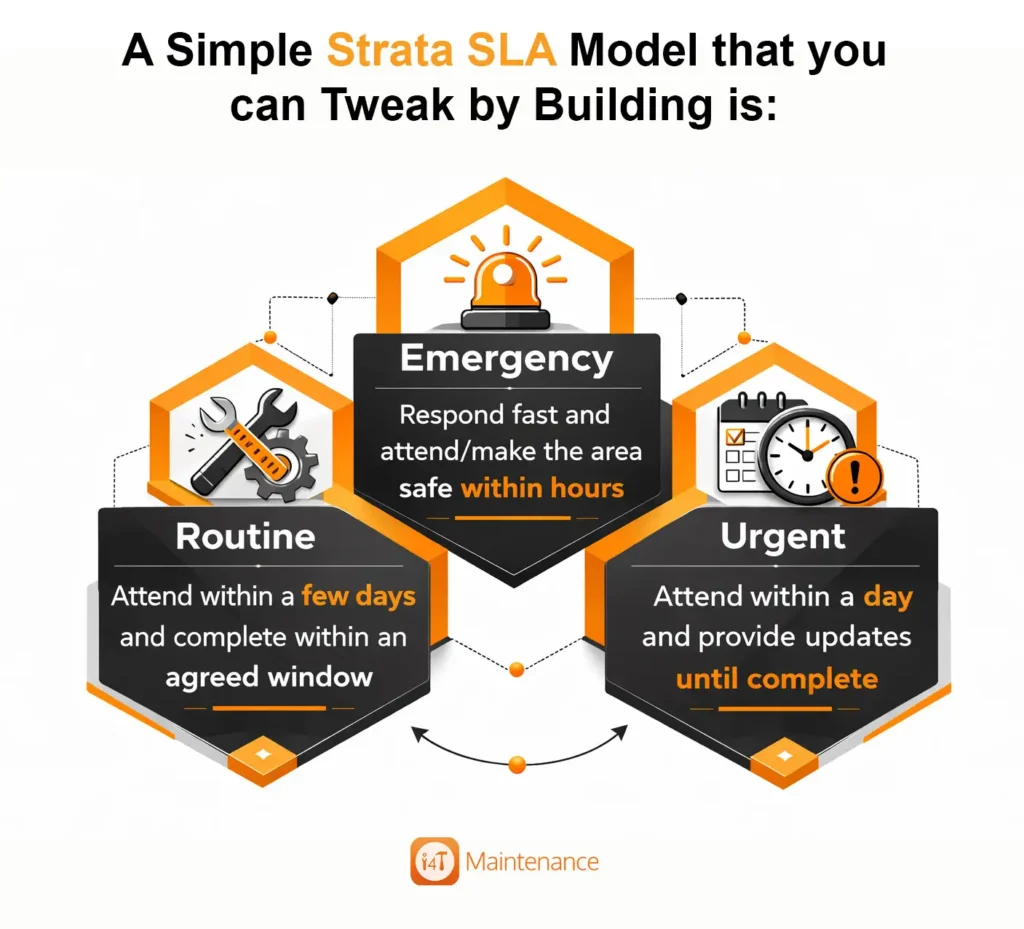
A simple strata SLA model that you can tweak by building is:
- Emergency: respond fast and attend/make the area safe within hours
- Urgent: attend within a day and provide updates until complete
- Routine: attend within a few days and complete within an agreed window
Then measure it with three clean metrics:
- SLA compliance %: jobs met SLA ÷ jobs with SLA × 100
- Median attendance time: Median is more useful than average because it’s less skewed by outliers
- Exception log: track legitimate delays which can be due to access issues, parts lead times, weather, and awaiting approvals
The exception log matters because it keeps the scorecard fair. A contractor shouldn’t be punished for a delayed key pickup or for waiting on committee approval, but they should be measured on how well they communicate and manage the delay.
Which cost KPIs tell you value?
In strata, cost blowouts usually don’t come from one big invoice. They come from little patterns that repeat: variations, unclear scope, call-backs, and inconsistent documentation.
So your cost KPIs should focus on predictability and control, not just price:
- Quote-to-invoice variance (%): how closely invoices match approved quotes
- Variation rate: percentage of jobs with variations and why
- Cost per job type: average cost for common tasks
- Rework spend: dollars linked to defects/call-backs
- Invoice quality: correct lot/common property split, clear descriptions, supporting photos where relevant
A really useful habit is to separate costs into two buckets when reporting:
- Rates – hourly rates, call-out fees, material margins
- Behaviour – variation frequency, quote accuracy, rework
Committees often fixate on rates because they’re easy to compare. Your scorecard helps them see the behavioural costs that hurt budgets over time.
What safety KPIs for maintenance contractors in strata should you track?
Safety can’t be treated as a vibe. In strata, you have residents, visitors, and multiple contractors sharing the same spaces, which is exactly where safety coordination matters.
Safe Work Australia is clear that in a contractual chain, multiple parties can hold WHS duties at the same time, and duties can’t simply be handed off down the line. That’s why scorecards should include WHS indicators that are observable and documentable.
Here are sensible safety KPIs for maintenance contractors in strata that you can track without turning into a safety officer:
- Induction completion: workers are inducted before work starts
- SWMS/JSA compliance: provided where required, submitted before work begins
- Licence/competency evidence: supplied for relevant high-risk or licensed work
- Site controls used: barriers, signage, isolations, spotters (as applicable)
- Incident/near-miss reporting: reported promptly with useful detail
- Corrective action close-out time: how quickly hazards are addressed
- Housekeeping and access safety: trip hazards, cables, materials stored safely
A quick practical note: you’re not trying to “catch” contractors. You’re trying to see whether they consistently plan work safely, control risks in common areas, and communicate properly when conditions change.
SafeWork NSW also sets out that contractors and workers have WHS obligations and should be proactive about health and safety. Using a scorecard to track inductions, SWMS, and incident reporting is one of the easiest ways to make that expectation real.
How should you weigh quality, SLA, cost and safety for strata buildings?
Weightings stop the scorecard from being a random list. They also help you explain to committees what matters most.
A sensible default weighting for many strata buildings is:
- Safety: 30%
- SLA / Time: 25%
- Quality: 25%
- Cost: 20%
Then adjust by context. Buildings with higher risk profiles should lean more heavily on safety.
Buildings with high resident sensitivity might lean more on SLA and communication. Large capital works often need higher quality and safety weightings than routine speed.
Whatever you choose, keep it stable for at least a couple of review cycles. Constant tweaking makes the score feel political and reduces trust.
How do you score vendors consistently?
Consistency comes from three things: a clear scale, clear evidence, and a consistent review period.
A simple scoring scale that works well in strata:
- 5 = exceeds expectations, no issues, documentation complete
- 4 = meets expectations, minor issues but handled well
- 3 = acceptable, some friction or follow-up required
- 2 = below expectations, repeated issues or admin drag
- 1 = unacceptable, risk exposure, rework, or safety concerns
Then connect every score to a type of evidence. In strata, the most defensible evidence usually lives in your work order history:
- timestamps (logged, assigned, attended, completed)
- photos and completion notes
- quotes vs invoices and approvals
- compliance docs (insurances, licences, SWMS)
- incident logs and corrective actions
Keeping evidence attached to each job is what makes your scorecard low-drama. If someone challenges the score, you can calmly show the record.
Also, choose a review period that matches job volume:
- Monthly for high-volume trades like plumbing, electrical, and cleaning
- Quarterly for specialist vendors like fire, lifts, and façade
- Per-project for capital works
What do you do when a contractor scores poorly?
This is where scorecards earn their keep. They give you a neutral way to improve performance without making it personal.
A good improvement pathway looks like this:
- Share the results early; don’t wait until renewal time
- Agree on 2–3 specific targets for the next period like SLA attendance should go up from 70% to 90%
- Document the actions, mentioning who will do what, and by when
- Re-score after the review window
- Escalate if needed with probation, reduction in work allocation, or replacement
Be especially firm on safety. A small dip in SLA might be coached. Repeated safety failures in common areas should trigger quick action because the downside risk is far greater.
And remember: scorecards don’t just identify problems. They also justify keeping a vendor who’s consistently solid, even if they’re not the cheapest on paper.
How do you roll this out across multiple schemes without adding admin chaos?
The secret is to build the scorecard into the work you already do; not bolt it on as an extra job.
Start with a standard template across your portfolio, then add small building-specific tweaks. For example, you might keep the same core KPIs everywhere, but add one extra KPI for buildings with stricter access rules or noise restrictions.
Roll-out steps that keep it manageable:
- Pilot with 1–2 high-volume vendors for one month
- Refine KPI definitions based on what you can realistically measure
- Lock the template and reuse it across buildings
- Report results in a one-page format for committees
- Review weightings annually, not weekly
Done well, a scorecard becomes a normal part of vendor management, not a spreadsheet you dread opening.
And as you’re building these systems, it helps to remember the broader context: owners corporations are expected to maintain common property, and having structured processes supports good decision-making and reporting.
Scorecards make vendor performance measurable, not emotional
Vendor scorecards are one of the most practical tools a strata manager can use to lift outcomes across an entire portfolio. When you measure performance consistently across quality, SLA, cost, and safety, you get clearer conversations, fewer unpleasant surprises, and a fairer way to reward the vendors who do the right thing.
If you want to make this process easier and more consistent across buildings, i4T Maintenance – Maintenance Management Software helps you centralise work orders, capture SLA timestamps, store compliance documents (SWMS, licences, insurances), and run vendor compliance tracking with reporting that supports your scorecards, so you’re managing performance from real job data, not email archaeology.
FAQs
A simple way to rate contractors on quality, SLA/timeframes, cost control and safety using consistent KPIs.
Track job timestamps (logged, acknowledged, attended, completed) and calculate the % of jobs that meet the agreed SLA windows.
First-time fix rate, defects/call-backs, workmanship checks, site cleanliness, photos, communication, and resident impact.
Induction completion, SWMS/JSA provided when required, correct site controls (barriers/signage), and incident/near-miss reporting.
Monthly for high-volume contractors (like plumbing/electrical/cleaning) and quarterly for specialist vendors (like lifts/fire systems).