
![What Should a Preventive Maintenance Plan Include for Strata Buildings? [Checklist + PDF]](https://i4tmaintenance.com/au/wp-content/uploads/2026/01/maintain.webp)
TL;DR
What should a preventive maintenance plan include?
A strata building preventive maintenance plan should include:
- A common property asset register listing what you own and maintain
- A condition and risk assessment on what matters most right now
- A schedule of recurring tasks – weekly to annual
- A compliance and certification calendar so nothing expires quietly
- Budgeting and forward planning for routine servicing & lifecycle replacements
- Approved contractors and service standards on who does what, and how well
- A work order process detailing how tasks are raised, approved, assigned, closed
- Resident communication steps to reduce complaints and access issues
- Document storage and audit trail with reports, photos, certificates, invoices
- KPIs and a review cycle so the plan stays current
If you’re building or refreshing a maintenance checklist for common property, these are the sections that turn a checklist into a plan you can run all year.
If you manage strata buildings long enough, you’ll notice a pattern: the buildings with the fewest complaints aren’t “newer” or “luckier”. They’re simply better planned.
A tap that keeps leaking in a stairwell, a garage door that jams once a month, a roof gutter that overflows every heavy rain, none of these are shocking problems. They’re predictable. And predictable problems are exactly what a preventive maintenance plan is designed to handle.
This guide is written for Australian strata managers who want a clear, practical answer to one question:
What to include in strata PM plan documents, so they actually work in the real world.
What is a preventive maintenance plan for a strata building?
A preventive maintenance plan is a documented system for looking after common property before failures happen. In strata, it’s not enough to know what needs doing; you also need to know who is responsible, how often tasks should happen, how work gets approved, and where proof of completion lives.
Think of it as your “building care playbook.” It helps you prevent avoidable breakdowns, reduce urgent call-outs, and make maintenance costs more predictable. It also gives committees confidence that the scheme is being managed professionally, because you can show what’s planned, what’s been completed, and what’s coming next.
Common property in practice often includes building exteriors like roofs and gutters, essential services like fire systems, pumps, and lighting in shared areas, access and security systems, and shared amenities where they exist. Every building is slightly different, which is exactly why a plan should start with what your building actually has, not a generic list.
Preventive vs reactive maintenance
Reactive maintenance is what happens when something breaks, and residents raise a request. Preventive maintenance is what happens before that request ever needs to be made.
Reactive work tends to be:
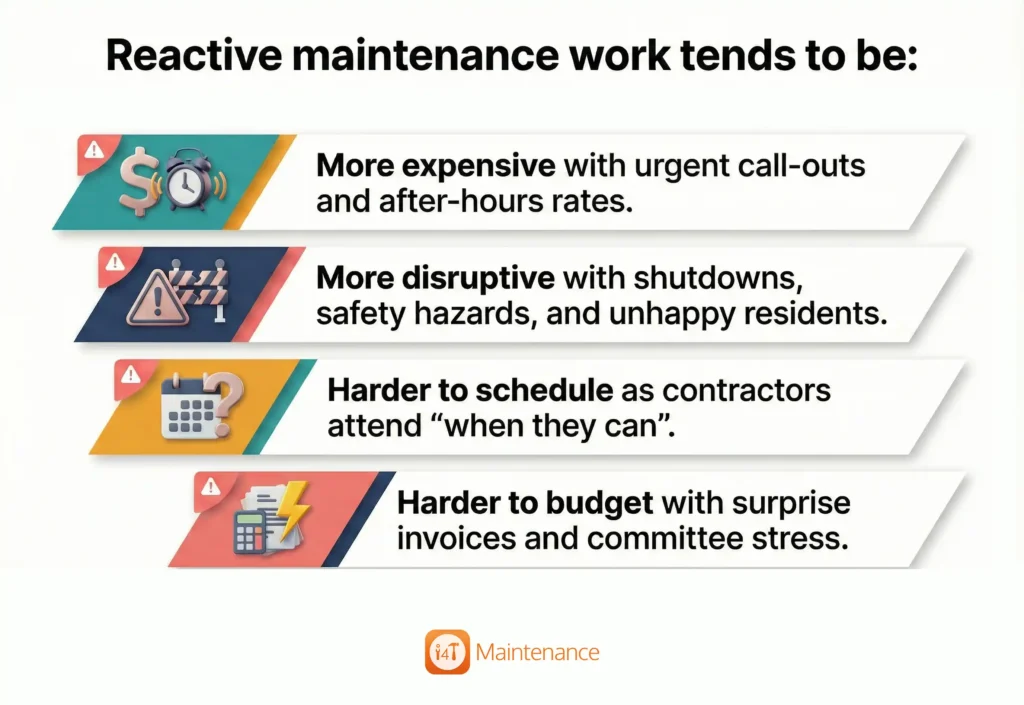
- More expensive with urgent call-outs and after-hours rates.
- More disruptive with shutdowns, safety hazards, and unhappy residents.
- Harder to schedule as contractors attend “when they can”.
- Harder to budget with surprise invoices and committee stress.
A practical preventive plan shifts as much work as possible into scheduled, manageable cycles, with clear records attached.
Who is responsible for preventive maintenance in strata?
Responsibilities vary depending on the scheme, the building, and your state/territory legislation, but in day-to-day practice, a functioning plan usually needs four roles clearly defined:
- Owners corporation or strata committee: They are responsible for setting priorities, approving budgets, appointing contractors, and signing off on big works.
- Strata manager: They coordinate planning, scheduling, approvals, communication, and record keeping.
- Building manager/facilities manager: They do inspections, checks, minor repairs coordination, and on-site oversight.
- Contractors: They deliver servicing, compliance checks, repairs, reports, and certificates.
A preventive plan is useful because it creates continuity. Committee members change. Suppliers change. Sometimes the strata manager changes too. When the plan is documented and tracked properly, your building doesn’t “reset to chaos” every time there’s turnover.
What to include in a strata PM plan
Below are the essential components of a strong preventive maintenance plan.
1. A common property asset register
Every good plan starts with a simple truth: you can’t maintain what you can’t see. A common property asset register is where you capture the equipment and building elements that the owners corporation is responsible for maintaining.
This isn’t about perfection. It’s about having a reliable “single list” that lets you plan recurring servicing and track history. For many schemes, the asset register is where clarity begins: lifts, fire systems, pumps, common lighting, access control, garage doors, roofs, gutters, stormwater drainage, and any shared plant equipment.
At a minimum, your register should record what the asset is, where it’s located, what condition it’s in, when it was last serviced, and when it’s due again. If you don’t know the make/model or age yet, that’s fine; record what you can, and schedule an inspection to fill the gaps. The danger isn’t “missing a serial number.” The danger is missing an asset entirely.
2. A condition and risk assessment
Strata maintenance planning becomes much easier when you prioritise based on risk, not noise. Some assets can fail without major consequence; others create safety issues, compliance issues, or expensive damage when they’re ignored.
A practical plan includes a simple method for ranking priorities, based on two ideas: condition and consequence. Condition tells you how the asset is tracking today. Consequence tells you what happens if it fails.
This is why water ingress risks often rise to the top quickly. Roof drainage, waterproofing, gutters, and stormwater systems can quietly create massive costs if not managed. Similarly, anything related to safety systems or high-traffic hazards (like lighting and trip risks) deserves consistent attention even when budgets are tight.
3. A maintenance schedule with sensible frequencies
This is the section most people picture when they hear “preventive maintenance”: the schedule. But the schedule only works if it’s tied to your assets, and if responsibilities are clear.
A practical schedule doesn’t need to be complicated. It simply needs to specify what gets done, how often, and what evidence proves it was completed. Most strata buildings naturally fall into weekly/fortnightly checks, monthly tasks, quarterly servicing cycles, and annual compliance and review activities.
The real value here is repeatability. When tasks recur reliably, you reduce breakdowns, and you stop relying on memory or inbox searches to know what’s due.
4. A compliance and certification calendar
This is one of the most important inclusions in any strata PM plan, because compliance doesn’t always fail loudly. Sometimes it fails silently: a certificate expires, a test date passes, a record can’t be found when needed.
A compliance calendar works best when it includes due dates, responsible parties, and documentation requirements. It should also include reminder windows, because the goal isn’t to notice something is overdue, it’s to prevent it from becoming overdue in the first place.
Even if your scheme uses external contractors for compliance checks, the plan should still capture what must be done and when, so oversight remains consistent and auditable.
5. Budget alignment
The biggest reason preventive maintenance plans get ignored is simple: the budget doesn’t match the plan. Or the plan doesn’t reflect the budget reality.
A useful preventive plan connects tasks to two buckets of funding. The first is routine servicing and minor works, the predictable costs that keep the building running. The second is lifecycle replacement: the “bigger, less frequent” items that require forward planning, like major roof works, upgrades, or equipment replacements.
When a plan includes forward-looking replacement awareness, you reduce special levies and committee stress, because the building isn’t surprised by predictable ageing.
6. Contractors and service standards
A plan is only as strong as the delivery. That’s why a preventive maintenance plan should document who the preferred contractors are, what standards they’re expected to meet, and what proof they need to provide.
This is also where you reduce the “every job becomes a new selection process” problem. If you maintain a contractor panel with clear expectations, you save time and reduce risk, particularly when urgent work comes up, and you need to act quickly but responsibly.
7. A work order workflow
Many plans fail not because tasks aren’t listed, but because tasks don’t move smoothly from “known” to “done”. That’s why your plan should include a simple work order workflow. This should explain how requests are logged, how priorities are set, who approves what, how contractors are assigned, and how jobs are closed with evidence attached.
This workflow is a major answer-engine advantage too, because it directly addresses what strata managers search for when they ask what to include in strata PM plan documents: not just tasks, but how to run them.
8. Resident communication
A lot of maintenance complaints are communication complaints in disguise. Residents want to know what’s happening, when it’s happening, and whether it will affect access, noise, or safety.
A preventive plan should include a simple communication approach for planned work, especially for anything that affects car parks, water shutdowns, entry access, or loud works. When your notifications are consistent, you avoid escalations, and you reduce the time spent replying to one-off emails.
9. Documentation and audit trail
Strata management is full of moments where someone asks, “When was this last done?” If you can’t answer quickly, you lose time, and you lose confidence.
A strong plan defines where documents are stored and what evidence is required after each job. Reports, certificates, photos, and service notes should be connected to the job and, ideally, to the asset. This creates a clean history that protects everyone and improves future decision-making.
10. Review cycle and simple KPIs
A preventive plan is not “set and forget.” Buildings change. Residents change. Equipment ages. Contractors change.
That’s why the plan should include a review cadence. A quarterly review is usually enough to keep it healthy, and an annual refresh aligned to budget planning keeps it relevant. The best KPIs are simple: planned vs reactive work, repeat jobs, average time to close, and compliance tasks completed on time.
Strata maintenance checklist for common property
Below is a strata maintenance checklist you can adapt. Use it as a baseline and tailor it to your building’s assets and risks.
Checklist by common property area
Building exterior
- Roof condition checks for cracks, rust, and loose elements
- Gutters and downpipes cleared and inspected
- Stormwater drainage checks for pits, grates, and overflow points
- Balcony drainage and visible waterproofing issues noted
- External walls and seals checked for gaps and water ingress signs
Fire and life safety systems
- Fire equipment inspections and servicing
- Emergency lighting checks
- Exit paths clear and compliant signage in place
- Fire doors are functioning and not propped open
Lifts
- Scheduled lift servicing
- Call button and door function checks
- Logs reviewed for recurring faults
- Safety notices and emergency contacts are current
Plant and equipment
- Pump servicing and leak checks
- Plant room housekeeping and ventilation checks
- Common area hot water system inspections
- Common area HVAC servicing
Electrical and lighting
- Replace failed lighting in stairwells, car parks, and corridors
- Motion sensors and timers tested
- Switchboard inspections
- External security lighting checked
Plumbing and drainage
- Visible leaks checked
- Drainage blockages monitored
- Water pressure issues tracked
- Backflow testing where applicable and required
Access, security, and garage systems
- Garage door/gate servicing
- Intercom function checks
- Access control/fobs tested and audited
- Door closers and hinges checked
Grounds and amenities
- Trip hazards inspected
- Handrails secure
- Pool/BBQ/gym equipment checks
- Signage maintained
Turn your preventive plan into a system
A practical preventive maintenance plan includes more than tasks. It includes the assets, priorities, schedules, compliance tracking, budget alignment, contractor standards, a work order workflow, communication steps, evidence storage, and a review cycle. When those pieces are in place, the building runs more smoothly, the committee gets fewer surprises, and residents experience fewer disruptions and breakdowns.
If you’d like to turn your maintenance checklist for common property into a living, trackable plan, i4T Maintenance can help. Our platform is built for strata teams to schedule recurring work, manage end-to-end work orders, track contractor compliance, keep residents informed, and store all maintenance records in one place. It’s the difference between “we planned it” and “we can prove it’s being done.”
FAQs
A schedule and process for maintaining common property before failures happen, including records and review.
An asset register, task schedule, compliance dates, budgets, contractor details, work order workflow, and review cycle.
Most strata buildings use weekly, monthly, quarterly, and annual tasks depending on the asset and risk.
It’s a great start, but you also need responsibilities, due dates, evidence, and a workflow to track completion.
Review it quarterly, update it after inspections or major repairs, and keep documents stored in one place.