If you’ve been in strata for a while, you’ve probably built a decent maintenance spreadsheet or inherited one from a previous manager. It might list trades, renewal dates, maybe even a tab or two for quotes and jobs.
It worked… for a while.
But today’s strata environment is a different beast. You’re juggling more buildings, more stakeholders, tougher regulations, and much higher expectations from residents and committees. Spreadsheets were never designed to manage the moving parts of day-to-day maintenance, emergency callouts, asset registers, and compliance obligations all at once.
That’s where a connected maintenance ecosystem comes in. Instead of scattered files, long email chains, and phone tag, you’ve got a digital maintenance platform for strata that connects managers, committees, residents and contractors in one place. Add a maintenance app for strata managers, and you’ve suddenly got real-time control in your pocket, not just on your desktop.
In this article, we’ll unpack why spreadsheets don’t work for strata maintenance anymore, the key benefits of strata maintenance software, and how to digitise strata maintenance workflows without overwhelming your team.
Spreadsheets Can’t Handle Real-World Strata Complexity
On paper, a spreadsheet looks neat. In the real world of strata, things get messy fast.
Each scheme has multiple lots, common property elements, assets, service provider contracts, and safety obligations. Multiply that by dozens of schemes, and your “simple” spreadsheet becomes fragile very quickly.
All it takes is one person overwriting a cell, saving an old version, or forgetting to update a tab and suddenly your “single source of truth” is anything but.
Why spreadsheets struggle with strata maintenance:
- Manual data entry leads to inevitable errors and gaps
- Different versions are floating around emails and desktops
- No easy way to track full maintenance history or asset lifecycle
As your portfolio grows, relying on spreadsheets actually introduces risk, both operational and compliance-related. They weren’t built for this level of complexity.
A Digital Maintenance Platform for Strata Creates One Source of Truth
A digital maintenance platform for strata replaces all those scattered spreadsheets, email threads and sticky notes with one connected system.
Instead of hunting through folders, you log into a single platform where every job, quote, invoice, contractor record, asset and compliance document lives. Everyone works from the same live data.
For you and your team, that means fewer “Where is that file?” moments and more time solving problems.
What a centralised maintenance platform gives you:
- Real-time visibility of all open, scheduled and completed jobs
- Instant access to maintenance history and documents per building or asset
- Less time wasted flipping between spreadsheets, emails and file drives
In short, your maintenance information becomes structured, searchable and shared, not buried in individual files.
Connected Workflows Reduce Risk and Compliance Headaches
Strata managers carry serious responsibility when it comes to safety and compliance: fire systems, lifts, emergency lighting, essential services, water systems, and more.
Trying to manage those obligations with a spreadsheet and calendar reminders is asking for trouble. One missed entry, one person going on leave, and crucial checks can easily slip through the cracks.
A connected maintenance ecosystem builds compliance into your workflows.
With a strata maintenance software platform, recurring tasks and statutory checks can be scheduled, assigned to contractors, and automated reminders sent, not just to you, but to everyone involved.
How connected workflows support compliance:
- Automated reminders for recurring inspections and service visits
- Pre-set templates for standard maintenance and compliance items
- Full audit trail of who did what, when, and with which contractor
Instead of constantly worrying about what might have been missed, you can show committees a clear, trackable record of everything that’s been done.
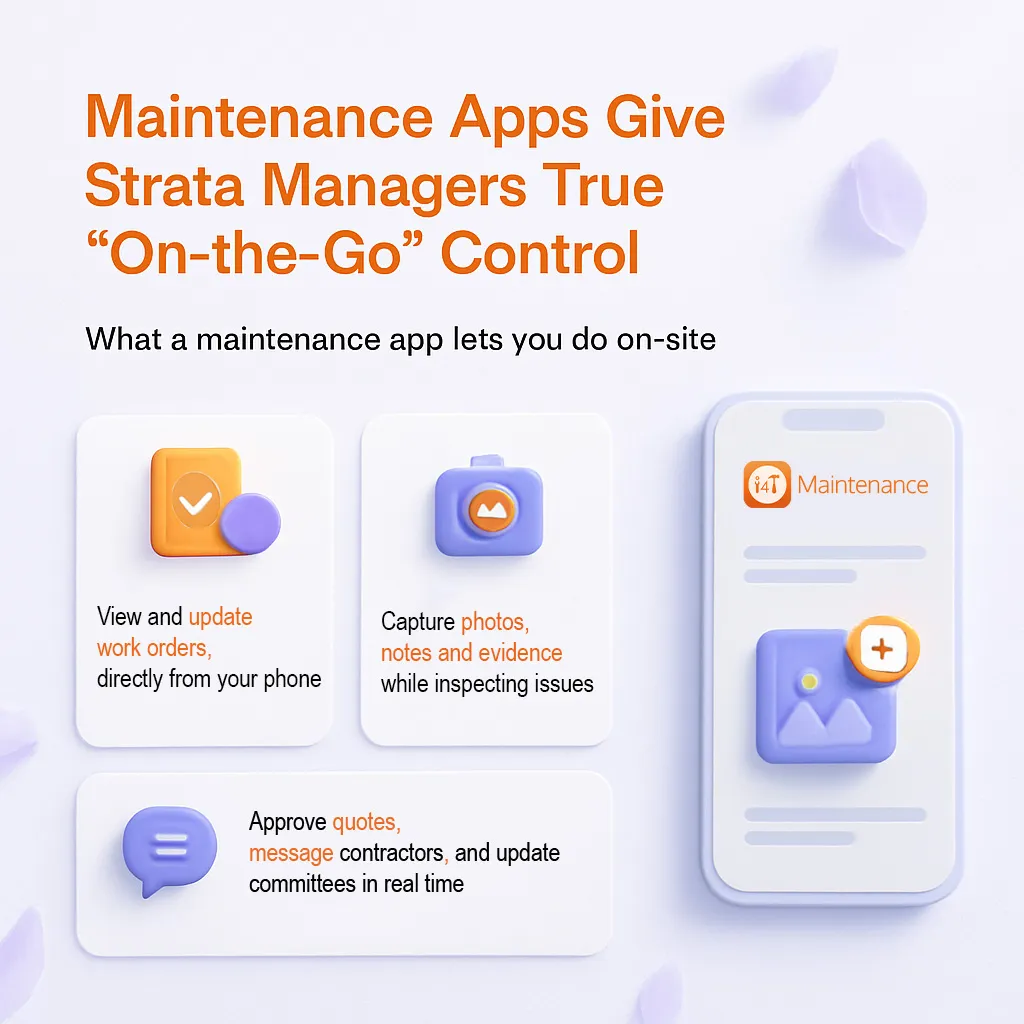
Maintenance Apps Give Strata Managers True “On-the-Go” Control
Strata isn’t a desk-only job. You’re on site, in meetings, on the phone, and in the car more than you’re in front of a large monitor.
That’s where a maintenance app for strata managers changes the game.
Instead of scribbling notes on paper or trying to remember what you saw on site until you’re back in the office, you can open the app, raise a job, attach photos, and notify the contractor, all while you’re still standing in the building foyer.
What a maintenance app lets you do on-site:
- View and update work orders directly from your phone
- Capture photos, notes and evidence while inspecting issues
- Approve quotes, message contractors, and update committees in real time
You’re not “waiting until later” to take action. You’re managing maintenance as it happens, which leads to quicker resolutions and fewer dropped balls.
Better Resident Experience and Fewer Complaints
Let’s be honest: a lot of strata complaints come down to communication. Residents lodge a maintenance request, hear nothing, then call, email, and chase until someone responds.
With spreadsheets and manual processes, it’s hard to provide real-time updates, especially when you’re juggling hundreds of requests across your portfolio.
A connected maintenance ecosystem improves the resident experience by making things more transparent. Residents and committees can lodge requests online, track status, and see when a contractor has been assigned.
How a digital maintenance platform improves service:
- Simple online forms or portals for residents to log requests
- Automatic updates when jobs are created, assigned or completed
- Clear visibility for committees on maintenance progress and spend
When people can see that something is being actioned, they’re far less likely to complain, chase, or escalate. Transparency builds trust.
The Benefits of Strata Maintenance Software for Team Productivity
The benefits of strata maintenance software go far beyond better record-keeping. They show up in your team’s workload, stress levels, and ability to focus on higher-value tasks.
Instead of manually keying information into spreadsheets, drafting individual emails to contractors, and updating multiple trackers, your team can rely on structured workflows and automation.
Approvals, updates, job allocation and communication all happen in the same system.
Productivity gains you’ll notice quickly:
- Less double-handling and copy-pasting between systems
- Faster internal approvals and smoother collaboration across your team
- More time for relationship-building with committees and owners
In other words, your people spend less time pushing data around and more time doing the work only humans can do: problem-solving, advising, and managing.
Data and Reporting Turn Maintenance into a Smart Strategy
When maintenance lives in spreadsheets, reporting tends to be reactive. You pull numbers together when a committee asks, or at budget time, and it’s often painful and incomplete.
A connected digital platform gives you structured data you can actually use.
You can see spending by building, asset type, or contractor. You can compare reactive vs planned maintenance. You can identify which buildings are costing more than they should, and why.
How reporting powers better decisions:
- Clear reports on where maintenance budgets are really going
- Insight into trends: frequent breakdowns, recurring issues, high-cost assets
- Evidence to support future capital works plans and levy discussions
Suddenly, you’re not just “the person who chases trades”. You’re a trusted advisor using hard data to guide committees and owners on the best way forward.
It’s Easier Than You Think to Digitise Strata Maintenance Workflows
Moving from spreadsheets to a digital maintenance platform for strata can feel like a big leap. But you don’t have to digitise everything overnight.
The key is to start small, prove the value, and build from there.
Think of how to digitise strata maintenance workflows as a staged journey:
- Start with core maintenance requests and work orders
- Add contractor management and communication
- Layer in asset registers, compliance schedules, and reporting
A practical approach to going digital is to begin with one building or portfolio as a pilot,s standardise a few key workflows, and use training and support from your software partner to bring the team on board.
Once your team sees how much easier life becomes, adoption usually takes care of itself.
Connected Contractor Network = Faster, Safer Job Delivery
Most strata managers rely on a mix of trusted contractors plus new trades when needed. Keeping track of licences, insurances, performance, and pricing via a spreadsheet list is tough.
In a connected maintenance ecosystem, your contractor network is built into the platform.
You can assign jobs to approved trades, see their response times, and store all their credentials in one place. Over time, you build a clear picture of who your top performers are, and who may need to be replaced.
Why a connected contractor network matters:
- Approved, insured contractors are visible and easy to allocate
- Side-by-side comparison of quotes and response times
- Accurate performance history to inform future decisions
That means safer buildings, better service, and less risk for both your agency and the schemes you manage.
Future-Proofing Your Strata Business
Owners and committees now expect their strata managers to be digitally capable. If your operations are still running off spreadsheets and paper, you risk looking outdated compared to competitors who offer transparent, app-based maintenance experiences.
A connected maintenance ecosystem isn’t just about today’s workload; it’s about future-proofing your business.
When processes are standardised in a platform, it’s easier to onboard new staff, hand over schemes, and scale your portfolio without everything falling apart.
Make the Shift from Spreadsheets to a Connected Ecosystem with i4T Maintenance
Spreadsheets had their moment. They were familiar, flexible and, for a while, “good enough”. But strata has changed. Portfolios are bigger, regulations are tighter, and residents expect faster, clearer communication than ever before.
A connected maintenance ecosystem built on a digital maintenance platform for strata gives you what spreadsheets never could: real-time visibility, structured workflows, mobile access, stronger compliance, better reporting, and a far smoother experience for residents and committees.
That’s exactly what i4T Maintenance delivers.
i4T Maintenance is purpose-built strata maintenance management software that acts as both a powerful platform and a user-friendly maintenance app for strata managers. It helps you streamline requests, connect with contractors, track compliance, and confidently show owners where their maintenance dollars are going.
If you’re ready to move beyond manual spreadsheets and scattered systems, now is the time.
Book a demo of i4T Maintenance today and see how easily you can digitise your strata maintenance workflows, reduce risk, and deliver a better experience for every building you manage.
FAQs
A connected maintenance ecosystem is a digital environment where all maintenance-related activities, people and data are linked in one place. It usually runs on a digital maintenance platform for strata, with a web portal and a mobile app for managers, residents, committees and contractors.
Spreadsheets are manual, fragile and not designed for collaboration. As your portfolio grows, it becomes too easy to miss updates, lose versions, or overlook critical dates. That’s why many managers now look at why spreadsheets don’t work for strata maintenance and replace them with purpose-built software.
Start small and simple. Choose one or two workflows, like maintenance requests and work orders, and move them into a strata maintenance software platform. Once your team is comfortable, you can gradually add contractor management, asset registers, and compliance schedules. A good software partner will guide you on how to digitise strata maintenance workflows step by step.
The key benefits of strata maintenance software include less manual admin, fewer errors, better communication with residents and contractors, stronger compliance tracking, and clearer reporting for committees. It helps you spend more time managing and less time chasing emails and updating spreadsheets.
Yes. Even smaller portfolios benefit from having maintenance requests, jobs, and contractor details in one system. It saves time, reduces risk, and makes your service look more professional. Plus, as your portfolio grows, you’re already set up on a scalable digital maintenance platform for strata, rather than scrambling to replace spreadsheets later.